
Pulp Fiction, 1928 · page 162 of 164
Argosy All-Story Weekly, February 18, 1928 — page 162: what you’re looking at
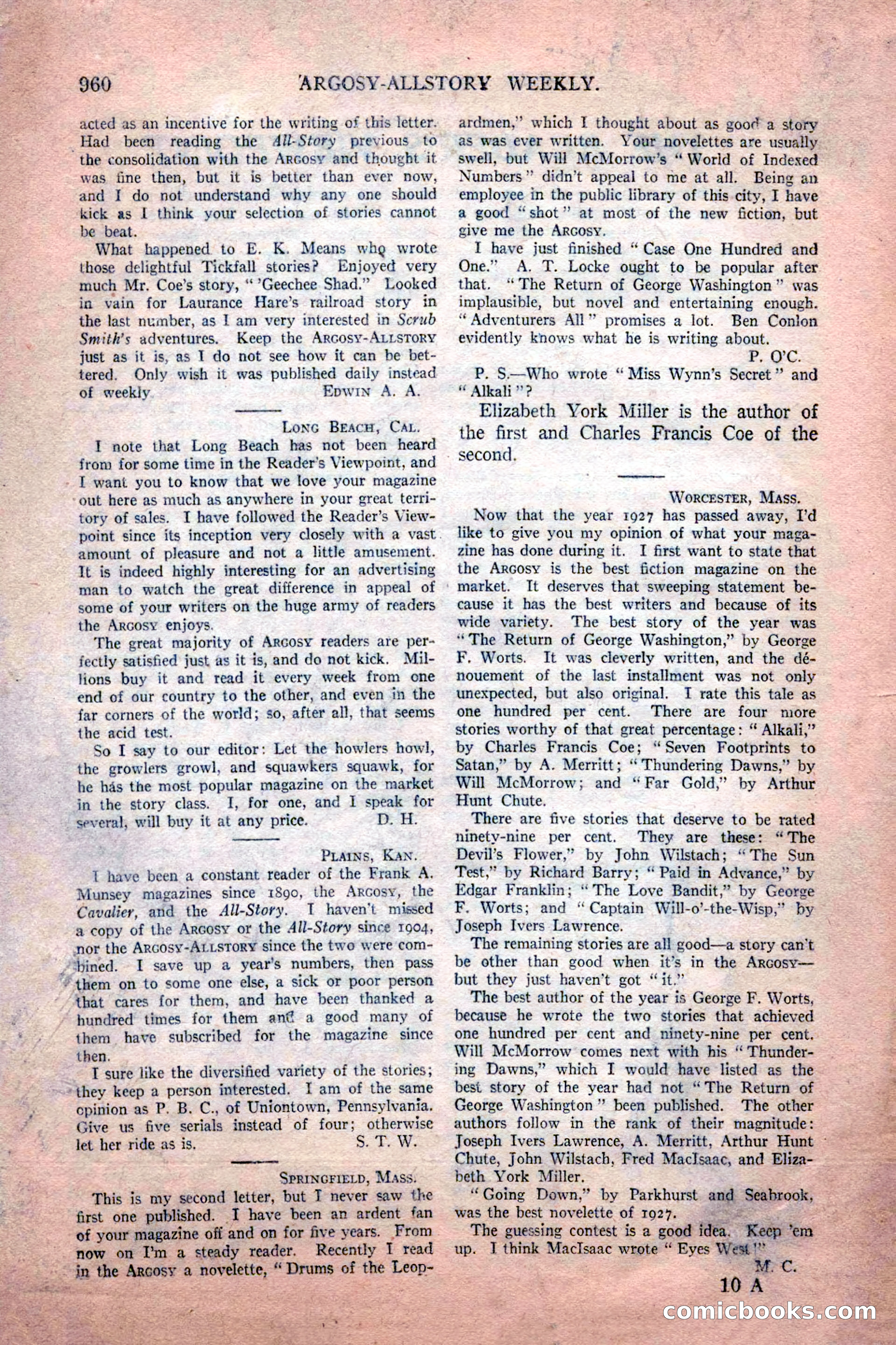
A restored page from Pulp Fiction, 1928. Page through the whole issue in the reader above.
📄 Transcribed text from this page (OCR, searchable)
Machine-transcribed from the original scan — historical spelling and the odd misread are preserved.
; ; ie ee ee e are ~ se - * ir. a ot 3 ~ a a : ee * * mee on ~~ 7 - ‘i £ 4 - , eee - 3. Had been reading the 4ll-Story previous to the consolidation with the Arcosy and thought it --was fine then, but it is better than ever now, and I do not understand why any one should kick as I think your selection of stories cannot = © be beat. ie What happened to E. K. Means whg wrote ES those delightful Tickfall stories? Enjoyed very much Mr. Coe’s story, “ ’Geechee Shad.” Looked in vain for Laurance Hare’s railroad story in eS the last number, as I am very interested in Scrub A Smith’s adventures. Keep the Arcosy-ALLSTORY pees just as it is, as I do not see how it can be bet- Eee tered. Only wish it was published daily instead of weekly Epwin A. A. Lone Beacu, CAL. I note that Long Beach has not been heard from for some time in the Reader's Viewpoint, and - IT want you to know that we love your magazine “out here as much as anywhere in your great terri- tory of sales. I have followed the Reader’s View- point since its inception very closely with a vast. amount of pleasure and not a little amusement. It is indeed highly interesting for an advertising =. man to watch the great difference in appeal of some of your writers on the huge army of readers the ARGosy enjoys. The great majority of Arcosy readers are per- fectly satisfied just as it is, and do not kick. Mil- lions buy it and read it every week from one end of our country to the other, and even in the far corners of the world; so, after all, that seems the acid test. So I say to our editor: Let the howlers howl, the growlers growl, and squawkers squawk, for he has the most popular magazine on the market in the story class. I, for one, and I speak for several, will buy it at any price. D. H. PLains, Kan. t have been a constant reader of the Frank A. Munsey magazines since 1890, the Arcosy, the Cavalier, and the All-Story. 1 haven't missed a copy of the Arcosy or the All-Story since 1904, nor the Arcosy-ALtstory since the two were com- ., ‘hined. I save up a year’s numbers, then pass # them on to some one else, a sick or poor person iia cares for them, and have been thanked a ae * hundred times for them anf a good many of _* them have subscribed for the magazine since then. ay! sure like the diversified variety of the stories; ps? * they keep a person interested. I am of the same ao cpinion as P. B. C., of Uniontown, Pennsylvania, ae . Give us five serials instead of four; otherwise det her nde. ps 3 is, Be he Wes SPRINGFIELD, Mass. This is my second letter, but IT never saw the pul lished. _ I have been an ardent fan bz 3 Ps) Shee ofi and on ie. five Recently From I read ARGOSY-ALLSTORY WEEKLY. acted as an incentive for the writing of this letter. was the best novelette of 1927. ardmen,” which I thought about as good a es as was ever written. Your novelettes are usually — swell, but Will McMorrow’s “ World of Indexed — es Numbers” didn’t appeal to me at all. Being an employee in the public library of this city, I have a good “shot” at most of the new fiction, but give me the ARGosy. I have just finished “ Case One Hundred and One.” A. T. Locke ought to be popular after that. “The Return of George Washington” was implausible, but novel and entertaining enough. ‘‘ Adventurers All” promises a lot. Ben Conlon evidently knows what he is writing about. ABO P. S—Who wrote “ Miss Wynn’s Secret” and Alkali”? Elizabeth York Miller is the author of the first and Charles Francis Coe of the - second. _—_——- Worcester, Mass. Now that the year 1927 has passed away, I’d like to give you my opinion of what your maga- zine has done during it. I first want to state that the Arcosy is the best fiction magazine on the market. It deserves that sweeping statement be- cause it has the best writers and because of its wide variety. The best story of the year was “The Return of George Washington,” by George F, Worts. It was cleverly written, and the dé- nouement of the last installment was not only unexpected, but also original. I rate this tale as — one hundred per cent. There are four more stories worthy of that great percentage: “ Alkali,” by Charles Francis Coe; “Seven Footprints to Satan,” by A. Merritt; “ Thundering Dawns,” by Will McMorrow; aad “Far Gold,” by Arthur Hunt Chute. There are five stories that deserve to be caked ninety-nine per cent. They are these: “The Devil’s Flower,” by John Wilstach; “The Sun Test,” by Richard Barry; “ Paid in Advance,” by Edgar Franklin; “The Love Bandit,” by George — F. Worts; and ‘“ Captain Will-o’-the-Wisp,” Joseph Ivers Lawrence. The remaining stories are all good—a story can't be other than good when it’s in the Angas: but they just haven’t got “ it.” The best author of the year is George F. Worts, because he wrote the two stories that achieved one hundred per cent and ninety-nine per cent. Will McMorrow comes next with his “'Thunder- ing Dawns,” which I would have listed as the best story of the year had not “The Return of — Le George Washington” been published. The other authors follow in the rank of their magnitude: : pe Chute, John Wilstach, Fred MaclIsaac, and Eliza beth York Miller. Se ee “Going Down,” by Parkhurst. nd Seabrook, ? The guessing contest is a good id oes I ie er wie 2 “Sr wees bye wc te , 44 kad 4 bys VAM DAP a BO ol ey! rhe +f Sah ae? f “ye ry see t SO Nall oS eee: ie) al Mot Ube tal "4 hes OP Miah! ee bay i ef, pao Be uae UeN ty ¥.! *“ — - ~ - 2s