
Pulp Fiction, 1928 · page 145 of 164
Argosy All-Story Weekly, February 18, 1928 — page 145: what you’re looking at
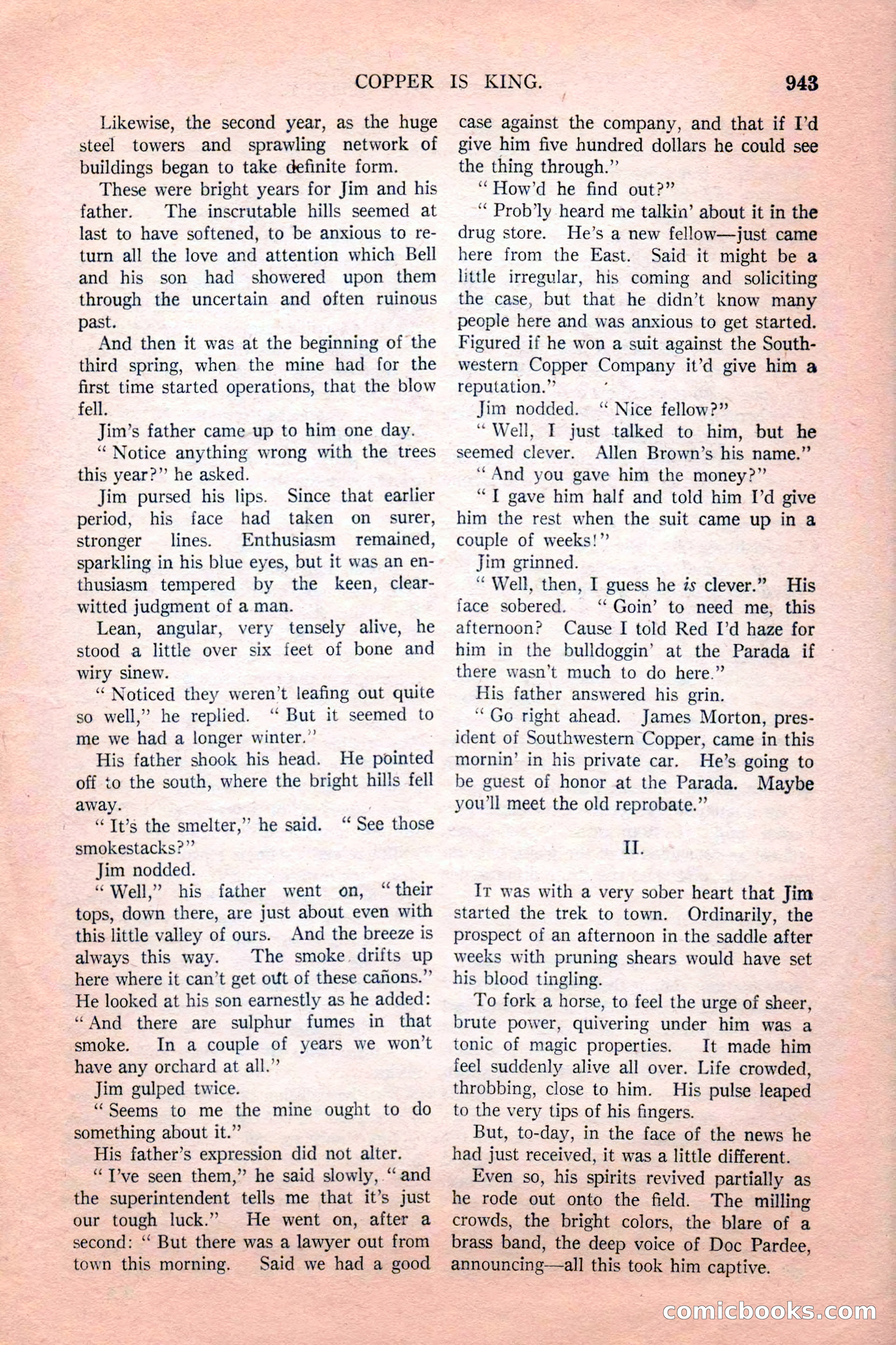
A restored page from Pulp Fiction, 1928. Page through the whole issue in the reader above.
📄 Transcribed text from this page (OCR, searchable)
Machine-transcribed from the original scan — historical spelling and the odd misread are preserved.
COPPER IS KING. Likewise, the second year, as the huge steel towers and sprawling network of buildings began to take definite form. These were bright years for Jim and his father. The inscrutable hills seemed at last to have softened, to be anxious to re- turn all the love and attention which Bell and his son had showered upon them through the uncertain and often ruinous past. And then it was at the beginning of the third spring, when the mine had for the first time started operations, that the blow fell. Jim’s father came up to him one day. “ Notice anything wrong with the trees this year?” he asked. Jim pursed his lips. Since that earlier period, his face had taken on_ surer, stronger lines. Enthusiasm remained, sparkling in his blue eyes, but it was an en- thusiasm tempered by the keen, clear- witted judgment of a man. Lean, angular, very tensely alive, he stood a little over six feet of bone and wiry sinew. ‘“ Noticed they weren’t leafing out quite so well,” he replied. ‘“ But it seemed to me we had a longer winter.”’ His father shook his head. He pointed off to the south, where the bright hills fell away. ‘“Tt’s the smelter,’ he said. “ See those smokestacks?” Jim nodded. “Well,” his father went on, “their tops, down there, are just about even with this little valley of ours. And the breeze is always this way. The smoke drifts up here where it can’t get ouft of these canons.” He looked at his son earnestly as he added: “And there are sulphur fumes in that smoke. In a couple of years we won't have any orchard at all.” Jim gulped twice. “Seems to me the mine ought to do something about it.” His father’s expression did not alter. “T’ve seen them,” he said slowly, “and the superintendent tells me that it’s just our tough luck.” He went on, after a second: ‘‘ But there was a lawyer out from town this morning. Said we had a good 943 case against the company, and that if I’d give him five hundred dollars he could see the thing through.” ‘“How’d he find out?” ‘“ Prob’ly heard me talkin’ about it in the drug store. He’s a new fellow—just came here from the East. Said it might be a little irregular, his coming and soliciting the case, but that he didn’t know many people here and was anxious to get started. Figured if he won a suit against the South- western Copper Company it’d give him a reputation.” Jim nodded. ‘“ Nice fellow?” “Well, I just talked to him, but he seemed clever. Allen Brown’s his name.” ‘“And you gave him the money?” “I gave him half and told him I’d give him the rest when the suit came up in a couple of weeks!” Jim grinned. ‘“ Well, then, I guess he zs clever.” His face sobered. ‘Goin’ to need me, this afternoon? Cause I told Red I’d haze for him in the bulldoggin’ at the Parada if there wasn’t much to do here.” His father answered his grin. ‘Go right ahead. James Morton, pres- ident of Southwestern Copper, came in this mornin’ in his private car. He’s going to be guest of honor at the Parada. Maybe you'll meet the old reprobate.” II. Ir was with a very sober heart that Jim started the trek to town. Ordinarily, the prospect of an afternoon in the saddle after weeks with pruning shears would have set his blood tingling. To fork a horse, to feel the urge of sheer, brute power, quivering under him was a tonic of magic properties. It made him feel suddenly alive all over. Life crowded, throbbing, close to him. His pulse leaped to the very tips of his fingers. But, to-day, in the face of the news he had just received, it was a little different. Even so, his spirits revived partially as he rode out onto the field. The milling crowds, the bright colors, the blare of a brass band, the deep voice of Doc Pardee, announcing—all this took him captive. Eomicbooks (E(0)