
Pulp Fiction, 1928 · page 143 of 164
Argosy All-Story Weekly, February 18, 1928 — page 143: what you’re looking at
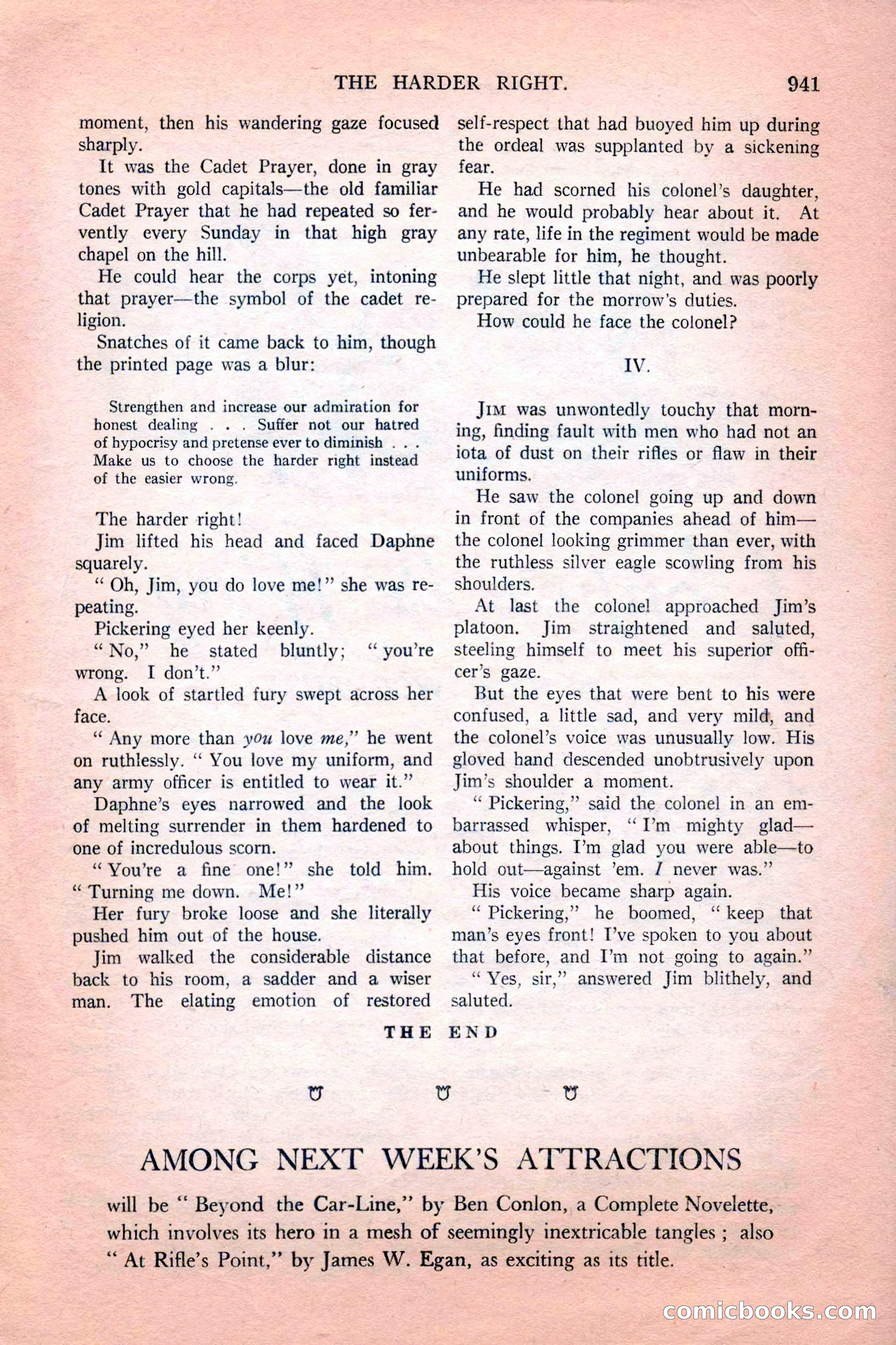
A restored page from Pulp Fiction, 1928. Page through the whole issue in the reader above.
📄 Transcribed text from this page (OCR, searchable)
Machine-transcribed from the original scan — historical spelling and the odd misread are preserved.
THE HARDER RIGHT. moment, then his wandering gaze focused sharply. It was the Cadet Prayer, done in gray tones with gold capitals—the old familiar Cadet Prayer that he had repeated so fer- vently every Sunday in that high gray chapel on the hill. He could hear the corps yet, intoning that prayer—the symbol of the cadet re- ligion. Snatches of it came back to him, though the printed page was a blur: Strengthen and increase our admiration for honest dealing . . . Suffer not our hatred of hypocrisy and pretense ever to diminish .. . Make us to choose the harder right instead of the easier wrong. The harder right! Jim lifted his head and faced Daphne squarely. ‘““Oh, Jim, you do love me!”’ she was re- peating. Pickering eyed her keenly. “No,” he stated bluntly; wrong. I don’t.” A look of startled fury swept across her face. “Any more than you love me,” he went on ruthlessly. ‘“‘ You love my uniform, and any army officer is entitled to wear it.” Daphne’s eyes narrowed and the look of melting surrender in them hardened to one of incredulous scorn. “Vou’re a fine one!” she told him. “Turning me down. Me!” Her fury broke loose and she literally pushed him out of the house. Jim walked the considerable distance back to his room, a sadder and a wiser man. The elating emotion of restored THE ** you’re U 941 self-respect that had buoyed him up during the ordeal was supplanted by a sickening fear. He had scorned his colonel’s daughter, and he would probably hear about it. At any rate, life in the regiment would be made unbearable for him, he thought. He slept little that night, and was poorly prepared for the morrow’s duties. How could he face the colonel? IV. Jim was unwontedly touchy that morn- ing, finding fault with men who had not an iota of dust on their rifles or flaw in their uniforms. He saw the colonel going up and down in front of the companies ahead of him— the colonel looking grimmer than ever, with the ruthless silver eagle scowling from his shoulders. At last the colonel! approached Jim’s platoon. Jim straightened and _ saluted, steeling himself to meet his superior offi- cer’s gaze. But the eyes that were bent to his were confused, a little sad, and very mild, and the colonel’s voice was unusually low. His gloved hand descended unobtrusively upon Jim’s shoulder a moment. ‘ Pickering,” said the colonel in an em- barrassed whisper, “I’m mighty glad— about things. I’m glad you were able—to hold out—against ’em. / never was.” His voice became sharp again. ‘“‘ Pickering,” he boomed, “ keep that man’s eyes front! I’ve spoken to you about that before, and I’m not going to again.” “Yes, sir,” answered Jim blithely, and saluted. END U U AMONG NEXT WEEK’S ATTRACTIONS will be “‘ Beyond the Car-Line,”’ by Ben Conlon, a Complete Novelette, which involves its hero in a mesh of seemingly inextricable tangles ; also “At Rifle’s Point,’” by James W. Egan, as exciting as its title. Eomicbooks (E(0)