
Pulp Fiction, 1928 · page 11 of 164
Argosy All-Story Weekly, February 18, 1928 — page 11: what you’re looking at
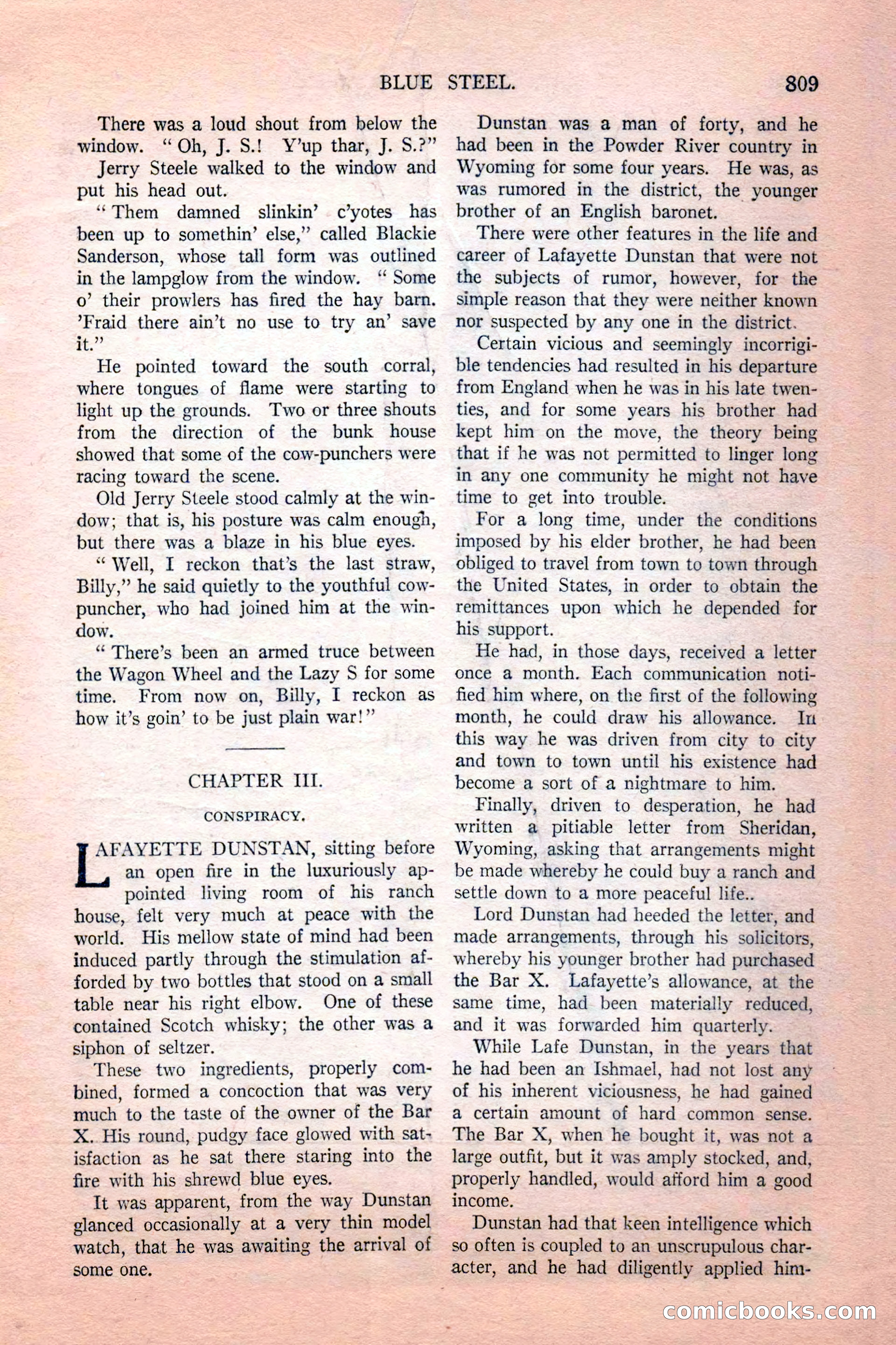
A restored page from Pulp Fiction, 1928. Page through the whole issue in the reader above.
📄 Transcribed text from this page (OCR, searchable)
Machine-transcribed from the original scan — historical spelling and the odd misread are preserved.
BLUE STEEL. There was a loud shout from below the window. ‘Oh, J. S.! Y’up thar, J. $.?” Jerry Steele walked to the window and put his head out. ‘“Them damned slinkin’ c’yotes has been up to somethin’ else,” called Blackie Sanderson, whose tall form was outlined in the lampglow from the window. “ Some o’ their prowlers has fired the hay barn. ’Fraid there ain’t no use to try an’ save tt” He pointed toward the south corral, where tongues of flame were starting to light up the grounds. Two or three shouts from the direction of the bunk house showed that some of the cow-punchers were racing toward the scene. Old Jerry Steele stood calmly at the win- dow; that is, his posture was calm enough, but there was a blaze in his blue eyes. “Well, I reckon that’s the last straw, Billy,” he said quietly to the youthful cow- puncher, who had joined him at the win- dow. “ There’s been an armed truce between the Wagon Wheel and the Lazy 5 for some time. From now on, Billy, I reckon as how it’s goin’ to be just plain war!” CHAPTER III. CONSPIRACY. AFAYETTE DUNSTAN, sitting before an open fire in the luxuriously ap- pointed living room of his ranch house, felt very much at peace with the world. His mellow state of mind had been induced partly through the stimulation af- forded by two bottles that stood on a small table near his right elbow. One of these contained Scotch whisky; the other was a siphon of seltzer. These two ingredients, properly com- bined, formed a concoction that was very much to the taste of the owner of the Bar X. His round, pudgy face glowed with sat- isfaction as he sat there staring into the fire with his shrewd blue eyes. It was apparent, from the way Dunstan elanced occasionally at a very thin model watch, that he was awaiting the arrival of some one. 809 Dunstan was a man of forty, and he had been in the Powder River country in Wyoming for some four years. He was, as was rumored in the district, the younger brother of an English baronet. There were other features in the life and career of Lafayette Dunstan that were not the subjects of rumor, however, for the simple reason that they were neither known nor suspected by any one in the district. Certain vicious and seemingly incorrigi- ble tendencies had resulted in his departure from England when he was in his late twen- ties, and for some years his brother had kept him on the move, the theory being that if he was not permitted to linger long in any one community he might not have time to get into trouble. For a long time, under the conditions imposed by his elder brother, he had been obliged to travel from town to town through the United States, in order to obtain the remittances upon which he depended for his support. He had, in those days, received a letter once a month. Each communication noti- fied him where, on the first of the following month, he could draw his allowance. Int this way he was driven from city to city and town to town until his existence had become a sort of a nightmare to him. Finally, driven to desperation, he had written a pitiable letter from Sheridan, Wyoming, asking that arrangements might be made whereby he could buy a ranch and settle down to a more peaceful life.. Lord Dunstan had heeded the letter, and made arrangements, through his solicitors, whereby his younger brother had purchased — the Bar X. Lafayette’s allowance, at the same time, had been materially reduced, and it was forwarded him quarterly. While Lafe Dunstan, in the years that he had been an Ishmael, had not lost any of his inherent viciousness, he had gained a certain amount of hard common sense. The Bar X, when he bought it, was not a large outfit, but it was amply stocked, and, properly handled, would afford him a good income. Dunstan had that keen intelligence which so often is coupled to an unscrupulous char- acter, and he had diligently applied him- Eomichbooks