
Pulp Fiction, 1928 · page 109 of 164
Argosy All-Story Weekly, February 18, 1928 — page 109: what you’re looking at
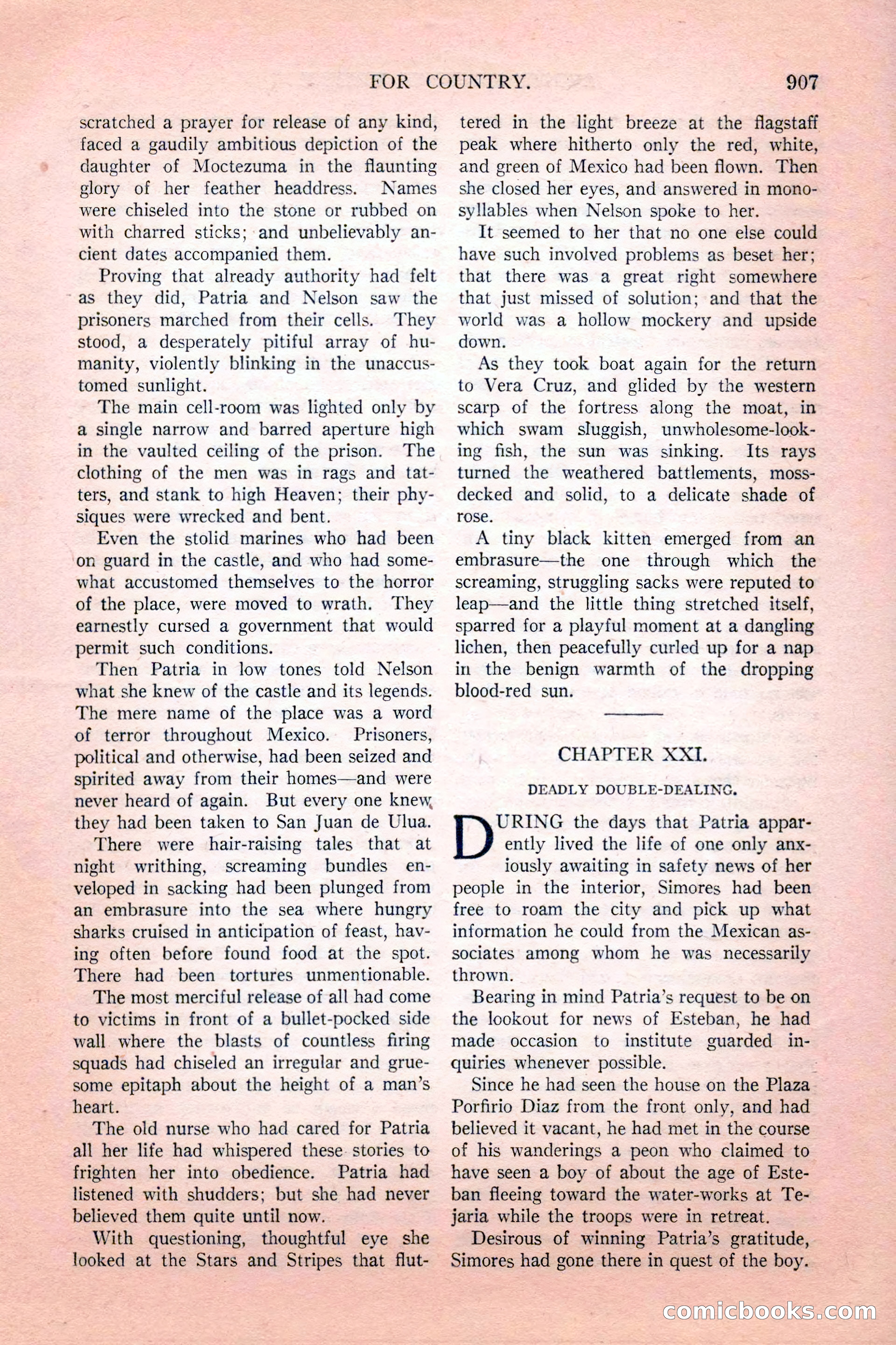
A restored page from Pulp Fiction, 1928. Page through the whole issue in the reader above.
📄 Transcribed text from this page (OCR, searchable)
Machine-transcribed from the original scan — historical spelling and the odd misread are preserved.
FOR COUNTRY. scratched a prayer for release of any kind, faced a gaudily ambitious depiction of the daughter of Moctezuma in the flaunting glory of her feather headdress. Names were chiseled into the stone or rubbed on with charred sticks; and unbelievably an- cient dates accompanied them. Proving that already authority had felt as they did, Patria and Nelson saw the prisoners marched from their cells. They stood, a desperately pitiful array of hu- manity, violently blinking in the wnaccus- tomed sunlight. The main cell-room was lighted only by a single narrow and barred aperture high in the vaulted ceiling of the prison. The clothing of the men was in rags and tat- ters, and stank to high Heaven; their phy- Siques were wrecked and bent. Even the stolid marines who had been on guard in the castle, and who had some- what accustomed themselves to the horror of the place, were moved to wrath. They earnestly cursed a government that would permit such conditions. Then Patria in low tones told Nelson what she knew of the castle and its legends. The mere name of the place was a word of terror throughout Mexico. Prisoners, political and otherwise, had been seized and spirited away from their homes—and were never heard of again. But every one knew, they had been taken to San Juan de Ulua. There were hair-raising tales that at night writhing, screaming bundles en- veloped in sacking had been plunged from an embrasure into the sea where hungry sharks cruised in anticipation of feast, hav- ing often before found food at the spot. There had been tortures unmentionable. The most merciful release of all had come to victims in front of a bullet-pocked side wall where the blasts of countless firing squads had chiseled an irregular and grue- some epitaph about the height of a man’s heart. The old nurse who had cared for Patria all her life had whispered these. stories to frighten her into obedience. Patria had listened with shudders; but she had never believed them quite until now. With questioning, thoughtful eye she looked at the Stars and Stripes that flut- 907 tered in the light breeze at the flagstaff peak where hitherto only the red, white, and green of Mexico had been flown. Then she closed her eyes, and answered in mono- syllables when Nelson spoke to her. It seemed to her that no one else could have such involved problems as beset her; that there was a great right somewhere that just missed of solution; and that the world was a hollow mockery and upside down. As they took boat again for the return to Vera Cruz, and glided by the western scarp of the fortress along the moat, in which swam sluggish, unwholesome-look- ing fish, the sun was sinking. Its rays turned the weathered battlements, moss- decked and solid, to a delicate shade of rose. | A tiny black kitten emerged from an embrasure—the one through which the screaming, struggling sacks were reputed to leap—and the little thing stretched itself, sparred for a playful moment at a dangling lichen, then peacefully curled up for a nap in the benign warmth of the dropping blood-red sun. ooo CHAPTER XXI. DEADLY DOUBLE-DEALING. URING the days that Patria appar- ently lived the life of one only anx- lously awaiting in safety news of her people in the interior, Simores had been free to roam the city and pick up what information he could from the Mexican as- sociates among whom he was necessarily thrown. Bearing in mind Patria’s request to be on the lookout for news of Esteban, he had made occasion to institute guarded in- quiries whenever possible. Since he had seen the house on the Plaza_ Porfirio Diaz from the front only, and had believed it vacant, he had met in the course of his wanderings a peon who claimed to have seen a boy of about the age of Este- ban fleeing toward the water-works at Te- jaria while the troops were in retreat. Desirous of winning Patria’s gratitude, Simores had gone there in quest of the boy. Gomichbooks (E@)