
Pulp Fiction, 1927 · page 52 of 168
Argosy All-Story Weekly, November 12, 1927 — page 52: what you’re looking at
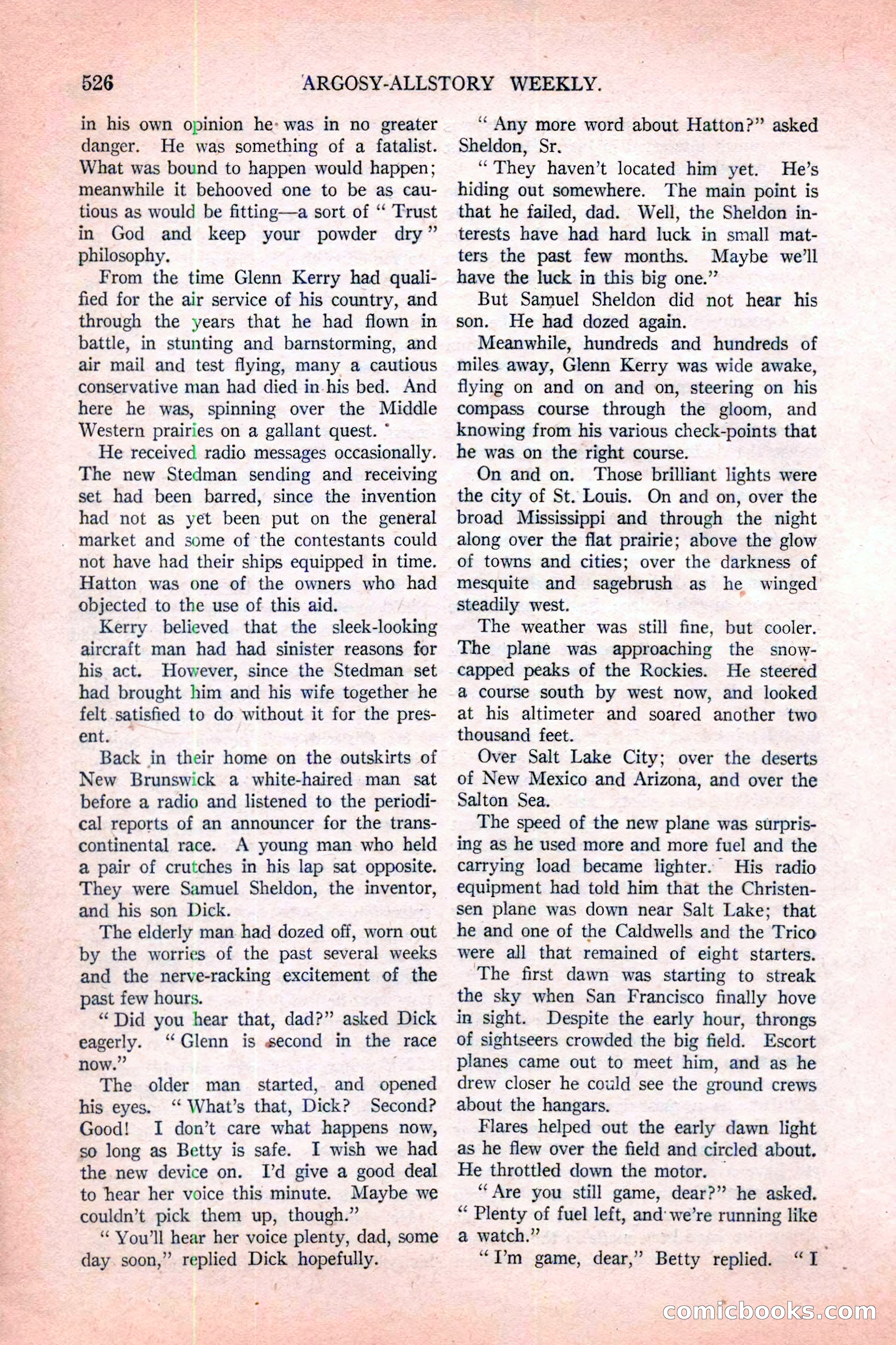
A restored page from Pulp Fiction, 1927. Page through the whole issue in the reader above.
📄 Transcribed text from this page (OCR, searchable)
Machine-transcribed from the original scan — historical spelling and the odd misread are preserved.
526 in his own opinion he> was in no greater danger. He was something of a fatalist. What was bound to happen would happen; meanwhile it behooved one to be as cau- tious as would be fitting—a sort of ‘‘ Trust in God and keep your powder dry” philosophy. From the time Glenn Kerry had quali- fied for the air service of his country, and through the years that he had flown in battle, in stunting and barnstorming, and air mail and test flying, many a cautious conservative man had died in-his bed. And here he was, spinning over the Middle Western prairies on a gallant quest. * He received radio messages occasionally. The new Stedman sending and receiving set had been barred, since the invention had not as yet been put on the general - market and some of the contestants could not have had their ships equipped in time. Hatton was one of the owners who had objected to the use of this aid. Kerry believed that the sleek-looking aircraft man had had sinister reasons for his act. However, since the Stedman set had brought him and his wife together he felt satisfied to do without it for the pres- ent. Back in their home on the outskirts of New Brunswick a white-haired man sat before a radio and listened to the periodi- cal reports of an announcer for the trans- continental race. A young man who held a pair of crutches in his lap sat opposite. They were Samuel Sheldon, the inventor, and his son Dick. The elderly man had dozed off, worn out by the worries of the past several weeks and the nerve-racking excitement of the past few hours. “Did you hear that, dad?” asked Dick eagerly. “Glenn is second in the race now.” | The older man started, and opened his eyes. ‘‘ What’s that, Dick? Second? Good! I don’t care what happens now, so long as Betty is safe. I wish we had the new device on. I'd give a good deal to hear her voice this minute. Maybe we couldn’t pick them up, though.” “You'll hear her voice plenty, dad, some day soon,” replied Dick hopefully. ARGOSY-ALLSTORY WEEKLY. ‘“ Any more word about Hatton?” asked Sheldon, Sr. “They haven’t located him yet. He’s hiding out somewhere. The main point is that he failed, dad. Well, the Sheldon in- terests have had hard luck in small mat- ters the past few months. Maybe we'll have the luck in this big one.” But Samuel Sheldon did not hear his son. He had dozed again. Meanwhile, hundreds and hundreds of miles away, Glenn Kerry was wide awake, flying on and on and on, steering on his compass course through the gloom, and knowing from his various check-points that he was on the right course. On and on. Those brilliant lights were the city of St. Louis. On and on, over the broad Mississippi and through the night along over the flat prairie; above the glow of towns and cities; over the darkness of mesquite and sagebrush as he winged steadily west. The weather was still fine, but cooler. The plane was approaching the snow- capped peaks of the Rockies. He steered a course south by west now, and looked at his altimeter and soared another two thousand feet. Over Salt Lake City; over the deserts of New Mexico and Arizona, and over the Salton Sea. The speed of the new plane was surpris- ing as he used more and more fuel and the carrying load became lighter. His radio equipment had told him that the Christen- sen plane was down near Salt Lake; that he and one of the Caldwells and the Trico were all that remained of eight starters. The first dawn was starting to streak the sky when San Francisco finally hove in sight. Despite the early hour, throngs of sightseers crowded the big field. Escort planes came out to meet him, and as he drew closer he could see the ground crews about the hangars. Flares helped out the early dawn light as he flew over the field and circled about. He throttled down the motor. — “Are you still game, dear?” he asked. “Plenty of fuel left, and’ we’re running like a watch.” “I’m game, dear,” Betty replied. EOPMICOOOKS «T (E@)