
Pulp Fiction, 1927 · page 43 of 168
Argosy All-Story Weekly, November 12, 1927 — page 43: what you’re looking at
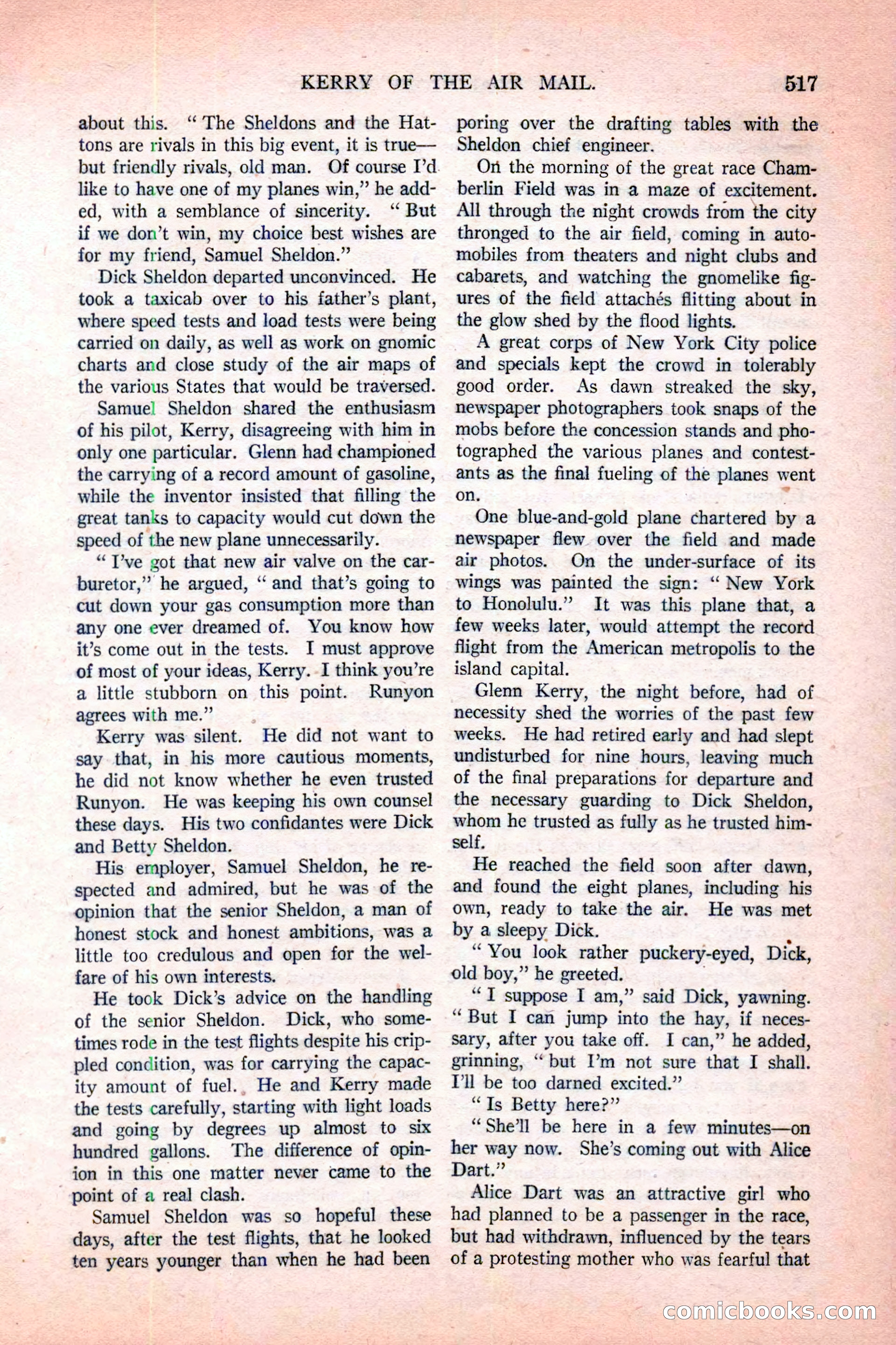
A restored page from Pulp Fiction, 1927. Page through the whole issue in the reader above.
📄 Transcribed text from this page (OCR, searchable)
Machine-transcribed from the original scan — historical spelling and the odd misread are preserved.
KERRY OF THE AIR MAIL. about this. ‘“ The Sheldons and the Hat- tons are rivals in this big event, it is true— but friendly rivals, old man. Of course I’d. like to have one of my planes win,” he add- ed, with a semblance of sincerity. ‘“ But if we don’t win, my choice best wishes are for my friend, Samuel Sheldon.” Dick Sheldon departed unconvinced. He took a taxicab over to his father’s plant, where speed tests and load tests were being carried on daily, as well as work on gnomic charts and close study of the air maps of the various States that would be traversed. Samuel] Sheldon shared the enthusiasm of his pilot, Kerry, disagreeing with him in only one particular. Glenn had championed the carrying of a record amount of gasoline, while the inventor insisted that filling the great tanks to capacity would cut down the speed of the new plane unnecessarily. “T’ve got that new air valve on the car- buretor,” he argued, “ and that’s going to cut down your gas consumption more than any one ever dreamed of. You know how it’s come out in the tests. I must approve of most of your ideas, Kerry. I think you’re a little stubborn on this point. Runyon agrees with me.” : Kerry was silent. He did not want to say that, in his more cautious moments, he did not know whether he even trusted Runyon. He was keeping his own counsel these days. His two confidantes were Dick and Betty Sheldon. His employer, Samuel Sheldon, he re- spected and admired, but he was of the opinion that the senior Sheldon, a man of honest stock and honest ambitions, was 2 little too credulous and open for the wel- fare of his own interests. He took Dick’s advice on the handling of the senior Sheldon. Dick, who some- times rode in the test flights despite his crip- pled condition, was for carrying the capac- ity amount of fuel., He and Kerry made the tests carefully, starting with light loads and going by degrees up almost to six hundred gallons. The difference of opin- ion in this one matter never came to the point of a real clash. Samuel Sheldon was so hopeful these days, after the test flights, that he looked ten years younger than when he had been 517 poring over the drafting tables with the - Sheldon chief engineer. On the morning of the great race Cham- berlin Field was in a maze of excitement. All through the night crowds from the city thronged to the air field, coming in auto- mobiles from theaters and night clubs and cabarets, and watching the gnomelike fig- ures of the field attachés flitting about in the glow shed by the flood lights. A great corps of New York City police and specials kept the crowd in tolerably good order. As dawn streaked the sky, newspaper photographers took snaps of the mobs before the concession stands and pho- tographed the various planes and contest- ants as the final fueling of the planes went on. 7 One blue-and-gold plane chartered by a newspaper flew over the field and made air photos. On the under-surface of its wings was painted the sign: “ New York to Honolulu.” It was this plane that, a few weeks later, would attempt the record flight from the American metropolis to the island capital. Glenn Kerry, the night before, had of necessity shed the worries of the past few weeks. He had retired early and had slept undisturbed for nine hours, leaving much of the final preparations for departure and the necessary guarding to Dick Sheldon, whom he trusted as fully as he trusted him- self, He reached the field soon after dawn, and found the eight planes, including his own, ready to take the air. He was met by a sleepy Dick. “You look rather puckery-eyed, Dick, old boy,” he greeted. “TI suppose I am,” said Dick, yawning. “ But I can jump into the hay, if neces- sary, after you take off. I can,” he added, grinning, “but I’m not sure that I shall. Pll be too darned excited.” “Ts Betty here?” “She'll be here in a few minutes—on her way now. She’s coming out with Alice Dart.” Alice Dart was an attractive girl who had planned to be a passenger in the race, but had withdrawn, influenced by the tears of a protesting mother who was fearful that COPMICLOOOKS (E@)