
Pulp Fiction, 1927 · page 30 of 168
Argosy All-Story Weekly, November 12, 1927 — page 30: what you’re looking at
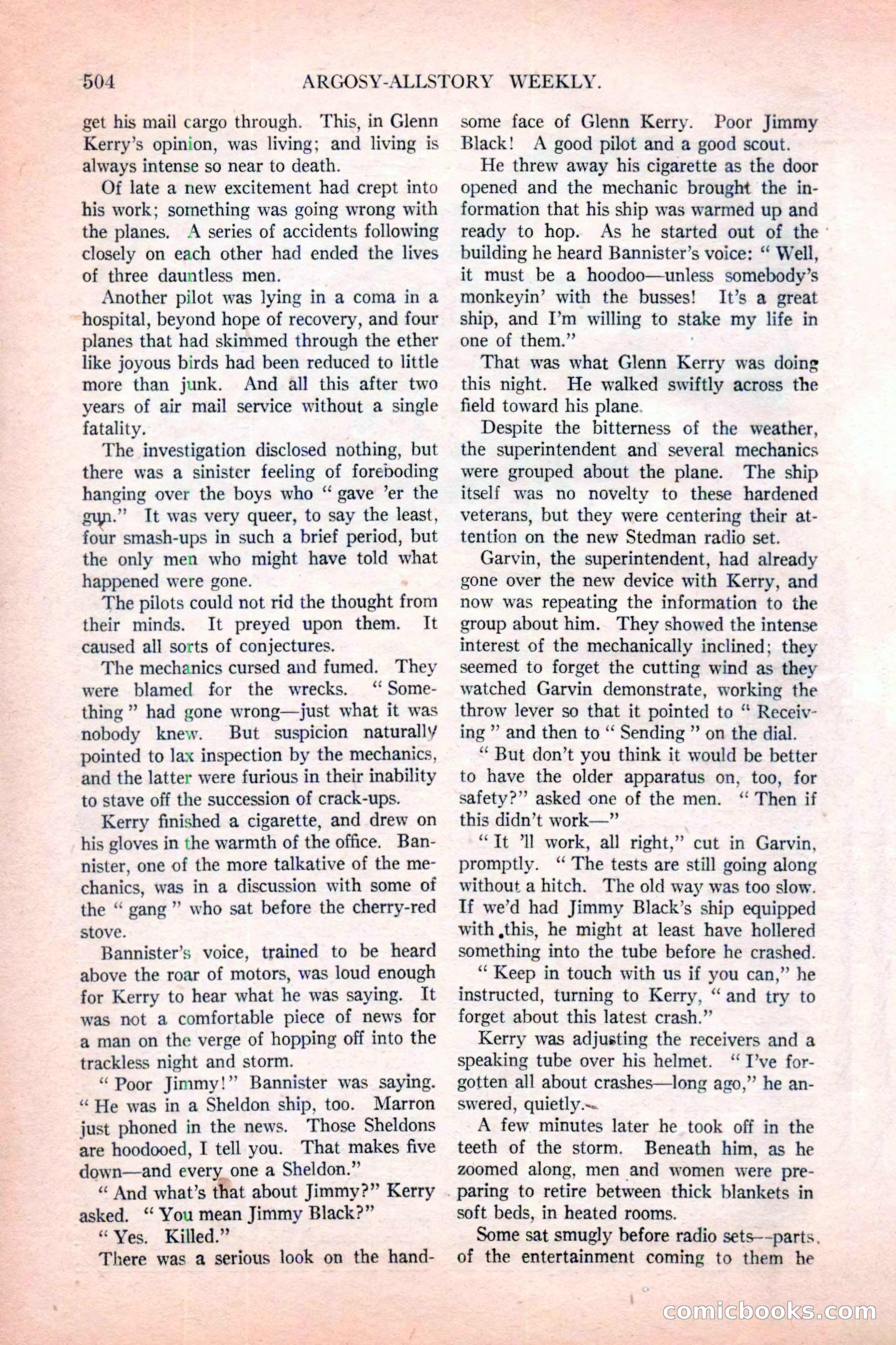
A restored page from Pulp Fiction, 1927. Page through the whole issue in the reader above.
📄 Transcribed text from this page (OCR, searchable)
Machine-transcribed from the original scan — historical spelling and the odd misread are preserved.
504 get his mail cargo through. This, in Glenn Kerry’s opinion, was living; and living is always intense so near to death. Of late a new excitement had crept into his work; something was going wrong with the planes. A series of accidents following closely on each other had ended the lives of three dauntless men. Another pilot was lying in a coma in a hospital, beyond hope of recovery, and four planes that had skimmed through the ether like joyous birds had been reduced to little more than junk. And all this after two years of air mail service without a single fatality. The investigation disclosed nothing, but there was a sinister feeling of foreboding hanging over the boys who “ gave ’er the gun.” It was very queer, to say the least, four smash-ups in such a brief period, but the only men who might have told what happened were gone. The pilots could not rid the thought from their minds. It preyed upon them. It caused all sorts of conjectures. The mechanics cursed and fumed. They were blamed for the wrecks. ‘‘ Some- thing” had gone wrong—just what it was nobody knew. But suspicion naturally pointed to lax inspection by the mechanics, and the latter were furious in their inability to stave off the succession of crack-ups. Kerry finished a cigarette, and drew on his gloves in the warmth of the office. Ban- nister, one of the more talkative of the me- chanics, was in a discussion with some of the “ gang” who sat before the cherry-red stove. Bannister’s voice, trained to be heard above the roar of motors, was loud enough for Kerry to hear what he was saying. It was not a comfortable piece of news for a man on the verge of hopping off into the trackless night and storm. “Poor Jimmy!” Bannister was saying. “He was in a Sheldon ship, too. Marron just phoned in the news. Those Sheldons are hoodooed, I tell you. That makes five down—and every one a Sheldon.” “ And what’s that about Jimmy?” Kerry asked. ‘“ You mean Jimmy Black?” “Ves, Killed.” There was a serious look on the hand- ARGOSY-ALLSTORY WEEKLY. some face of Glenn Kerry. Poor Jimmy Black! A good pilot and a good scout. He threw away his cigarette as the door opened and the mechanic brought the in- formation that his ship was warmed up and ready to hop. As he started out of the - building he heard Bannister’s voice: ‘‘ Well, it must be a hoodoo—unless somebody’s monkeyin’ with the busses! It’s a great ship, and I’m willing to stake my life in one of them.” : That was what Glenn Kerry was doing this night. He walked swiftly across the field toward his plane. Despite the bitterness of the weather, the superintendent and several mechanics were grouped about the plane. The ship itself was no novelty to these hardened veterans, but they were centering their at- tention on the new Stedman radio set. Garvin, the superintendent, had already gone over the new device with Kerry, and now was repeating the information to the group about him. They showed the intense interest of the mechanically inclined; they seemed to forget the cutting wind as they watched Garvin demonstrate, working the throw lever so that it pointed to “ Receiv- ing” and then to “ Sending ” on the dial. “ But don’t you think it would be better to have the older apparatus on, too, for safety?” asked one of the men. “ Then if this didn’t work—”’ “Tt “ll work, all right,” cut in Garvin, promptly. “ The tests are still going along without a hitch. The old way was too slow. If we’d had Jimmy Black’s ship equipped with ,this, he might at least have hollered something into the tube before he crashed. “Keep in touch with us if you can,” he instructed, turning to Kerry, “and try to forget about this latest crash.” Kerry was adjusting the receivers and a speaking tube over his helmet. “ I’ve for- gotten all about crashes—long ago,’”’ he an- swered, quietly.~. A few minutes later he took off in the teeth of the storm. Beneath him, as he zoomed along, men and women were pre- . paring to retire between thick blankets in soft beds, in heated rooms. Some sat smugly before radio sets—-parts, of the entertainment coming to them he ' ECOPMICLOOOKS (E@)