
Pulp Fiction, 1927 · page 148 of 168
Argosy All-Story Weekly, November 12, 1927 — page 148: what you’re looking at
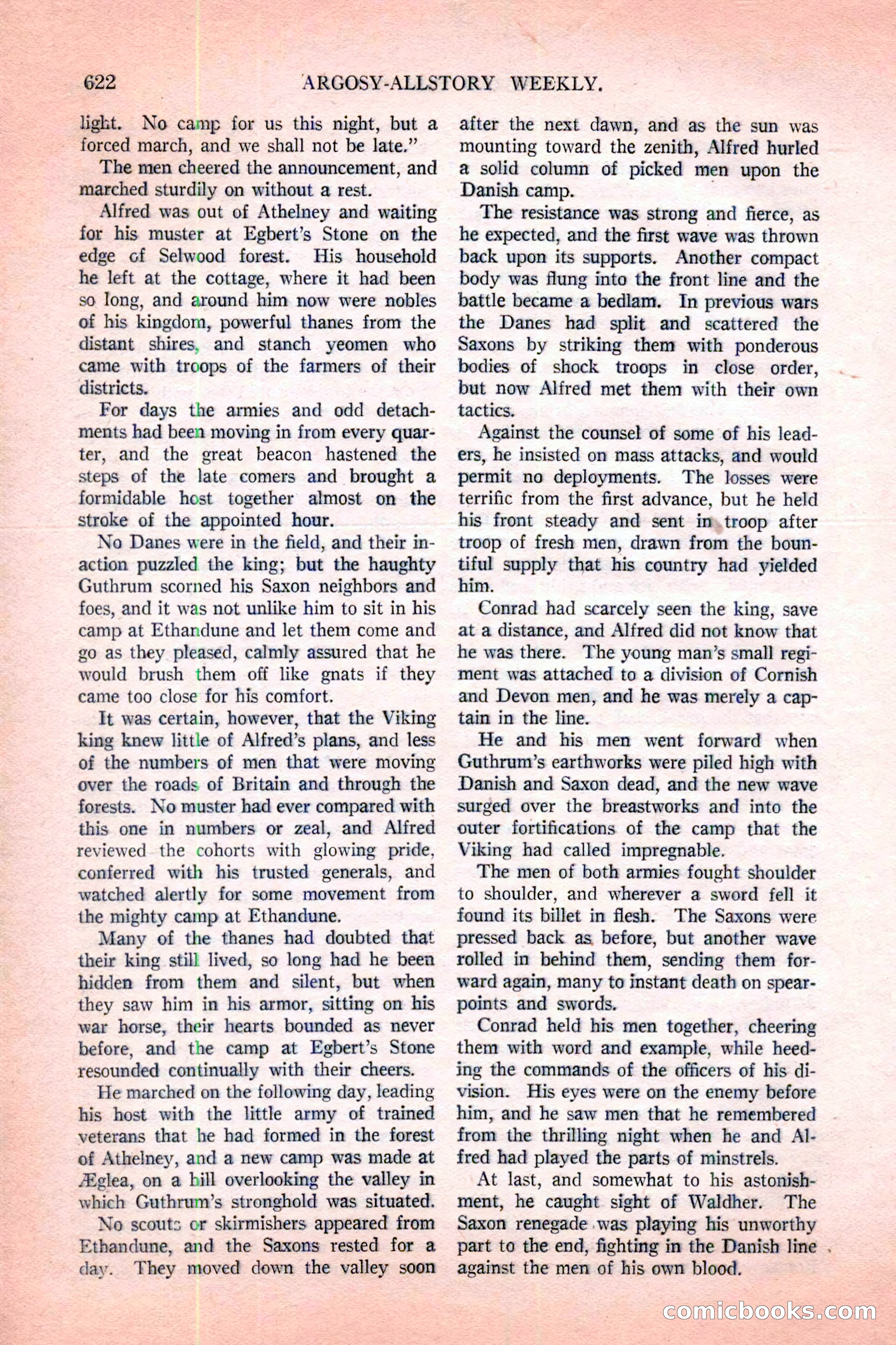
A restored page from Pulp Fiction, 1927. Page through the whole issue in the reader above.
📄 Transcribed text from this page (OCR, searchable)
Machine-transcribed from the original scan — historical spelling and the odd misread are preserved.
622 ligkt. No camp for us this night, but a forced march, and we shall not be late.” The men cheered the announcement, and marched sturdily on without a rest. Alfred was out of Athelney and waiting for his muster at Egbert’s Stone on the edge cf Selwood forest. His household he left at the cottage, where it had been so Iong, and around him now were nobles of his kingdom, powerful thanes from the distant shires, and stanch yeomen who came with troops of the farmers of their districts. For days the armies and odd detach- ments had been moving in from every quar- ter, and the great beacon hastened the steps of the late comers and brought a formidable host together almost on the stroke of the appointed hour. No Danes were in the field, and their in- action puzzled the king; but the haughty Guthrum scorned his Saxon neighbors and foes, and it was not unlike him to sit in his camp at Ethandune and let them come and go as they pleased, calmly assured that he would brush them off like gnats if they came too close for his comfort. It was certain, however, that the Viking king knew little of Alfred’s plans, and less of the numbers of men that were moving over the roads of Britain and through the forests. No muster had ever compared with this one in numbers or zeal, and Alfred reviewed the cohorts with glowing pride, conferred with his trusted generals, and watched alertly for some movement from the mighty camp at Ethandune. Many of the thanes had doubted that their king still lived, so long had he been hidden from them and silent, but when they saw him in his armor, sitting on his war horse, their hearts bounded as never before, and the camp at Egbert’s Stone resounded continually with their cheers. He marched on the following day, leading his host with the little army of trained veterans that he had formed in the forest of Athelney, and a new camp was made at ZEglea, on a hill overlooking the valley in which Guthrum’s stronghold was situated. No scouts or skirmishers appeared from Ethandune, and the Saxons rested for a day. They moved down the valley soon ARGOSY-ALLSTORY WEEKLY. after the next dawn, and as the sun was mounting toward the zenith, Alfred hurled a solid column of picked men upon the Danish camp. | The resistance was strong and fierce, as he expected, and the first wave was thrown back upon its supports. Another compact body was flung into the front line and the battle became a bedlam. In previous wars the Danes had split and scattered the Saxons by striking them with ponderous bodies of shock troops in close order, but now Alfred met them with their own tactics. Against the counsel of some of his lead- ers, he insisted on mass attacks, and would permit no deployments. The losses were terrific from the first advance, but he held his front steady and sent im troop after troop of fresh men, drawn from the boun- tiful supply that his country had yielded him. Conrad had scarcely seen the king, save at a distance, and Alfred did not know that he was there. The young man’s small regi- ment was attached to a division of Cornish and Devon men, and he was merely a cap- tain in the line. He and his men went forward when Guthrum’s earthworks were piled high with Danish and Saxon dead, and the new wave surged over the breastworks and into the outer fortifications of the camp that the Viking had called impregnable. The men of both armies fought shoulder to shoulder, and wherever a sword fell it found its billet in flesh. The Saxons were pressed back as before, but another wave rolled in behind them, sending them for- ward again, many to instant death on spear- points and swords. Conrad held his men together, cheering them with word and example, while heed- ing the commands of the officers of his di- vision. His eyes were on the enemy before him, and he saw men that he remembered from the thrillmg night when he and Al- fred had played the parts of minstrels. At last, and somewhat to his astonish- ment, he caught sight of Waldher. The Saxon renegade was playing his unworthy part to the end, fighting in the Danish line . against the men of his own blood. Gomichbooks (EO)