
Pulp Fiction, 1927 · page 146 of 168
Argosy All-Story Weekly, November 12, 1927 — page 146: what you’re looking at
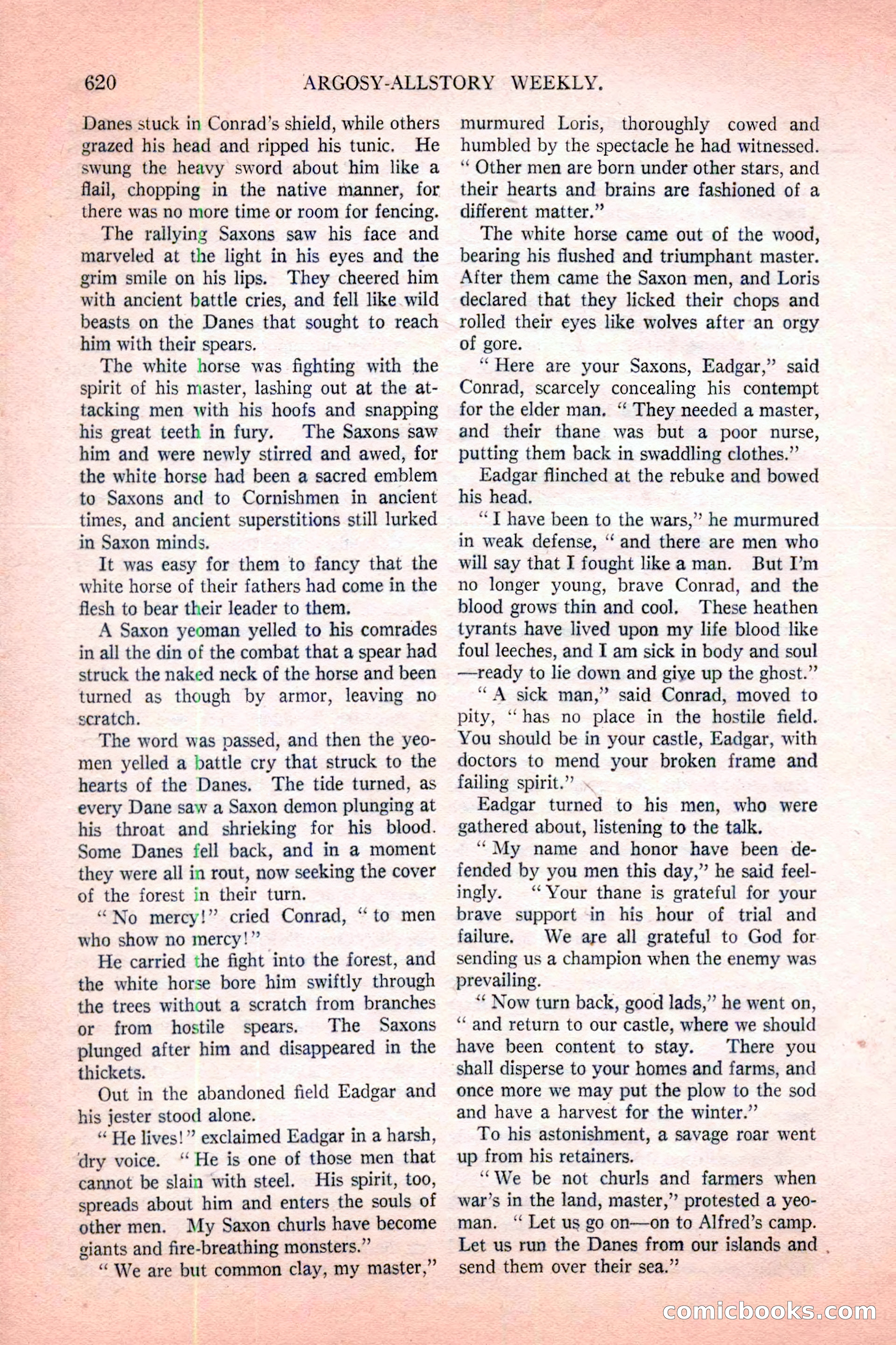
A restored page from Pulp Fiction, 1927. Page through the whole issue in the reader above.
📄 Transcribed text from this page (OCR, searchable)
Machine-transcribed from the original scan — historical spelling and the odd misread are preserved.
620 Danes stuck in Conrad’s shield, while others grazed his head and ripped his tunic. He swung the heavy sword about him like a flail, chopping in the native manner, for there was no more time or room for fencing. The rallying Saxons saw his face and marveled at the light in his eyes and the grim smile on his lips. They cheered him with ancient battle cries, and fell like wild beasts on the Danes that sought to reach him with their spears. The white horse was fighting with the spirit of his master, lashing out at the at- tacking men with his hoofs and snapping his great teeth in fury. The Saxons saw him and were newly stirred and awed, for the white horse had been a sacred emblem to Saxons and to Cornishmen in ancient times, and ancient superstitions still lurked in Saxon minds. It was easy for them to fancy that the white horse of their fathers had come in the flesh to bear their leader to them. A Saxon yeoman yelled to his comrades in all the din of the combat that a spear had struck the naked neck of the horse and been turned as though by armor, leaving no scratch. The word was passed, and then the yeo- men yelled a battle cry that struck to the hearts of the Danes. The tide turned, as every Dane saw a Saxon demon plunging at his throat and shrieking for his blood. Some Danes fell back, and in a moment they were all in rout, now seeking the cover of the forest in their turn. “No mercy!” cried Conrad, “to men who show no mercy!” He carried the fight into the forest, and the white horse bore him swiftly through the trees without a scratch from branches or from hostile spears. The Saxons plunged after him and disappeared in the thickets. Out in the abandoned field Eadgar and his jester stood alone. “ He lives!” exclaimed Eadgar in a harsh, dry voice. “He is one of those men that cannot be slain with steel. His spirit, too, spreads about him and enters the souls of other men. My Saxon churls have become giants and fire-breathing monsters.” “ We are but common clay, my master,” ARGOSY-ALLSTORY WEEKLY. murmured Loris, thoroughly cowed and humbled by the spectacle he had witnessed. ‘‘ Other men are born under other stars, and their hearts and brains are fashioned of a different matter.” The white horse came out of the wood, bearing his flushed and triumphant master. Aiter them came the Saxon men, and Loris declared that they licked their chops and rolled their eyes like wolves after an orgy of gore. ‘Here are your Saxons, Eadgar,” said Conrad, scarcely concealing his contempt for the elder man. “‘ They needed a master, and their thane was but a poor nurse, putting them back in swaddling clothes.” Eadgar flinched at the rebuke and bowed his head. ‘“T have been to the wars,” he murmured in weak defense, ‘‘ and there are men who will say that I fought likea man. But I’m no longer young, brave Conrad, and the blood grows thin and cool, These heathen tyrants have lived upon my life blood like foul leeches, and I am sick in body and soul —ready to lie down and giye up the ghost.” ‘A sick man,” said Conrad, moved to pity, “‘has no place in the hostile field. You should be in your castle, Eadgar, with doctors to mend your broken frame and failing spirit.” . Eadgar turned to his men, who were gathered about, listening to the talk. ‘“My name and honor have been de- fended by you men this day,” he said feel- ingly. “Your thane is grateful for your brave support in his hour of trial and failure. We are all grateful to God for sending us a champion when the enemy was prevailing. “* Now turn back, good lads,” he went on, ‘‘ and return to our castle, where we should have been content to stay. There you shall disperse to your homes and farms, and once more we may put the plow to the sod and have a harvest for the winter.” To his astonishment, a savage roar went up from his retainers. ‘“We be not churls and farmers when war’s in the land, master,” protested a yeo- man. ‘ Let us go on—on to Alfred’s camp. Let us run the Danes from our islands and . send them over their sea.” Gomichbooks (EO)