
Pulp Fiction, 1927 · page 141 of 168
Argosy All-Story Weekly, November 12, 1927 — page 141: what you’re looking at
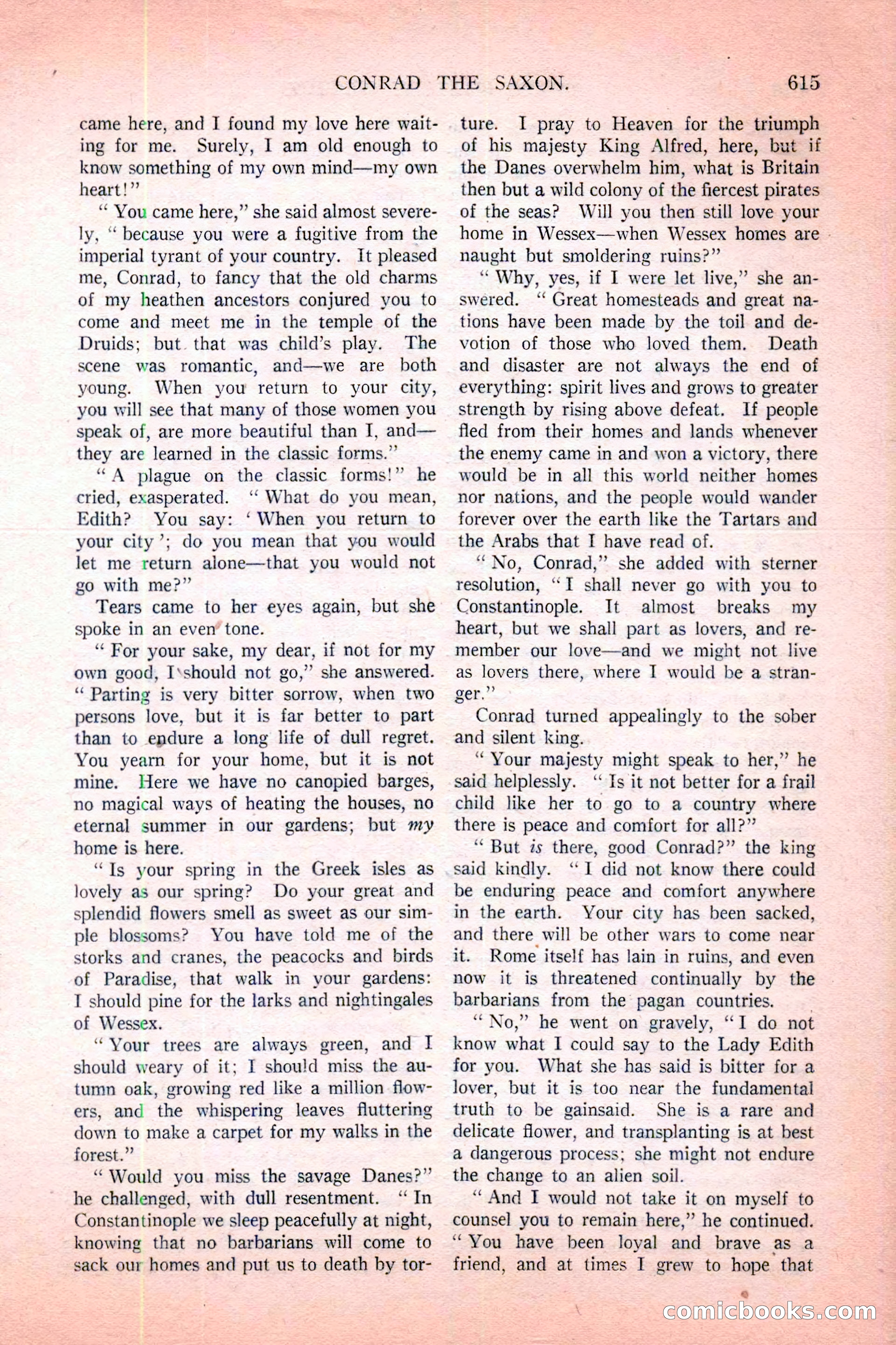
A restored page from Pulp Fiction, 1927. Page through the whole issue in the reader above.
📄 Transcribed text from this page (OCR, searchable)
Machine-transcribed from the original scan — historical spelling and the odd misread are preserved.
CONRAD THE SAXON. came here, and I found my love here wait- ing for me. Surely, I am old enough to know something of my own mind—my own heart!” ‘“ You came here,” she said almost severe- ly, ‘‘ because you were a fugitive from the imperial tyrant of your country. It pleased me, Conrad, to fancy that the old charms of my heathen ancestors conjured you to come and meet me in the temple of the Druids; but. that was child’s play. The scene was romantic, and—we are both young. When you return to your city, you will see that many of those women you speak of, are more beautiful than I, and— they are learned in the classic forms.” “A plague on the classic forms!” he cried, exasperated. ‘“‘ What do you mean, Edith? You say: ‘When you return to your city’; do you mean that you would let me return alone—that you would not go with me?” Tears came to her eyes again, but she spoke in an even’ tone. ‘For your sake, my dear, if not for my own good, I‘should not go,” she answered. “ Parting is very bitter sorrow, when two persons love, but it is far better to part than to endure a long life of dull regret. You yearn for your home, but it is not mine. Here we have no canopied barges, no magical ways of heating the houses, no eternal summer in our gardens; but my home is here. “Ts your spring in the Greek isles as lovely as our spring? Do your great and splendid flowers smell as sweet as our sim- ple blossoms? You have told me of the storks and cranes, the peacocks and birds of Paradise, that walk in your gardens: I should pine for the larks and nightingales of Wessex. “Vour trees are always green, and I should weary of it; I should miss the au- tumn oak, growing red like a million flow- ers, and the whispering leaves fluttering down to make a carpet for my walks in the forest.” ‘Would you miss the savage Danes?” he challenged, with dull resentment. “ In Constantinople we sleep peacefully at night, knowing that no barbarians will come to sack our homes and put us to death by tor- 615 ture. I pray to Heaven for the triumph of his majesty King Alfred, here, but if the Danes overwhelm him, what is Britain then but a wild colony of the fiercest pirates of the seas? Will you then still love your home in Wessex—when Wessex homes are ~ naught but smoldering ruins?” ‘Why, yes, if I were let live,” she an- swered. ‘‘ Great homesteads and great na- tions have been made by the toil and de- votion of those who loved them. Death and disaster are not always the end of everything: spirit lives and grows to greater strength by rising above defeat. If people fled from their homes and lands whenever the enemy came in and won a victory, there would be in all this world neither homes nor nations, and the people would wander forever over the earth like the Tartars and the Arabs that I have read of. ‘““No, Conrad,” she added with sterner resolution, “I shall never go with you to Constantinople. It almost breaks my heart, but we shall part as lovers, and re- member our love—and we might not live as lovers there, where I would he a stran- ger.”’ Conrad turned appealingly to the sober and silent king. ‘“ Your majesty might speak to her,” he said helplessly. ‘Is it not better for a frail child like her to go to a country where there is peace and comfort for all?” ‘“ But zs there, good Conrad?” the king said kindly. ‘I did not know there could be enduring peace and comfort anywhere in the earth. Your city has been sacked, and there will be other wars to come near it. Rome itself has lain in ruins, and even now it is threatened continually by the barbarians from the pagan countries. | “No,” he went on gravely, ‘I do not know what I could say to the Lady Edith for you. What she has said is bitter for a lover, but it is too near the fundamental truth to be gainsaid. She is a rare and delicate flower, and transplanting is at best a dangerous process; she might not endure the change to an alien soil. ‘“And I would not take it on myself to counsel you to remain here,” he continued. “You have been loyal and brave as a friend, and at times I grew to hope that a ‘ EOPMICL OOO KS (E@)