
Pulp Fiction, 1927 · page 136 of 168
Argosy All-Story Weekly, November 12, 1927 — page 136: what you’re looking at
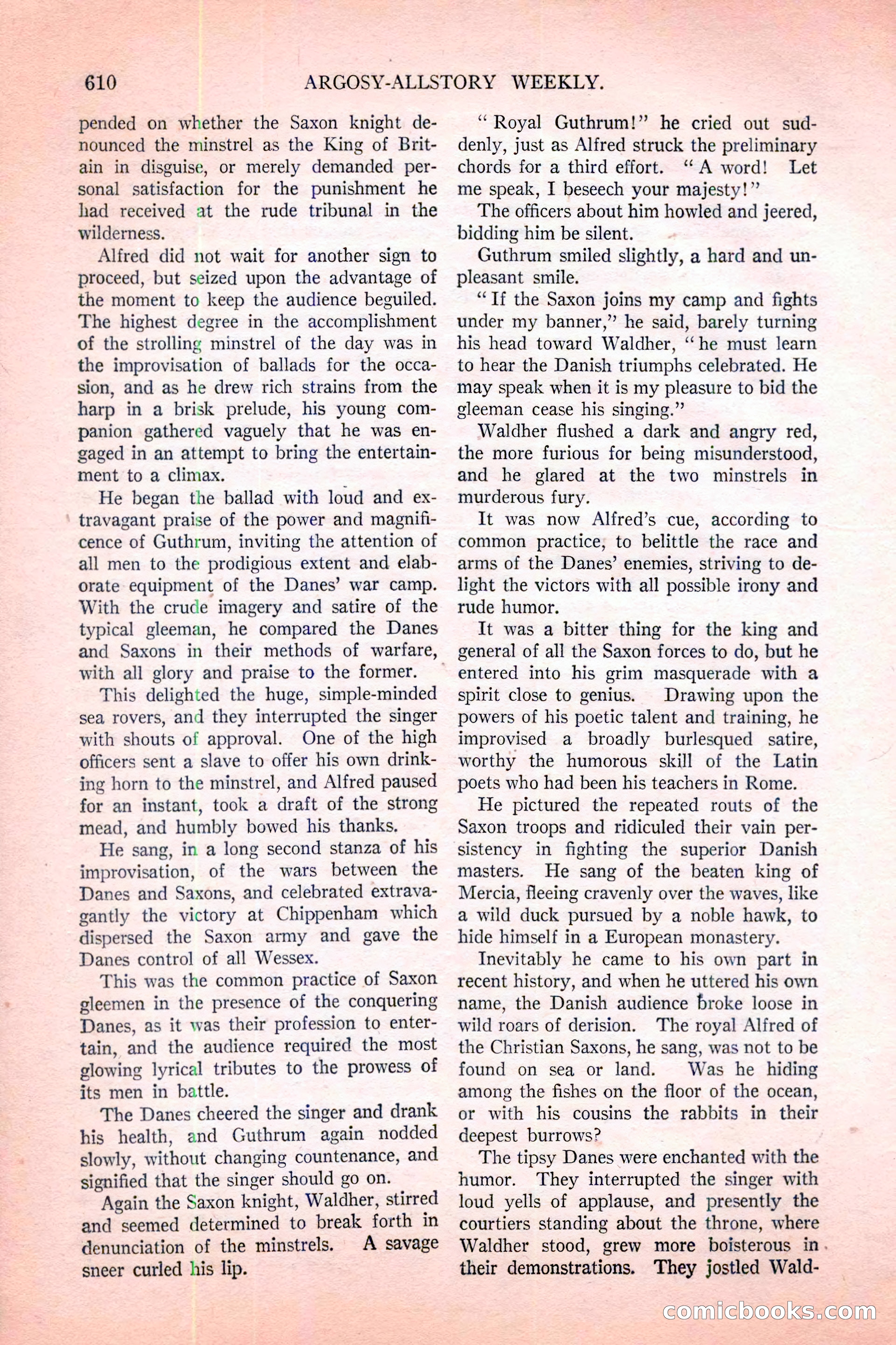
A restored page from Pulp Fiction, 1927. Page through the whole issue in the reader above.
📄 Transcribed text from this page (OCR, searchable)
Machine-transcribed from the original scan — historical spelling and the odd misread are preserved.
610 pended on whether the Saxon knight de- nounced the minstrel as the King of Brit- ain in disguise, or merely demanded per- sonal satisfaction for the punishment he had received at the rude tribunal in the wilderness. Alfred did not wait for another sign to proceed, but seized upon the advantage of the moment to keep the audience beguiled. The highest degree in the accomplishment of the strolling minstrel of the day was in the improvisation of ballads for the occa- sion, and as he drew rich strains from the harp in a brisk prelude, his young com- panion gathered vaguely that he was en- gaged in an attempt to bring the entertain- ment to a climax. : He began the ballad with loud and ex- travagant praise of the power and magnifi- cence of Guthrum, inviting the attention of all men to the prodigious extent and elab- orate equipment of the Danes’ war camp. With the crude imagery and satire of the typical gleeman, he compared the Danes and Saxons in their methods of warfare, with all glory and praise to the former. This delighted the huge, simple-minded sea rovers, and they interrupted the singer with shouts of approval. One of the high officers sent a slave to offer his own drink- ing horn to the minstrel, and Alfred paused for an instant, took a draft of the strong mead, and humbly bowed his thanks. He sang, in a long second stanza of his improvisation, of the wars between the Danes and Saxons, and celebrated extrava- gantly the victory at Chippenham which dispersed the Saxon army and gave the Danes control of all Wessex. This was the common practice of Saxon gleemen in the presence of the conquering Danes, as it was their profession to enter- tain, and the audience required the most glowing lyrical tributes to the prowess of its men in battle. The Danes cheered the singer and drank his health, and Guthrum again nodded slowly, without changing countenance, and signified that the singer should go on. Again the Saxon knight, Waldher, stirred and seemed determined to break forth in denunciation of the minstrels. A savage sneer curled his lip. ARGOSY-ALLSTORY WEEKLY. ‘Royal Guthrum!” he cried out sud- denly, just as Alfred struck the preliminary chords for a third effort. ‘“‘ A word! Let me speak, I beseech your majesty!” The officers about him howled and jeered, bidding him be silent. Guthrum smiled slightly, a hard and un- pleasant smile. “If the Saxon joins my camp and fights under my banner,” he said, barely turning his head toward Waldher, ‘‘he must learn to hear the Danish triumphs celebrated. He may speak when it is my pleasure to bid the gleeman cease his singing.” Waldher flushed a dark and angry red, the more furious for being misunderstood, and he glared at the two minstrels in murderous fury. It was now Alfred’s cue, according to common practice, to belittle the race and arms of the Danes’ enemies, striving to de- light the victors with all possible irony and rude humor. It was a bitter thing for the king and general of all the Saxon forces to do, but he entered into his grim masquerade with a spirit close to genius. Drawing upon the powers of his poetic talent and training, he improvised a broadly burlesqued satire, worthy the humorous skill of the Latin poets who had been his teachers in Rome. He pictured the repeated routs of the Saxon troops and ridiculed their vain per- sistency in fighting the superior Danish masters. He sang of the beaten king of Mercia, fleeing cravenly over the waves, like a wild duck pursued by a noble hawk, to hide himself in a European monastery. Inevitably he came to his own part in recent history, and when he uttered his own name, the Danish audience broke loose in wild roars of derision. ‘The royal Alfred of the Christian Saxons, he sang, was not to be found on sea or land. Was he hiding among the fishes on the floor of the ocean, or with his cousins the rabbits in their deepest burrows? The tipsy Danes were enchanted with the humor. They interrupted the singer with loud yells of applause, and presently the courtiers standing about the throne, where Waldher stood, grew more boisterous in. their demonstrations. They jostled Wald- (E00) .OO MAI cS (E)