
Pulp Fiction, 1927 · page 13 of 168
Argosy All-Story Weekly, November 12, 1927 — page 13: what you’re looking at
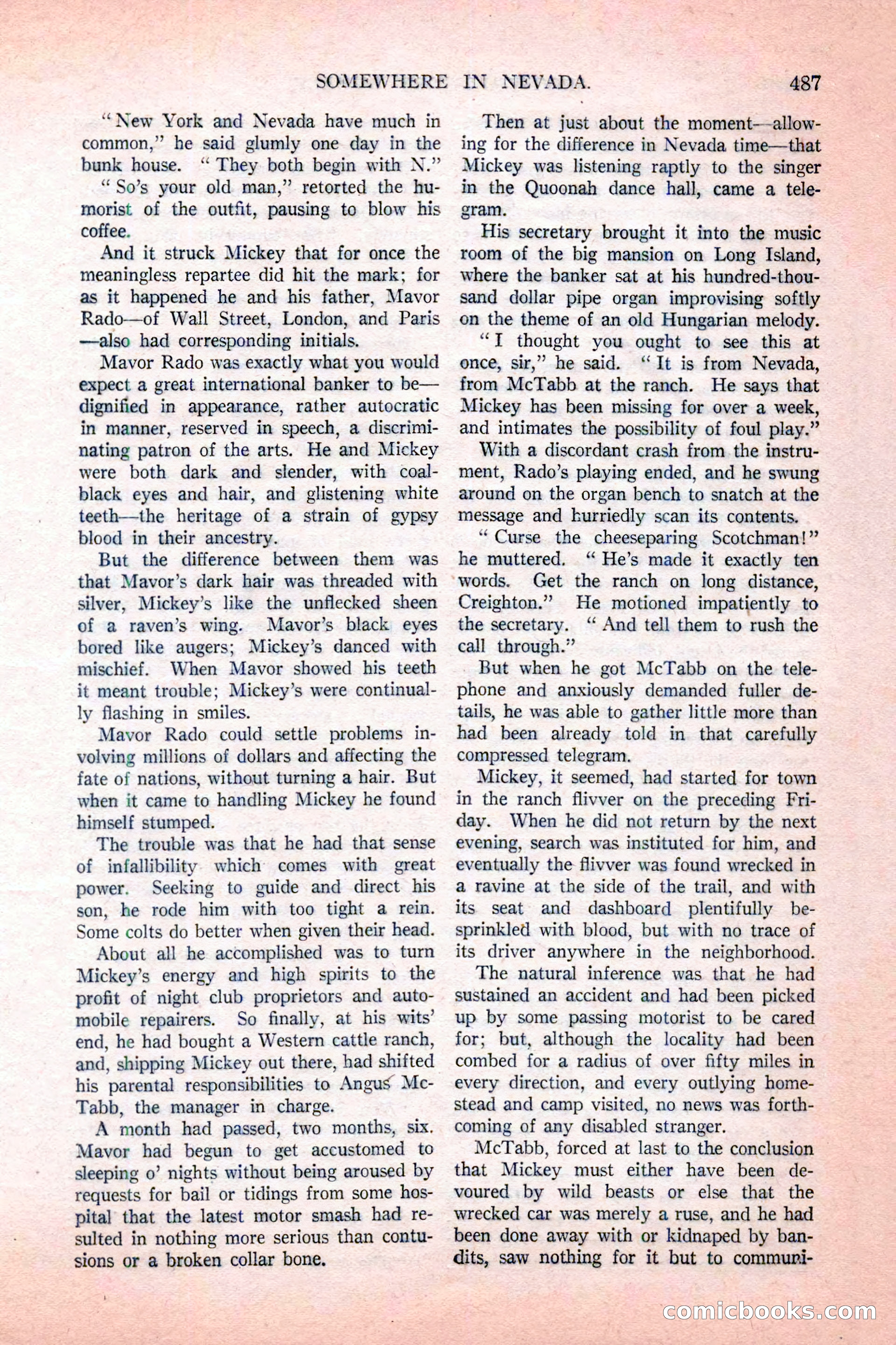
A restored page from Pulp Fiction, 1927. Page through the whole issue in the reader above.
📄 Transcribed text from this page (OCR, searchable)
Machine-transcribed from the original scan — historical spelling and the odd misread are preserved.
SOMEWHERE IN NEVADA. ‘“New York and Nevada have much in common,” he said glumly one day in the bunk house. “ They both begin with N.” “So’s your old man,” retorted the hu- morist of the outfit, pausing to blow his coffee. And it struck Mickey that for once the meaningless repartee did hit the mark; for as it happened he and his father, Mavor Rado—of Wall Street, London, and Paris —also had corresponding initials. Mavor Rado was exactly what you would expect a great international banker to be— dignified in appearance, rather autocratic in manner, reserved in speech, a discrimi- nating patron of the arts. He and Mickey were both dark and slender, with coal- black eyes and hair, and glistening white teeth—the heritage of a strain of gypsy blood in their ancestry. But the difference between them was that Mavor’s dark hair was threaded with silver, Mickey’s like the unflecked sheen of a raven’s wing. Mavor’s black eyes bored like augers; Mickey’s danced with mischief. When Mavor showed his teeth it meant trouble; Mickey’s were continual- ly flashing in smiles. Mavor Rado could settle problems in- volving millions of dollars and affecting the fate of nations, without turning a hair. But when it came to handling Mickey he found himself stumped. The trouble was that he had that sense of infallibility which comes with great power. Seeking to guide and direct his son, he rode him with too tight a rein. Some colts do better when given their head. About all he accomplished was to turn Mickey’s energy and high spirits to the profit of night club proprietors and auto- mobile repairers. So finally, at his wits’ end, he had bought a Western cattle ranch, and, shipping Mickey out there, had shifted his parental responsibilities to Angus Mc- Tabb, the manager in charge. A month had passed, two months, six. Mavor had begun to get accustomed to sleeping o’ nights without being aroused by requests for bail or tidings from some hos- pital that the latest motor smash had re- sulted in nothing more serious than contu- sions or a broken collar bone. words. 487 Then at just about the moment—allow- ing for the difference in Nevada time—that Mickey was listening raptly to the singer m the Quoonah dance hall, came a tele- gram. His secretary brought it into the music room of the big mansion on Long Island, where the banker sat at his hundred-thou- sand dollar pipe organ improvising softly on the theme of an old Hungarian melody. “TI thought you ought to see this at once, sir,” he said. ‘It is from Nevada, from McTabb at the ranch. He says that Mickey has been missing for over a week, and intimates the possibility of foul play.” With a discordant crash from the instru- ment, Rado’s playing ended, and he swung around on the organ bench to snatch at the message and kurriedly scan its contents. “Curse the cheeseparing Scotchman!” he muttered. “ He’s made it exactly ten Get the ranch on long distance, He motioned impatiently to “ And tell them to rush the Creighton.”’ the secretary. call through.” But when he got McTabb on the tele- phone and anxiously demanded fuller de- tails, he was able to gather little more than had been already told in that carefully compressed telegram. Mickey, it seemed, had started for town in the ranch flivver on the preceding Fri- day. When he did not return by the next evening, search was instituted for him, and eventually the flivver was found wrecked in a ravine at the side of the trail, and with its seat and dashboard plentifully be- sprinkled with blood, but with no trace of its driver anywhere in the neighborhood. The natural inference was that he had sustained an accident and had been picked up by some passing motorist to be cared for; but, although the locality had been combed for a radius of over fifty miles in every direction, and every outlying home- stead and camp visited, no news was forth- coming of any disabled stranger. McTabb, forced at last to the conclusion — that Mickey must either have been de- voured by wild beasts or else that the wrecked car was merely a ruse, and he had been done away with or kidnaped by ban- dits, saw nothing for it but to communri- COMMENOOKS (E@)