
Pulp Fiction, 1927 · page 113 of 168
Argosy All-Story Weekly, November 12, 1927 — page 113: what you’re looking at
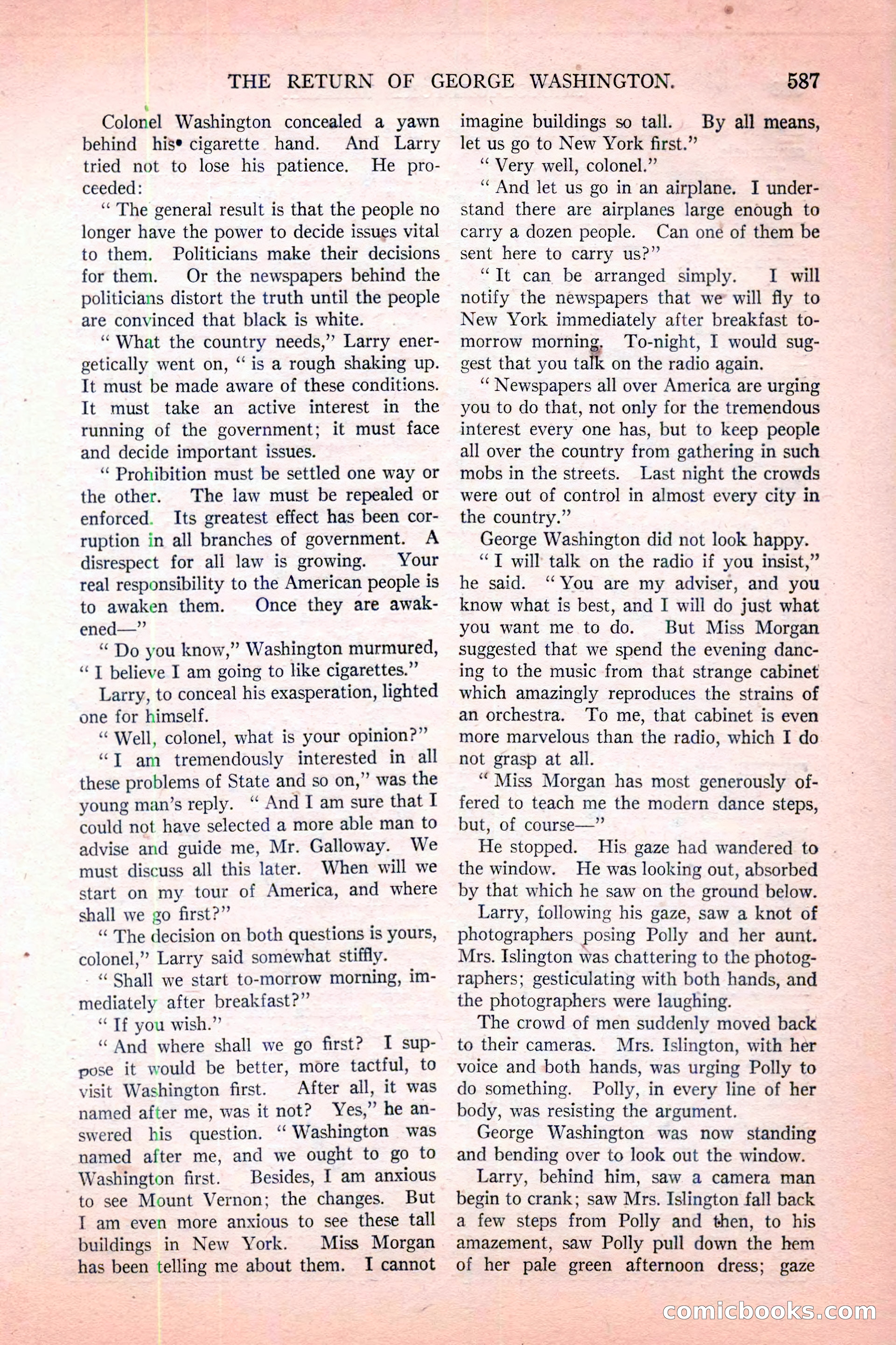
A restored page from Pulp Fiction, 1927. Page through the whole issue in the reader above.
📄 Transcribed text from this page (OCR, searchable)
Machine-transcribed from the original scan — historical spelling and the odd misread are preserved.
THE RETURN OF GEORGE WASHINGTON. Colonel Washington concealed a yawn behind his® cigarette hand. And Larry tried not to lose his patience. He pro- ceeded: “The general result is that the people no longer have the power to decide issues vital to them. Politicians make their decisions for them. Or the newspapers behind the politicians distort the truth until the people are convinced that black is white. ‘What the country needs,” Larry ener- getically went on, ‘‘ is a rough shaking up. It must be made aware of these conditions. It must take an active interest in the running of the government; it must face and decide important issues. ‘Prohibition must be settled one way or the other. The law must be repealed or enforced. Its greatest effect has been cor- ruption in all branches of government. A disrespect for ali law is growing. Your real responsibility to the American people is to awaken them. Once they are awak- ened—” “Do you know,” Washington murmured, ‘“‘T believe I am going to like cigarettes.” Larry, to conceal his exasperation, lighted one for himself. “ Well, colonel, what is your opinion?” “JT am tremendously interested in all these problems of State and so on,” was the young man’s reply. “ And I am sure that I could not have selected a more able man to advise and guide me, Mr. Galloway. We must discuss all this later. When will we start on my tour of America, and where shall we go first?” “ The decision on both questions is yours, colonel,” Larry said somewhat stiffly. - “ Shall we start to-morrow morning, 1m- mediately after breakfast?” “Tf you wish.” “And where shall we go first? I sup- pose it would be better, more tactful, to visit Washington first. After all, it was named after me, was it not? Yes,” he an- swered his question. “‘ Washington was named after me, and we ought to go to Washington first. Besides, I am anxious ~to see Mount Vernon; the changes. But I am even more anxious to see these tall buildings in New York. Miss Morgan has been telling me about them. I cannot 587 imagine buildings so tall. By all means, let us go to New York first.” “Very well, colonel.” ‘And let us go in an airplane. I under- stand there are airplanes large enough to carry a dozen people. Can one of them be sent here to carry us?” “It can be arranged simply. I will notify the newspapers that we’ will fly to New York immediately after breakfast to- morrow morning, ‘To-night, I would sug- gest that you talk on the radio again. ‘Newspapers all over America are urging you to do that, not only for the tremendous interest every one has, but to keep people all over the country from gathering in such mobs in the streets. Last night the crowds were out of control in almost every city in the country.” George Washington did not look happy. ““T will talk on the radio if you insist,” he said. “You are my adviser, and you know what is best, and I will do just what you want me to do. But Miss Morgan suggested that we spend the evening danc- ing to the music from that strange cabinet which amazingly reproduces the strains of an orchestra. To me, that cabinet is even more marvelous than the radio, which I do not grasp at all. “Miss Morgan has most generously of- fered to teach me the modern dance steps, but, of course—” He stopped. His gaze had wandered to . the window. He was looking out, absorbed by that which he saw on the ground below. Larry, following his gaze, saw a knot of photographers posing Polly and her aunt. Mrs. Islington was chattering to the photog- raphers; gesticulating with both hands, and the photographers were laughing. The crowd of men suddenly moved back to their cameras. Mrs. Islington, with her voice and both hands, was urging Polly to do something. Polly, in every line of her body, was resisting the argument. George Washington was now standing and bending over to look out the window. Larry, behind him, saw a camera man begin to crank; saw Mrs. Islington fall back a few steps from Polly and then, to his amazement, saw Polly pull down the hem of her pale green afternoon dress; gaze EOPMIEL OOO KS (E@)