
Pulp Fiction, 1927 · page 80 of 180
Argosy All-Story Weekly, Vol. 189, No. 4 — page 80: what you’re looking at
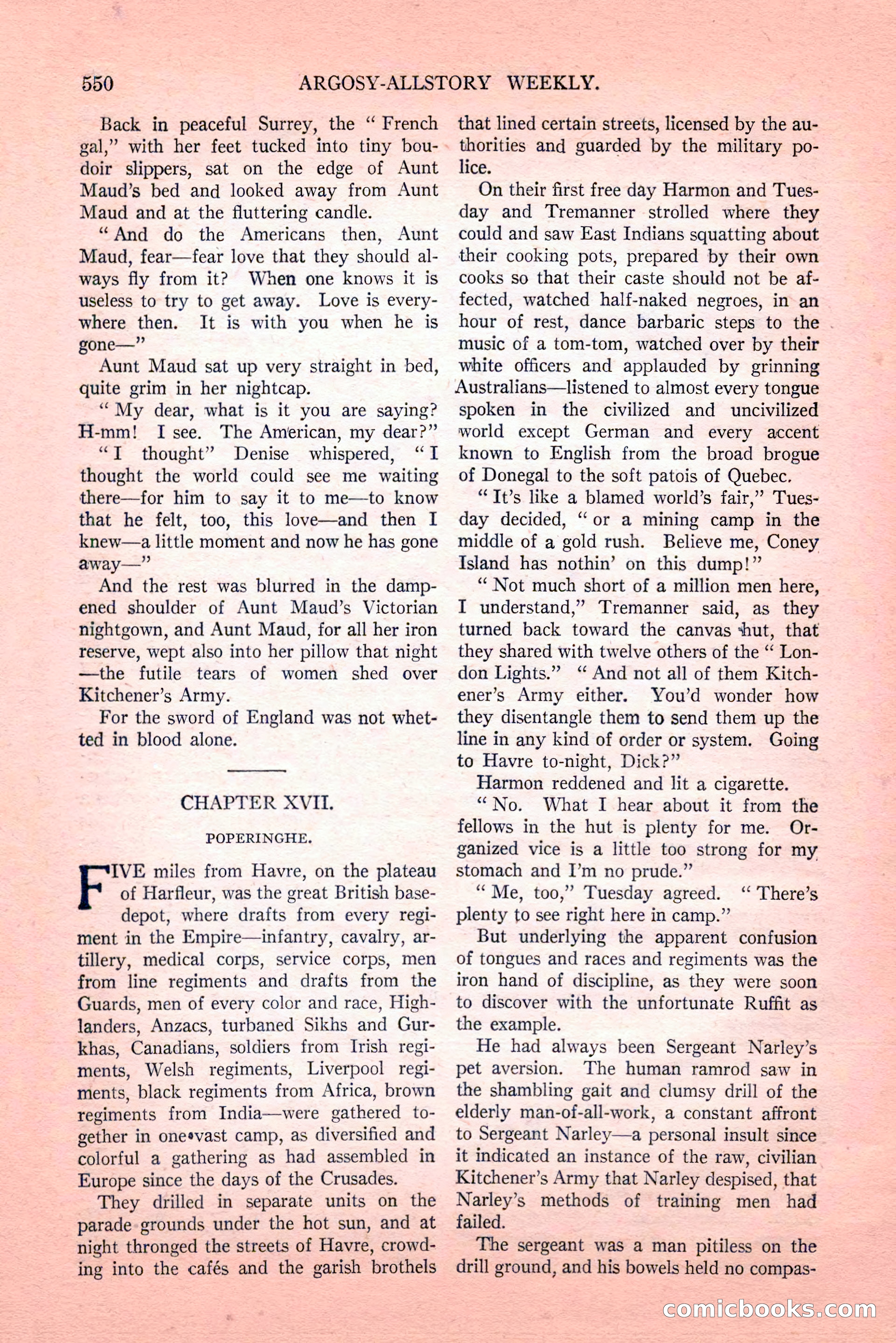
A restored page from Pulp Fiction, 1927. Page through the whole issue in the reader above.
📄 Transcribed text from this page (OCR, searchable)
Machine-transcribed from the original scan — historical spelling and the odd misread are preserved.
550 Back in peaceful Surrey, the “ French gal,” with her feet tucked into tiny bou- doir slippers, sat on the edge of Aunt Maud’s bed and looked away from Aunt Maud and at the fluttering candle. “And do the Americans then, Aunt Maud, fear—fear love that they should al- ways fly from it? When one knows it is useless to try to get away. Love is every- where then. It is with you when he is gone—” Aunt Maud sat up very straight in bed, quite grim in her nightcap. ‘““My dear, what is it you are saying? H-mm! I see. The American, my dear?” “T thought” Denise whispered, “TI thought the world could see me waiting there—for him to say it to me—to know that he felt, too, this love—and then I knew—a little moment and now he has gone away—” And the rest was blurred in the damp- ened shoulder of Aunt Maud’s Victorian nightgown, and Aunt Maud, for all her iron reserve, wept also into her pillow that night —the futile tears of women shed over Kitchener’s Army. For the sword of England was not whet- ted in blood alone. CHAPTER XVII. POPERINGHE. IVE miles from Havre, on the plateau of Harfleur, was the great British base- depot, where drafts from every regi- ment in the Empire—infantry, cavalry, ar- tillery, medical corps, service corps, men from line regiments and drafts from the Guards, men of every color and race, High- landers, Anzacs, turbaned Sikhs and Gur- khas, Canadians, soldiers from Irish regi- ments, Welsh regiments, Liverpool regi- ments, black regiments from Africa, brown regiments from India—were gathered to- gether in onesvast camp, as diversified and colorful a gathering as had assembled in Europe since the days of the Crusades. They drilled in separate units on the parade grounds under the hot sun, and at night thronged the streets of Havre, crowd- ing into the cafés and the garish brothels ARGOSY-ALLSTORY WEEKLY. that lined certain streets, licensed by the au- thorities and guarded by the military po- lice. On their first free day Harmon and Tues- day and Tremanner strolled where they could and saw East Indians squatting about their cooking pots, prepared by their own cooks so that their caste should not be af- fected, watched half-naked negroes, in an hour of rest, dance barbaric steps to the . music of a tom-tom, watched over by their white officers and applauded by grinning Australians—listened to almost every tongue spoken in the civilized and uncivilized world except German and every accent known to English from the broad brogue of Donegal to the soft patois of Quebec. “It’s like a blamed world’s fair,” Tues- day decided, “or a mining camp in the middle of a gold rush. Believe me, Coney Island has nothin’ on this dump!” “Not much short of a million men here, I understand,” Tremanner said, as they turned back toward the canvas shut, that they shared with twelve others of the ‘‘ Lon- don Lights.” ‘ And not all of them Kitch- ener’s Army either. You’d wonder how they disentangle them to send them up the line in any kind of order or system. Going to Havre to-night, Dick?” Harmon reddened and lit a cigarette. “No. What I hear about it from the fellows in the hut is plenty for me. Or- ganized vice is a little too strong for my stomach and I’m no prude.” “Me, too,” Tuesday agreed. plenty to see right here in camp.” But underlying the apparent confusion of tongues and races and regiments was the iron hand of discipline, as they were soon to discover with the unfortunate Ruffit as the example. He had always been Sergeant Narley’s pet aversion. The human ramrod saw in the shambling gait and clumsy drill of the elderly man-of-all-work, a constant affront to Sergeant Narley—a personal insult since it indicated an instance of the raw, civilian Kitchener’s Army that Narley despised, that Narley’s methods of training men had failed. The sergeant was a man pitiless on the drill ground, and his bowels held no compas- ‘** There’s (ECO AMC S) .OO (E@)