
Pulp Fiction, 1927 · page 67 of 180
Argosy All-Story Weekly, Vol. 189, No. 4 — page 67: what you’re looking at
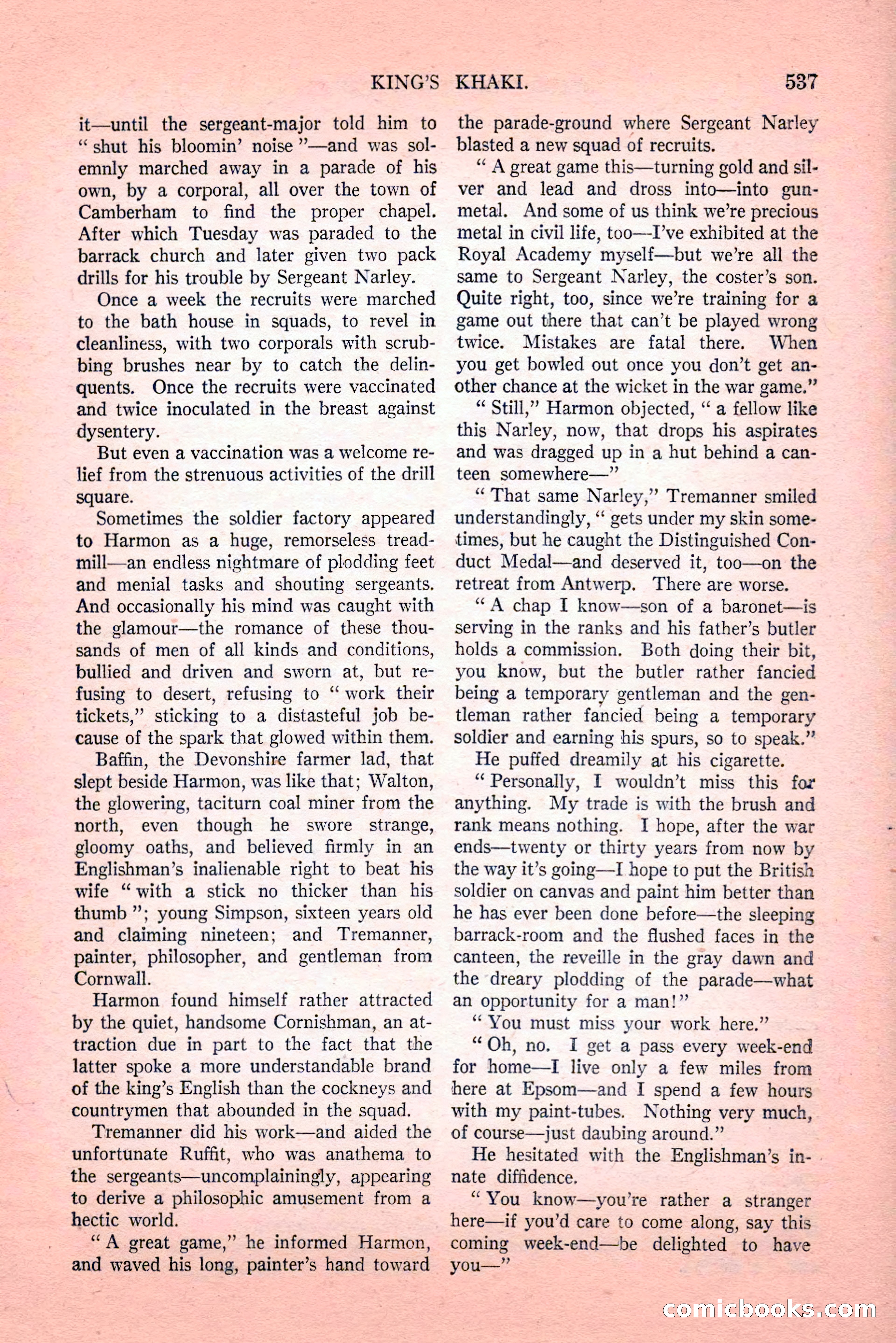
A restored page from Pulp Fiction, 1927. Page through the whole issue in the reader above.
📄 Transcribed text from this page (OCR, searchable)
Machine-transcribed from the original scan — historical spelling and the odd misread are preserved.
KING’S it—until the sergeant-major told him to “shut his bloomin’ noise ”—and was sol- emnly marched away in a parade of his own, by a corporal, all over the town of Camberham to find the proper chapel. After which Tuesday was paraded to the barrack church and later given two pack drills for his trouble by Sergeant Narley. Once a week the recruits were marched to the bath house in squads, to revel in cleanliness, with two corporals with scrub- bing brushes near by to catch the delin- quents. Once the recruits were vaccinated and twice inoculated in the breast against dysentery. But even a vaccination was a welcome re- lief from the strenuous activities of the drill square. Sometimes the soldier factory appeared to Harmon as a huge, remorseless tread- mill—an endless nightmare of plodding feet and menial tasks and shouting sergeants. And occasionally his mind was caught with the glamour—the romance of these thou- sands of men of all kinds and conditions, bullied and driven and sworn at, but re- fusing to desert, refusing to ‘‘ work their tickets,” sticking to a distasteful job be- cause of the spark that glowed within them. Baffin, the Devonshire farmer lad, that slept beside Harmon, was like that; Walton, the glowering, taciturn coal miner from the north, even though he swore strange, gloomy oaths, and believed firmly in an Englishman’s inalienable right to beat his wife “with a stick no thicker than his thumb ”; young Simpson, sixteen years old and claiming nineteen; and Tremanner, painter, philosopher, and gentleman from Cornwall. Harmon found himself rather attracted by the quiet, handsome Cornishman, an at- traction due in part to the fact that the latter spoke a more understandable brand of the king’s English than the cockneys and countrymen that abounded in the squad. Tremanner did his work—and aided the unfortunate Ruffit, who was anathema to the sergeants—uncomplainingly, appearing to derive a philosophic amusement from a hectic world. “A great game,” he informed Harmon, and waved his long, painter’s hand toward KHAKI, 537 the parade-ground where Sergeant Narley blasted a new squad of recruits. “A great game this—turning gold and sil- ver and lead and dross into—into gun- metal. And some of us think we’re precious metal in civil life, too—-I’ve exhibited at the Royal Academy myself—but we’re all the same to Sergeant Narley, the coster’s son. Quite right, too, since we’re training for a game out there that can’t be played wrong twice. Mistakes are fatal there. When you get bowled out once you don’t get an- other chance at the wicket in the war game.” * Still,” Harmon objected, ‘“ a fellow like this Narley, now, that drops his aspirates and was dragged up in a hut behind a can- teen somewhere—”’ “That same Narley,” Tremanner smiled understandingly, “‘ gets under my skin some- times, but he caught the Distinguished Con- duct Medal—and deserved it, too—on the retreat from Antwerp. There are worse. “A chap I know—son of a baronet—is serving in the ranks and his father’s butler holds a commission. Both doing their bit, you know, but the butler rather fancied being a temporary gentleman and the gen- tleman rather fancied being a temporary soldier and earning his spurs, so to speak.” He puffed dreamily at his cigarette. “Personally, I wouldn’t miss this foz anything. My trade is with the brush and rank means nothing. I hope, after the war ends—twenty or thirty years from now by the way it’s going—I hope to put the British soldier on canvas and paint him better than he has ever been done before—the sleeping barrack-room and the flushed faces in the canteen, the reveille in the gray dawn and the dreary plodding of the parade—what an opportunity for a man!” ‘You must miss your work here.” “Oh, no. I get a pass every week-end for home—TI live only a few miles from here at Epsom—and I spend a few hours with my paint-tubes. Nothing very much, of course—just daubing around.” He hesitated with the Englishman’s in- - nate diffidence. “You know—you’re rather a stranger here—if you’d care to come along, say this coming week-end—be delighted to have you—” Gomichbooks (EO)