
Pulp Fiction, 1927 · page 60 of 180
Argosy All-Story Weekly, Vol. 189, No. 4 — page 60: what you’re looking at
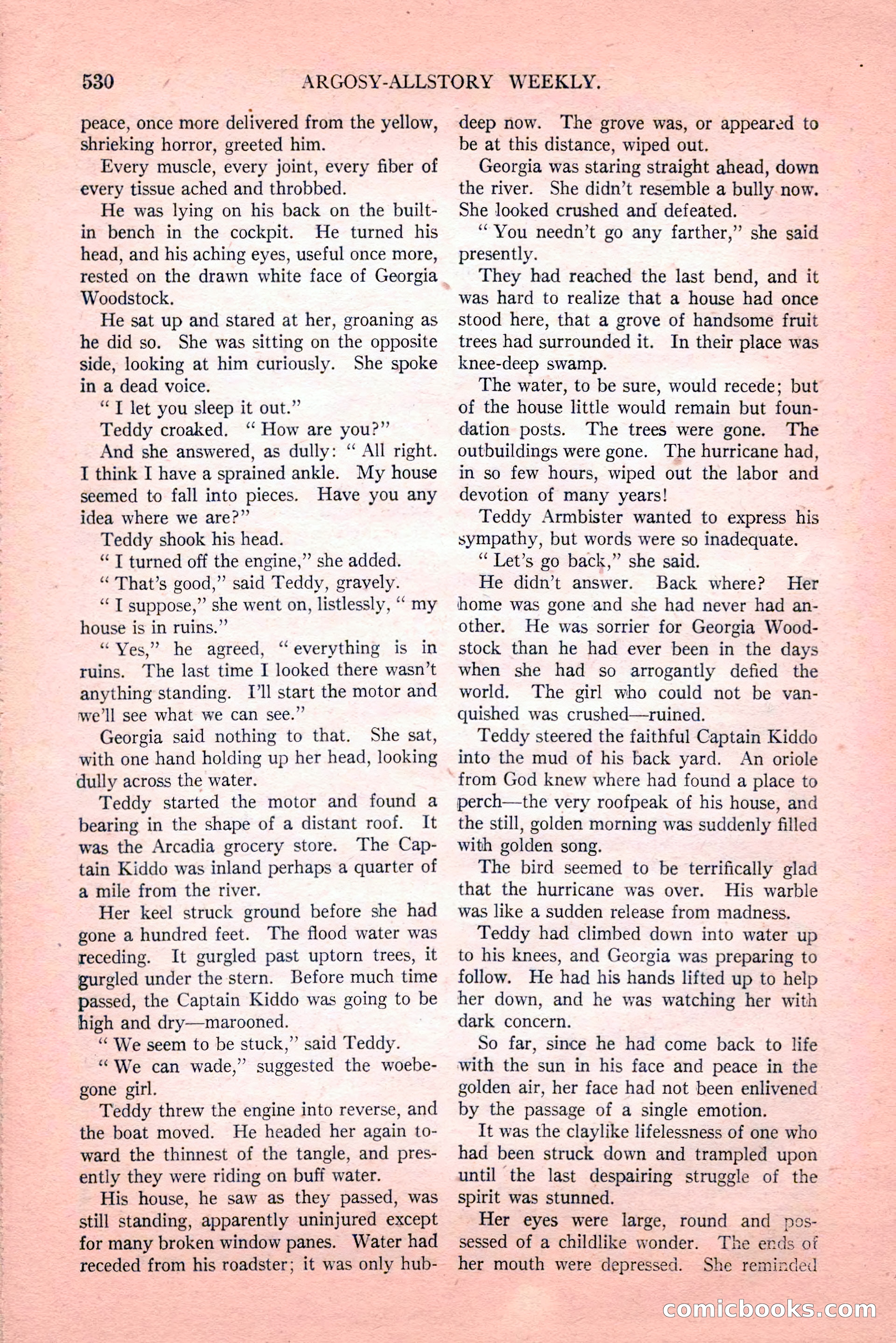
A restored page from Pulp Fiction, 1927. Page through the whole issue in the reader above.
📄 Transcribed text from this page (OCR, searchable)
Machine-transcribed from the original scan — historical spelling and the odd misread are preserved.
530 peace, once more delivered from the yellow, shrieking horror, greeted him. Every muscle, every joint, every fiber of every tissue ached and throbbed. He was lying on his back on the built- in bench in the cockpit. He turned his head, and his aching eyes, useful once more, rested on the drawn white face of Georgia Woodstock. He sat up and stared at her, groaning as he did so. She was sitting on the opposite side, looking at him curiously. She spoke in a dead voice. “T let you sleep it out.”’ Teddy croaked. ‘‘ How are you?” And she answered, as dully: “ All right. I think I have a sprained ankle. My house seemed to fall into pieces. Have you any idea where we are?” Teddy shook his head. “ T turned off the engine,” she added. “ That’s good,” said Teddy, gravely. ‘“T suppose,” she went on, listlessly, “ my house is in ruins.” “Ves,” he agreed, “everything is in ruins. The last time I looked there wasn’t anything standing. I'll start the motor and we'll see what we can see.” Georgia said nothing to that. She sat, with one hand holding up her head, looking dully across the water. Teddy started the motor and found a bearing in the shape of a distant roof. It was the Arcadia grocery store. The Cap- tain Kiddo was inland perhaps a quarter of a mile from the river. Her keel struck ground before she had gone a hundred feet. The flood water was receding. It gurgled past uptorn trees, it gurgled under the stern. Before much time passed, the Captain Kiddo was going to be high and dry—marooned. “We seem to be stuck,” said Teddy. “We can wade,” suggested the woebe- gone girl. Teddy threw the engine into reverse, and the boat moved. He headed her again to- ward the thinnest of the tangle, and pres- ently they were riding on buff water. His house, he saw as they passed, was still standing, apparently uninjured except for many broken window panes. Water had receded from his roadster; it was only hub- ARGOSY-ALLSTORY WEEKLY. deep now. The grove was, or appeared to be at this distance, wiped out. Georgia was staring straight ahead, down the river. She didn’t resemble a bully now. She looked crushed and defeated. “You needn’t go any farther,” she said presently. They had reached the last bend, and it was hard to realize that a house had once stood here, that a grove of handsome fruit trees had surrounded it. In their place was knee-deep swamp. The water, to be sure, would recede; but of the house little would remain but foun- dation posts. The trees were gone. The outbuildings were gone. The hurricane had, in so few hours, wiped out the labor and devotion of many years! Teddy Armbister wanted to express his sympathy, but words were so inadequate. “Let’s go back,” she said. He didn’t answer. Back where? Her home was gone and she had never had an- other. He was sorrier for Georgia Wood- stock than he had ever been in the days when she had so arrogantly defied the world. The girl who could not be van- quished was crushed—ruined. Teddy steered the faithful Captain Kiddo into the mud of his back yard. An oriole from God knew where had found a place to perch—the very roofpeak of his house, and the still, golden morning was suddenly filled with golden song. The bird seemed to be terrifically glad that the hurricane was over. His warble was like a sudden release from madness. Teddy had climbed down into water up to his knees, and Georgia was preparing to follow. He had his hands lifted up to help her down, and he was watching her with dark concern. So far, since he had come back to life with the sun in his face and peace in the golden air, her face had not been enlivened by the passage of a single emotion. It was the claylike lifelessness of one who had been struck down and trampled upon until the last despairing struggle of the spirit was stunned. Her eyes were large, round and pos- sessed of a childlike wonder. The ends of her mouth were depressed. She reminded (E(0) .DOOKS AMI (EO)