
Pulp Fiction, 1927 · page 57 of 180
Argosy All-Story Weekly, Vol. 189, No. 4 — page 57: what you’re looking at
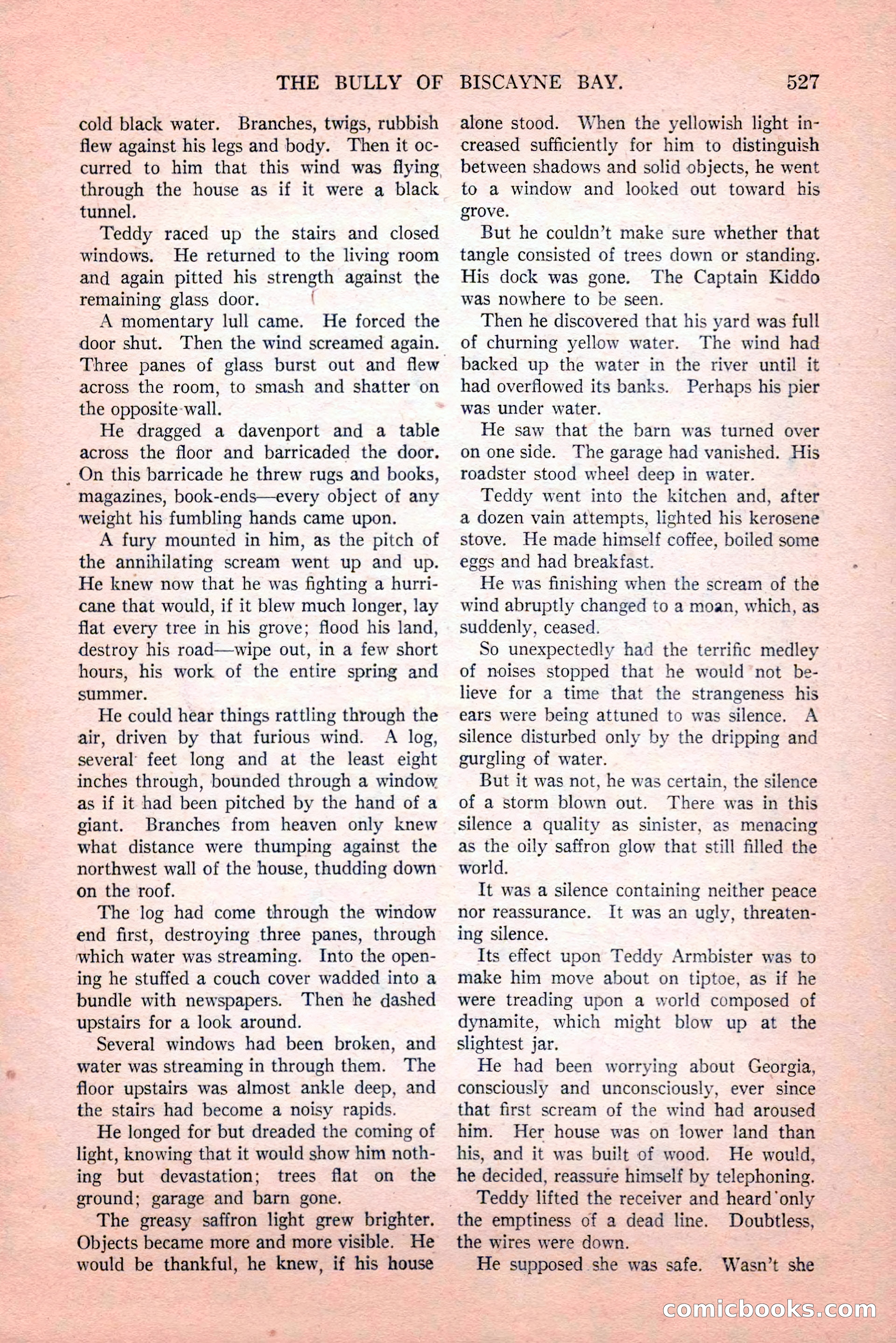
A restored page from Pulp Fiction, 1927. Page through the whole issue in the reader above.
📄 Transcribed text from this page (OCR, searchable)
Machine-transcribed from the original scan — historical spelling and the odd misread are preserved.
THE BULLY OF cold black water. Branches, twigs, rubbish flew against his legs and body. Then it oc- curred to him that this wind was flying through the house as if it were a black tunnel. Teddy raced up the stairs and closed windows. He returned to the living room and again pitted his strength against the remaining glass door. A momentary lull came. He forced the door shut. Then the wind screamed again. Three panes of glass burst out and flew across the room, to smash and shatter on the opposite-wall. He dragged a davenport and a table across the floor and barricaded the door. _ On this barricade he threw rugs and books, magazines, book-ends—every object of any weight his fumbling hands came upon. A fury mounted in him, as the pitch of the annihilating scream went up and up. He knew now that he was fighting a hurri- cane that would, if it blew much longer, lay flat every tree in his grove; flood his land, destroy his road—wipe out, in a few short hours, his work of the entire spring and summer. He could hear things rattling through the air, driven by that furious wind. A log, several’ feet long and at the least eight inches through, bounded through a window as if it had been pitched by the hand of a giant. Branches from heaven only knew what distance were thumping against the northwest wall of the house, thudding down on the roof. The log had come through the window end first, destroying three panes, through which water was streaming. Into the open- ing he stuffed a couch cover wadded into a bundle with newspapers. Then he dashed upstairs for a look around. Several windows had been broken, and water was streaming in through them. The floor upstairs was almost ankle deep, and the stairs had become a noisy rapids. He longed for but dreaded the coming of light, knowing that it would show him noth- ing but devastation; trees flat on the ground; garage and barn gone. The greasy saffron light grew brighter. Objects became more and more visible. He would be thankful, he knew, if his house BISCAYNE BAY. 527 alone stood. When the yellowish light in- creased sufficiently for him to distinguish between shadows and solid objects, he went to a window and looked out toward his grove. But he couldn’t make sure whether that tangle consisted of trees down or standing. His dock was gone. The Captain Kiddo was nowhere to be seen. Then he discovered that his yard was full of churning yellow water. The wind had backed up the water in the river until it had overflowed its banks. Perhaps his pier was under water. He saw that the barn was turned over on one side. The garage had vanished. His roadster stood wheel deep in water. Teddy went into the kitchen and, after a dozen vain attempts, lighted his kerosene stove. He made himself coffee, boiled some eges and had breakfast. He was finishing when the scream of the wind abruptly changed to a moan, which, as suddenly, ceased. So unexpectedly had the terrific medley of noises stopped that he would not be- lieve for a time that the strangeness his ears were being attuned to was silence. A silence disturbed only by the dripping and gurgling of water. But it was not, he was certain, the silence of a storm blown out. There was in this silence a quality as sinister, as menacing as the oily saffron glow that still filled the world. It was a silence containing neither peace nor reassurance. It was an ugly, threaten- ing silence. Its effect upon Teddy Armbister was to make him move about on tiptoe, as if he were treading upon a world composed of dynamite, which might blow up at the slightest jar. He had been worrying about Georgia, consciously and unconsciously, ever since that first scream of the wind had aroused him. Her house was on lower land than his, and it was built of wood. He would, he decided, reassure himself by telephoning. Teddy lifted the receiver and heard ‘only the emptiness of a dead line. Doubtless, the wires were down. He supposed she was safe. Wasn’t she Gomichooks (E@)