
Pulp Fiction, 1927 · page 55 of 180
Argosy All-Story Weekly, Vol. 189, No. 4 — page 55: what you’re looking at
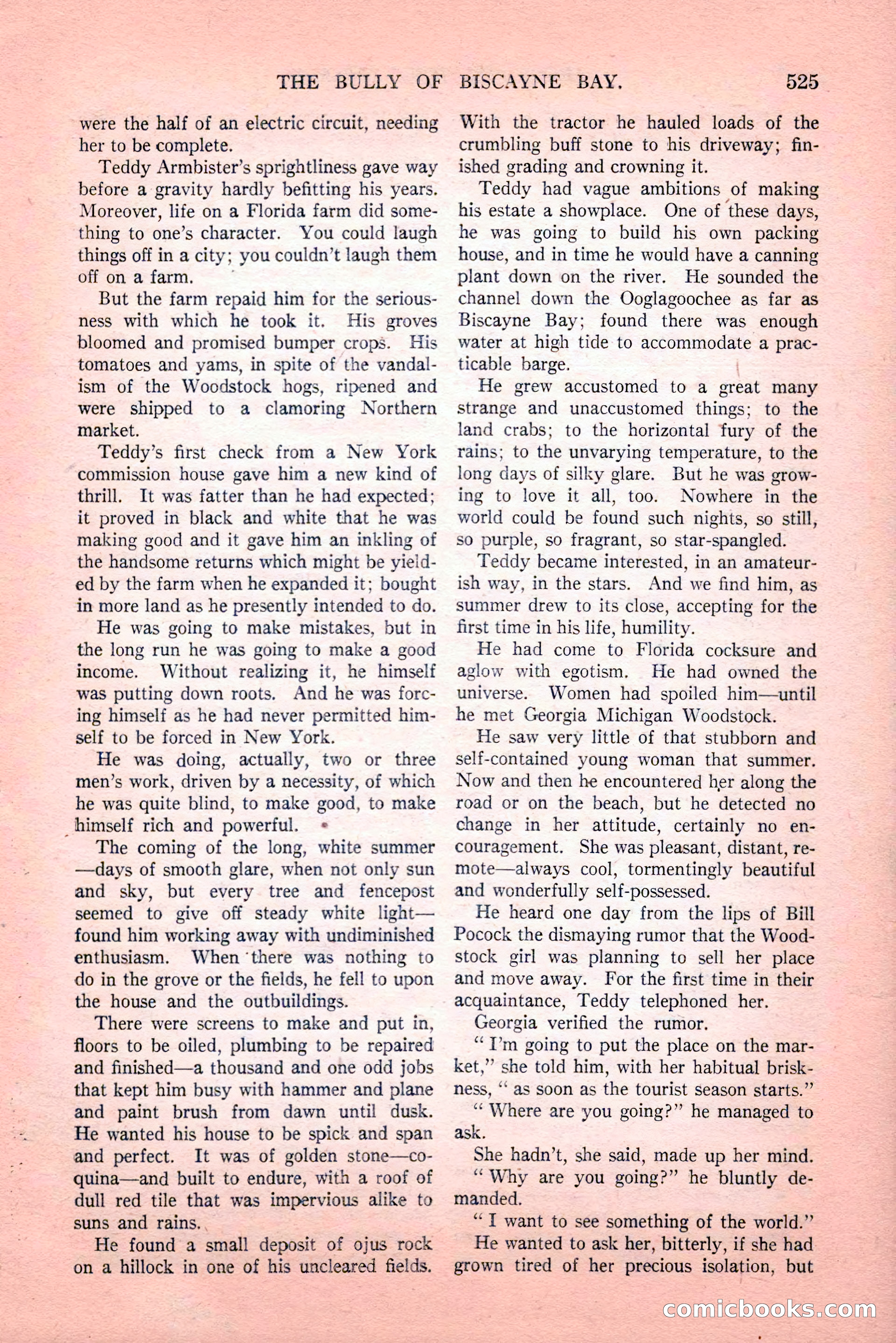
A restored page from Pulp Fiction, 1927. Page through the whole issue in the reader above.
📄 Transcribed text from this page (OCR, searchable)
Machine-transcribed from the original scan — historical spelling and the odd misread are preserved.
THE BULLY OF were the half of an electric circuit, needing her to be complete. Teddy Armbister’s sprightliness gave way before a gravity hardly befitting his years. Moreover, life on a Florida farm did some- thing to one’s character. You could laugh things off in a city; you couldn’t laugh them off on a farm. But the farm repaid him for the serious- ness with which he took it. His groves bloomed and promised bumper crops. His tomatoes and yams, in spite of the vandal- ism of the Woodstock hogs, ripened and were shipped to a clamoring Northern market. Teddy’s first check from a New York commission house gave him a new kind of thrill. It was fatter than he had expected; it proved in black and white that he was making good and it gave him an inkling of the handsome returns which might be yieild- ed by the farm when he expanded it; bought in more land as he presently intended to do. He was going to make mistakes, but in the long run he was going to make a good income. Without realizing it, he himself was putting down roots. And he was forc- ing himself as he had never permitted him- self to be forced in New York. He was doing, actually, two or three men’s work, driven by a necessity, of which he was quite blind, to make good, to make himself rich and powerful. The coming of the long, white summer —days of smooth glare, when not only sun and sky, but every tree and fencepost seemed to give off steady white light— found him working away with undiminished enthusiasm. When ‘there was nothing to do in the grove or the fields, he fell to upon the house and the outbuildings. There were screens to make and put in, floors to be oiled, plumbing to be repaired and finished—a thousand and one odd jobs that kept him busy with hammer and plane and paint brush from dawn until dusk. He wanted his house to be spick and span and perfect. It was of golden stone—co- quina—and built to endure, with a roof of dull red tile that was impervious alike to suns and rains. | He found a small deposit of ojus rock on a hillock in one of his uncleared fields. BISCAYNE BAY, With the tractor he hauled loads of the crumbling buff stone to his driveway; fin- ished grading and crowning it. Teddy had vague ambitions of making his estate a showplace. One of these days, he was going to build his own packing house, and in time he would have a canning plant down on the river. He sounded the channel down the Ooglagoochee as far as Biscayne Bay; found there was enough water at high tide to accommodate a prac- ticable barge. He grew accustomed to a oreat many strange and unaccustomed chines: to the land crabs; to the horizontal fury of the rains; to the unvarying temperature, to the long days of silky glare. But he was grow- ing to love it all, too. Nowhere in the world could be found such nights, so still, so purple, so fragrant, so star-spangled. Teddy became interested, in an amateur- ish way, in the stars. And we find him, as summer drew to its close, accepting for the first time in his life, humility. He had come to Florida cocksure and aglow with egotism. He had owned the universe. Women had spoiled him—until he met Georgia Michigan Woodstock. He saw very little of that stubborn and self-contained young woman that summer. Now and then he encountered her along the road or on the beach, but he detected no change in her attitude, certainly no en- couragement. She was pleasant, distant, re- mote—always cool, tormentingly beautiful and wonderfully self-possessed. He heard one day from the lips of Bill Pocock the dismaying rumor that the Wood- stock girl was planning to sell her place and move away. For the first time in their acquaintance, Teddy telephoned her. Georgia verified the rumor. “T’m going to put the place on the mar- ket,’”’ she told him, with her habitual brisk- ness, ‘‘ as soon as the tourist season starts.” ‘Where are you going?” he managed to ask. She hadn’t, she said, made up her mind. ‘Why are you going?” he bluntly de- manded. ‘““T want to see something of the world.” He wanted to ask her, bitterly, if she had grown tired of her precious isolation, but Gomichbooks 525 (E(@)