
Pulp Fiction, 1927 · page 91 of 168
Argosy All-Story Weekly, February 12, 1927 — page 91: what you’re looking at
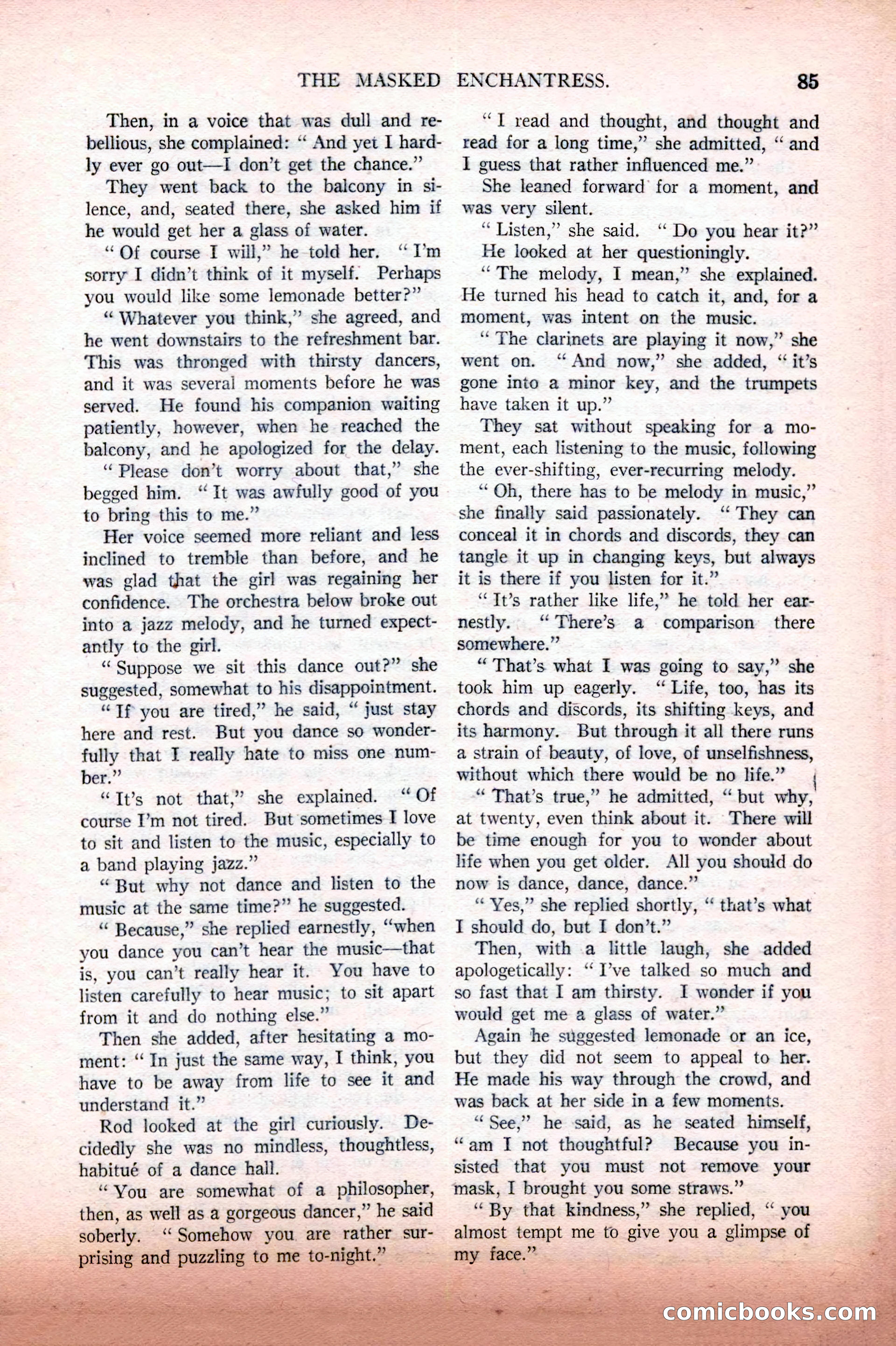
A restored page from Pulp Fiction, 1927. Page through the whole issue in the reader above.
📄 Transcribed text from this page (OCR, searchable)
Machine-transcribed from the original scan — historical spelling and the odd misread are preserved.
THE MASKED Then, in a voice that was dull and re- bellious, she complained: “‘ And yet I hard- ly ever go out—lI don’t get the chance.” They went back to the balcony in si- lence, and, seated there, she asked him if he would get her a glass of water. “Of course I will,” he told her. ‘“ I’m sorry I didn’t think of it myself. Perhaps you would like some lemonade better?” “ Whatever you think,” she agreed, and he went downstairs to the refreshment bar. This was thronged with thirsty dancers, and it was several moments before he was served. He found his companion waiting patiently, however, when he reached the balcony, and he apologized for the delay. “Please don’t worry about that,” she begged him. “It was awfully good of you to bring this to me.” Her voice seemed more reliant and less inclined to tremble than before, and he was glad that the girl was regaining her confidence. The orchestra below broke out into a jazz melody, and he turned expect- antly to the girl. “Suppose we sit this dance out?” she suggested, somewhat to his disappointment. “Tf you are tired,” he said, “ just stay here and rest. But you dance so wonder- fully that I really hate to miss one num- ber.” “Tt’s not that,” she explained. “Of course I’m not tired. But sometimes I love to sit and listen to the music, especially to a band playing jazz.” “But why not dance and listen to the music at the same time?” he suggested. “ Because,” she replied earnestly, “when you dance you can’t hear the music—that is, you can’t really hear it. You have to listen carefully to hear music; to sit apart from it and do nothing else.” Then she added, after hesitating a mo- ment: ‘In just the same way, I think, you have to be away from life to see it and understand it.” Rod looked at the girl curiously. De- cidedly she was no mindless, thoughtless, habitué of a dance hall. “You are somewhat of a philosopher, then, as well as a gorgeous dancer,” he said op eee you. are Badese sur- ENCHANTRESS. 85 ‘I read and thought, and thought and read for a long time,” she admitted, “‘ and I guess that rather influenced me.” She leaned forward for a moment, and was very silent. “ Listen,” she said. ‘“ Do you hear it?” He looked at her questioningly. “The melody, I mean,” she explained. He turned his head to catch it, and, for a moment, was intent on the music. ‘The clarinets are playing it now,” she went on. “And now,” she added, “it’s gone into a minor key, and the trumpets have taken it up.” They sat without speaking for a mo- ment, each listening to the music, following the ever-shifting, ever-recurring melody. “Oh, there has to be melody in music,” she finally said passionately. ‘“ They can conceal it in chords and discords, they can tangle it up in changing keys, but always it is there if you listen for it.” “It’s rather like life,” he told her ear- nestly. “ There’s a comparison there somewhere.” “That’s what I was going to say,” she took him up eagerly. “ Life, too, has its chords and discords, its shifting keys, and its harmony. But through it all there runs a strain of beauty, of love, of unselfishness, without which there would be no life.” “ That’s true,” he admitted, “but why, at twenty, even think about it. There will be time enough for you to wonder about life when you get older. All you should do now is dance, dance, dance.” “ Yes.” she replied shortly, “ that’s what IT should do, but I don’t.” Then, with a little laugh, she added apologetically: “‘ I’ve talked so much and so fast that I am thirsty. I wonder if you would get me a glass of water.” Again he suggested lemonade or an ice, but they did not seem to appeal to her. He made his way through the crowd, and was back at her side in a few moments. “See,” he said, as he seated himself, “am I not thoughtful? Because you in- sisted that you must not remove your mask, I brought you some straws.” “ By that kindness,” she replied, “ you almost ser me to eve: you a aves > a comicbooks.com