
Pulp Fiction, 1927 · page 8 of 168
Argosy All-Story Weekly, February 12, 1927 — page 8: what you’re looking at
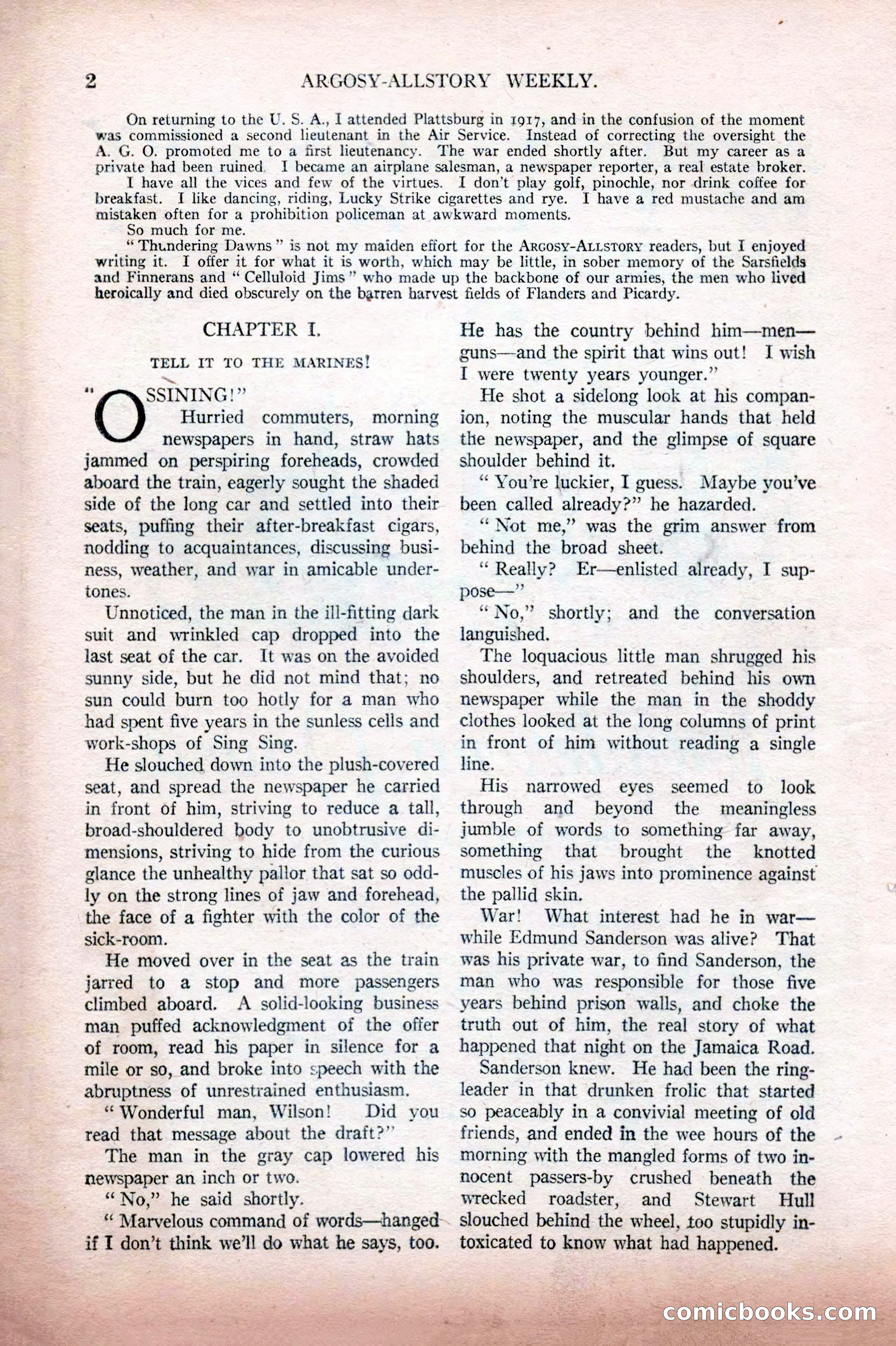
A restored page from Pulp Fiction, 1927. Page through the whole issue in the reader above.
📄 Transcribed text from this page (OCR, searchable)
Machine-transcribed from the original scan — historical spelling and the odd misread are preserved.
2 ARGOSY-ALLSTORY WEEKLY. On returning to the U. S. A., I attended Plattsburg in 1917, and in the confusion of the moment was commissioned a second lieutenant in the Air Service. The war ended shortly after. A. G. O. promoted me to a first lieutenancy. Instead of correcting the oversight the But my career as a private had been ruined. I became an airplane salesman, a newspaper reporter, a real estate broker. I have all the vices and few of the virtues. breakfast. I don’t play golf, pinochle, nor drink coffee for I like dancing, riding, Lucky Strike cigarettes and rye. I have a red mustache and am mistaken often for a prohibition policeman at awkward moments. So much for me. “ Thundering Dawns ” is not my maiden effort for the Arcosy-ALLsTory readers, but I enjoyed writing it. I offer it for what it is worth, which may be little, in sober memory of the Sarsfields and Finnerans and “ Celluloid Jims”? who made up the backbone of our armies, the men who lived heroically and died obscurely on the barren harvest fields of Flanders and Picardy. CHAPTER [f, TELL IT TO THE MARINES! > SSINING!”’ () Hurried commuters, morning newspapers in hand, straw hats jammed on perspiring foreheads, crowded aboard the train, eagerly sought the shaded side of the long car and settled into their seats, puffing their after-breakfast cigars, nodding to acquaintances, discussing busi- ness, weather, and war in amicable under- tones. Unnoticed, the man in the ill-fitting dark suit and wrinkled cap dropped into the last seat of the car. It was on the avoided sunny side, but he did not mind that; no sun could burn too hotly for a man who had spent five years in the sunless cells and work-shops of Sing Sing. He slouched down into the plush-covered seat, and spread the newspaper he carried in front of him, striving to reduce a tall, broad-shouldered body to unobtrusive di- mensions, striving to hide from the curious glance the unhealthy pallor that sat so odd- ly on the strong lines of jaw and forehead, the face of a fighter with the color of the sick-room. He moved over in the seat as the train jarred to a stop and more passengers climbed aboard. A solid-looking business man puffed acknowledgment of the offer of room, read his paper in silence for a mile or so, and broke into speech with the abruptness of unrestrained enthusiasm. “Wonderful man, Wilson! Did you read that message about the draft?” The man in the gray cap lowered his newspaper an inch or two. “No,” he said shortly. * Marvelous command of words—hanged- if I don’t think we’ll do what he says, too. He has the country behind him—men— guns—and the spirit that wins out! I wish [ were twenty years younger.”’ He shot a sidelong look at his compan- ion, noting the muscular hands that held the newspaper, and the glimpse of square shoulder behind it. “ Youre luckier, I guess. Maybe you’ve been called already?” he hazarded. ‘““Not me,” was the grim answer from behind the broad sheet. “Really? Er—enlisted already, I sup- pose—” “No,” shortly; and the conversation languished. | The loquacious little man shrugged his shoulders, and retreated behind his own newspaper while the man in the shoddy clothes looked at the long columns of print in front of him without reading a single line. His narrowed eyes seemed to look through and beyond the meaningless jumble of words to something far away, something that brought the knotted muscles of his jaws into prominence against the pallid skin. War! What interest had he in war— while Edmund Sanderson was alive? That was his private war, to find Sanderson, the man who was responsible for those five years behind prison walls, and choke the truth out of him, the real story of what happened that night on the Jamaica Road. Sanderson knew. He had been the ring- leader in that drunken frolic that started so peaceably in a convivial meeting of old friends, and ended in the wee hours of the morning with the mangled forms of two in- nocent passers-by crushed beneath the wrecked roadster, and Stewart Hull slouched behind the wheel, too stupidly in- toxicated to know what had happened.