
Pulp Fiction, 1927 · page 78 of 168
Argosy All-Story Weekly, February 12, 1927 — page 78: what you’re looking at
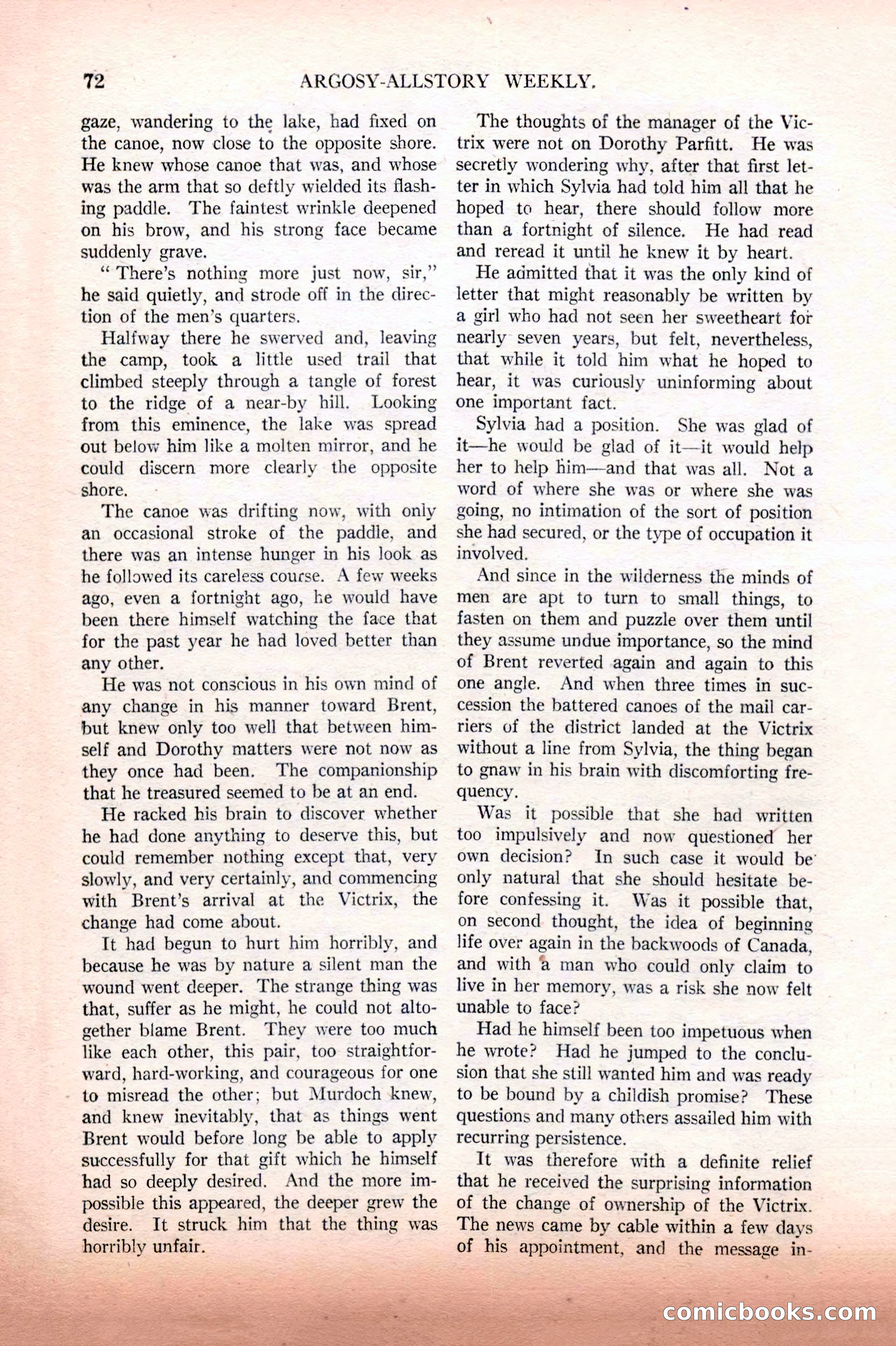
A restored page from Pulp Fiction, 1927. Page through the whole issue in the reader above.
📄 Transcribed text from this page (OCR, searchable)
Machine-transcribed from the original scan — historical spelling and the odd misread are preserved.
ey geri Se ee eo - to misread the other; a aes, Sao ox 72 gaze, wandering to the lake, had fixed on the canoe, now close to the opposite shore. He knew whose canoe that was, and whose was the arm that so deftly wielded its flash- ing paddle. The faintest wrinkle deepened on his brow, and his strong face became suddenly grave. “There’s nothing more just now, sir,” he said quietly, and strode off in the direc- tion of the men’s quarters. Halfway there he swerved and, leaving the camp, took a little used trail that climbed steeply through a tangle of forest to the ridge of a near-by hill. Looking from this eminence, the lake was spread out below him like a molten mirror, and he could discern more clearly the opposite shore. The canoe was drifting now, with only an occasional stroke of the paddle, and there was an intense hunger in his look as he followed its careless course. A few weeks ago, even a fortnight ago, he would have been there himself watching the face that for the past year he had loved better than any other. He was not conscious in his own mind of any change in his manner toward Brent, but knew only too well that between him- self and Dorothy matters were not now as they once had been. The companionship that he treasured seemed to be at an end. He racked his brain to discover whether he had done anything to deserve this, but could remember nothing except that, very slowly, and very certainly, and commencing with Brent’s arrival at the Victrix, the change had come about. It had begun to hurt him horribly, and because he was by nature a silent man the wound went deeper. The strange thing was that, suffer as he might, he could not alto- gether blame Brent. They were too much like each other, this pair, too straightfor- ward, hard-working, and courageous for one but Murdoch knew, and knew inevitably, that as things went Brent would before long be able to apply successfully for that gift which he himself had so deeply desired. And the more im- possible this appeared, the deeper grew the desire. It struck him that the thing was horribly unfair. aes Fie fea rs —— of Bs Peds and. ie es in- . Nae ne eed =~ ~— ~~ a > - Sees =< Ste pe Peet > ARGOSY-ALLSTORY WEEKLY, The thoughts of the manager of the Vic- trix were not on Dorothy Parfitt. He was secretly wondering why, after that first let- ter in which Sylvia had told him all that he hoped to hear, there should follow more than a fortnight of silence. He had read and reread it until he knew it by heart. He admitted that it was the only kind of letter that might reasonably be written by a girl who had not seen her sweetheart for nearly seven years, but felt, nevertheless, that while it told him what he hoped to hear, it was curiously uninforming about one important fact. Sylvia had a position. She was glad of it—he would be glad of it—it would help her to help him—and that was all. Not a word of where she was or where she was going, no intimation of the sort of position she had secured, or the type of occupation it involved. And since in the wilderness the minds of men are apt to turn to small things, to fasten on them and puzzle over them until they assume undue importance, so the mind of Brent reverted again and again to this one angle. And when three times in suc- cession the battered canoes of the mail car- riers of the district landed at the Victrix without a line from Sylvia, the thing began to gnaw in his brain with discomforting fre- quency. Was it possible that she had written too impulsively and now questioned her own decision? In such case it would be’ only natural that she should hesitate be- fore confessing it. Was it possible that, on second thought, the idea of beginning life over again in the backwoods of Canada, and with 4 man who could only claim to live in her memory, was a risk she now felt unable to face? Had he himself been too impetuous when he wrote? Had he jumped to the conclu- sion that she still wanted him and was ready to be bound by a childish promise? These questions and many others assailed him with recurring persistence. It was therefore with a definite relief that he received the surprising information of the change of ownership of the Victrix. The news came by cable within a few days TORIC ODE COT