
Pulp Fiction, 1927 · page 66 of 168
Argosy All-Story Weekly, February 12, 1927 — page 66: what you’re looking at
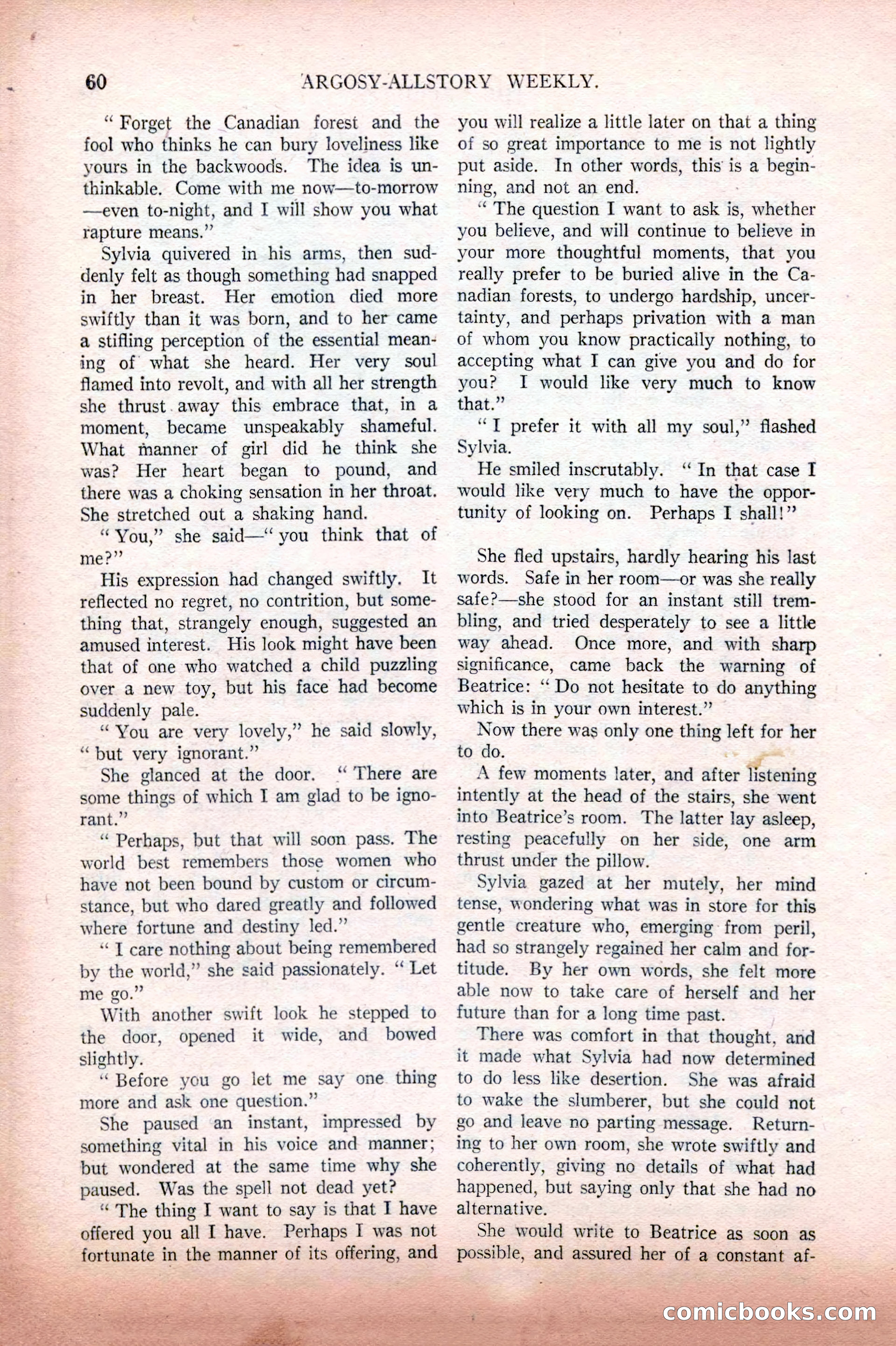
A restored page from Pulp Fiction, 1927. Page through the whole issue in the reader above.
📄 Transcribed text from this page (OCR, searchable)
Machine-transcribed from the original scan — historical spelling and the odd misread are preserved.
60 ARGOSY-ALLSTORY WEEKLY. “Forget the Canadian forest and the fool who thinks he can bury loveliness like yours in the backwoods. The idea is un- thinkable. Come with me now—to-morrow —even to-night, and I will show you what rapture means,” Sylvia quivered in his arms, then sud- denly felt as though something had snapped in her breast. Her emotion died more swiftly than it was born, and to her came a stifling perception of the essential mean- ing of what she heard. Her very soul flamed into revolt, and with all her strength she thrust. away this embrace that, in a moment, became unspeakably shameful. What manner of girl did he think she was? Her heart began to pound, and there was a choking sensation in her throat. She stretched out a shaking hand. “Vou,” she said—‘ you think that of me?” His expression had changed swiftly. It reflected no regret, no contrition, but some- thing that, strangely enough, suggested an amused interest. His look might have been that of one who watched a child puzzling over a new toy, but his face had become suddenly pale. “Vou are very lovely,” he said slowly, “but very ignorant.” She glanced at the door. “ There are some things of which I am glad to be igno- rant.” “ Perhaps, but that will soon pass. The world best remembers those women who have not been bound by custom or circum- stance, but who dared greatly and followed where fortune and destiny led.” “ T care nothing about being remembered by the world,” she said passionately. “ Let me go.” With another swift look he stepped to the door, opened it wide, and bowed slightly. “Before you go let me say one thing more and ask one question.” She paused an instant, impressed by something vital in his voice and manner; but wondered at the same time why she paused. Was the spell not dead yet? “ The thing I want to say is that I have offered you all I have. Perhaps I was not oe x eoeranste in the manner of its see. = ‘ _—~ . ae ie a5 es =i ee a me > =! ; et ed ——- ih ae ee eS eee eee ; a 5 > st ie 3 ee s > AS F “. a reg £. <n 2 you will realize a little later on that a thing of so great importance to me is not lightly put aside. In other words, this is a begin- ning, and not an end. “The question I want to ask is, whether you believe, and will continue to believe in your more thoughtful moments, that you really prefer to be buried alive in the Ca- nadian forests, to undergo hardship, uncer- tainty, and perhaps privation with a man of whom you know practically nothing, to accepting what I can give you and do for you? I would like very much to know that.” “IT prefer it with all my soul,” flashed Sylvia. He smiled inscrutably. “In that case I would like very much to have the oppor- tunity of looking on. Perhaps I shall!” She fled upstairs, hardly hearing his last words. Safe in her room—or was she really safe?—she stood for an instant still trem- bling, and tried desperately to see a little way ahead. Once more, and with sharp significance, came back the warning of Beatrice: “ Do not hesitate to do anything which is in your own interest.” Now there was only one thing left for her to do. - A few moments later, and after istening intently at the head of the stairs, she went into Beatrice’s room. The latter lay asleep, resting peacefully on her side, one arm thrust under the pillow. Sylvia gazed at her mutely, her mind tense, wondering what was in store for this gentle creature who, emerging from peril, had so strangely regained her calm and for- titude. By her own words, she felt more able now to take care of herself and her future than for a long time past. There was comfort in that thought, and it made what Sylvia had now determined to do less like desertion. She was afraid to wake the slumberer, but she could not go and leave no parting message. Return- ing to her own room, she wrote swiftly and coherently, giving no details of what had happened, but saying only that she had no alternative. She would write to Beatrice as soon as passe: and assured her ot a constant af- SS Ecomicbooke. com