
Pulp Fiction, 1927 · page 43 of 168
Argosy All-Story Weekly, February 12, 1927 — page 43: what you’re looking at
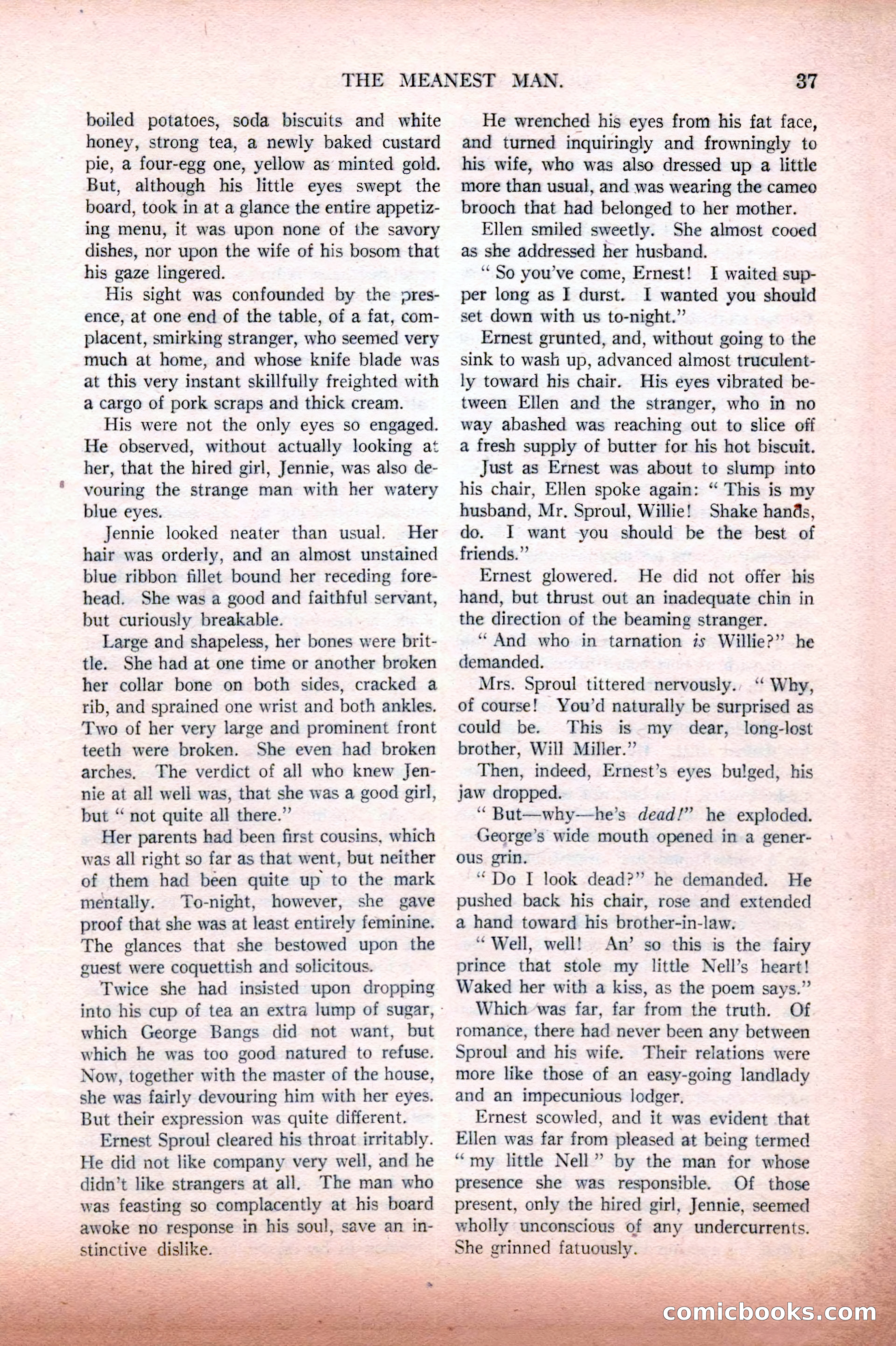
A restored page from Pulp Fiction, 1927. Page through the whole issue in the reader above.
📄 Transcribed text from this page (OCR, searchable)
Machine-transcribed from the original scan — historical spelling and the odd misread are preserved.
re ee _ o> is . Se a ae: ae * neil a = % We ae ee ae -_ ae > arn THE boiled potatoes, soda biscuits and white honey, strong tea, a newly baked custard pie, a four-egg one, yellow as minted gold. But, although his little eyes swept the board, took in at a glance the entire appetiz- ing menu, it was upon none of the savory dishes, nor upon the wife of his bosom that his gaze lingered. His sight was confounded by the pres- ence, at one end of the table, of a fat, com- placent, smirking stranger, who seemed very much at home, and whose knife blade was at this very instant skillfully freighted with a cargo of pork scraps and thick cream. His were not the only eyes so engaged. He observed, without actually looking at her, that the hired girl, Jennie, was also de- vouring the strange man with her watery blue eyes. Jennie looked neater than usual. Her hair was orderly, and an almost unstained blue ribbon fillet bound her receding fore- head. She was a good and faithful servant, but curiously breakable. Large and shapeless, her bones were brit- tle. She had at one time or another broken her collar bone on both sides, cracked a rib, and sprained one wrist and both ankles. Two of her very large and prominent front teeth were broken. She even had broken arches. The verdict of all who knew Jen- nie at all well was, that she was a good girl, but “ not quite all there.” Her parents had been first cousins, which was all right so far as that went, but neither of them had been quite up to the mark mentally. To-night, however, she gave proof that she was at least entirely feminine. The glances that she bestowed upon the suest were coquettish and solicitous. Twice she had insisted upon dropping into his cup of tea an extra lump of sugar, - which George Bangs did not want, but which he was too good natured to refuse. Now, together with the master of the house, she was fairly devouring him with her eyes. But their expression was quite different. Ernest Sproul cleared his throat irritably. He did not like company very well, and he didn’t like strangers at all. The man who was feasting so complacently at his board awoke no response in his soul, save an in- stinctive dislike. : a >i az “Ft 7 - . eae <a E> sages ag ee e — Sees a nd MEANEST MAN. She ia iatusialy. 37 He wrenched his eyes from his fat face, and turned inquiringly and frowningly to his wife, who was also dressed up a little more than usual, and was wearing the cameo brooch that had belonged to her mother. Ellen smiled sweetly. She almost cooed as she addressed her husband. ‘So you’ve come, Ernest! I waited sup- per long as | durst. I wanted you should set down with us to-night.” Ernest grunted, and, without going to the sink to wash up, advanced almost truculent- ly toward his chair. His eyes vibrated be- tween Ellen and the stranger, who in no way abashed was reaching out to slice off a fresh supply of butter for his hot biscuit. Just as Ernest was about to slump into his chair, Ellen spoke again: “ This is my husband, Mr. Sproul, Willie! Shake hands, do. JI want you should be the best of friends.” Ernest glowered. He did not offer his hand, but thrust out an inadequate chin in the direction of the beaming stranger. ‘““And who in tarnation is Willie?” he demanded. Mrs. Sproul tittered nervously., ‘“‘ Why, of course! You'd naturally be surprised as could be. This is my dear, long-lost brother, Will Miller.” Then, indeed, Ernest’s eyes bulged, his jaw dropped. ‘““ But—why—he’s dead!” he exploded. George’s wide mouth opened in a gener- ous grin. “Do I look dead?” he demanded. He pushed back his chair, rose and extended a hand toward his brother-in-law. ‘Well, well! An’ so this is the fairy prince that stole my little Nell’s heart! Waked her with a kiss, as the poem says.” Which was far, far from the truth. Of romance, there had never been any between Sproul and his wife. Their relations were more like those of an easy-going landlady and an impecunious lodger, Ernest scowled, and it was evident that Ellen was far from pleased at being termed “my littl Nell” by the man for whose presence she was responsible. Of those present, only the hired girl, Jennie, seemed wholly unconscious of any undercurrents. Etiacs poe: aoe Sea es a Se = nl eo ‘ a OTEDOOK. com