
Pulp Fiction, 1927 · page 19 of 168
Argosy All-Story Weekly, February 12, 1927 — page 19: what you’re looking at
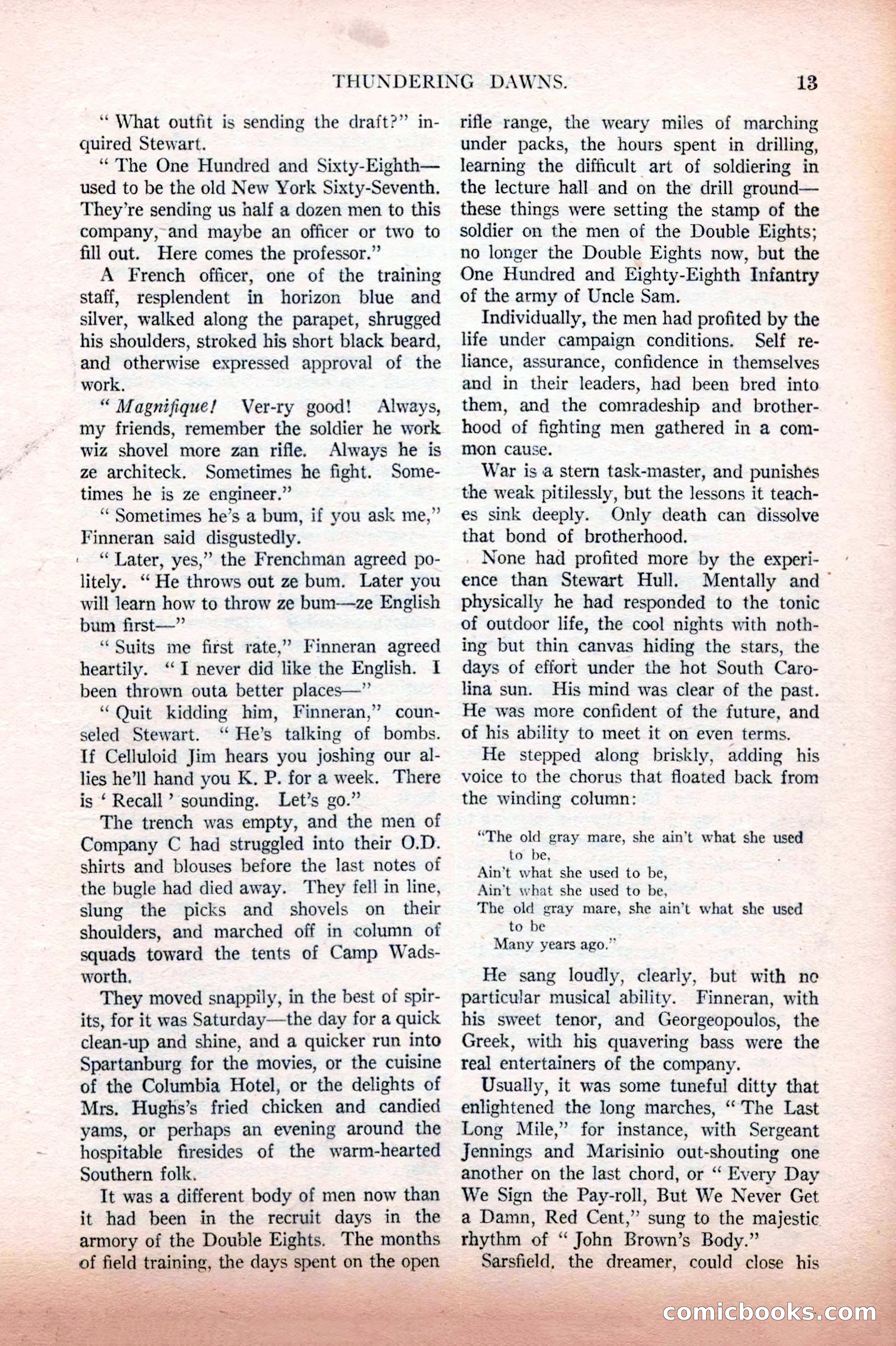
A restored page from Pulp Fiction, 1927. Page through the whole issue in the reader above.
📄 Transcribed text from this page (OCR, searchable)
Machine-transcribed from the original scan — historical spelling and the odd misread are preserved.
ee See ; = s . . Bs g —s co Fae are 3 = me THUNDERING DAWNS. 13 “What outfit is sending the draft?” in- quired Stewart. “The One Hundred and Sixty-Eighth— used to be the old New York Sixty-Seventh, They’re sending us half a dozen men to this company, and maybe an officer or two to fill out. Here comes the professor.” A French officer, one of the training staff, resplendent in horizon blue and silver, walked along the parapet, shrugged his shoulders, stroked his short black beard, and otherwise expressed approval of the work. “ Magnifique! Ver-ry good! Always, my friends, remember the soldier he work wiz shovel more zan rifle. Always he is ze architeck. Sometimes he fight. Some- times he is ze engineer.” ‘“‘ Sometimes he’s a bum, if you ask me,” Finneran said disgustedly. “Later, yes,” the Frenchman agreed po- litely. “‘ He throws out ze bum. Later you will learn how to throw ze bum—ze English bum first—”’ ‘Suits me first rate,” Finneran agreed heartily. “I never did like the English. I been thrown outa better places—” “ Quit kidding him, Finneran,” coun- seled Stewart. ‘‘ He’s talking of bombs. If Celluloid Jim hears you joshing our al- lies he’ll hand you K. P. for a week. There is ‘ Recall’ sounding. Let’s go.” The trench was empty, and the men of Company C had struggled into their O.D. shirts and blouses before the last notes of the bugle had died away. They fell in line, slung the picks and shovels on_ their shoulders, and marched off in column of squads toward the tents of Camp Wads- worth. They moved snappily, in the best of spir- its, for it was Saturday—the day for a quick clean-up and shine, and a quicker run into Spartanburg for the movies, or the cuisine of the Columbia Hotel, or the delights of Mrs. Hughs’s fried chicken and candied yams, or perhaps an evening around the hospitable firesides of the warm-hearted Southern folk. It was a different body of men now than it had been in the recruit days in the armory of the Double Eights. The months of field Lsaining, the ee Be < on n the ee — , ~ 4 ——— ~ Pe . ~~ =<, ra , aay =. : - - = —_ ‘2 ae Mees == 36a , SS lS Ain Sai ED ange eg PO ete a PP SS Saee ee ee at - rifle range, the weary miles of marching under packs, the hours spent in drilling, learning the difficult art of soldiering in the lecture hall and on the drill ground— these things were setting the stamp of the soldier on the men of the Double Eights; no longer the Double Eights now, but the One Hundred and Eighty-Eighth Infantry of the army of Uncle Sam. Individually, the men had profited by the life under campaign conditions. Self re- liance, assurance, confidence in themselves and in their leaders, had been bred into them, and the comradeship and _ brother- hood of fighting men gathered in a com- mon cause. War is a stern task-master, and punishes the weak pitilessly, but the lessons it teach- es sink deeply. Only death can dissolve that bond of brotherhood. None had profited more by the experi- ence than Stewart Hull. physically he had responded to the tonic of outdoor life, the cool nights with noth- ing but thin canvas hiding the stars, the days of effort under the hot South Caro- lina sun. His mind was clear of the past. He was more confident of the future, and of his ability to meet it on even terms. He stepped along briskly, adding his voice to the chorus that floated back from the winding column: “The old gray mare, she ain’t what she used to be, é Ain’t what she used to be, Ain't what she used to be, The old gray mare, she ain’t what she used to be Many years ago.” He sang loudly, clearly, but with ne particular musical ability. Finneran, with his sweet tenor, and Georgeopoulos, the Greek, with his quavering bass were the real entertainers of the company. Usually, it was some tuneful ditty that enlightened the long marches, “The Last Long Mile,” for instance, with Sergeant Jennings and Marisinio out-shouting one another on the last chord, or “ Every Day We Sign the Pay-roll, But We Never Get a Damn, Red Cent,” sung to the majestic rhythm of “ John Brown’s Body.” Sarsfield, the dreamer, could close his i —— . = —— oe 55>: - 0) © @ WJ Mentally and ~ oe et I ee ee ry