
Pulp Fiction, 1927 · page 121 of 168
Argosy All-Story Weekly, February 12, 1927 — page 121: what you’re looking at
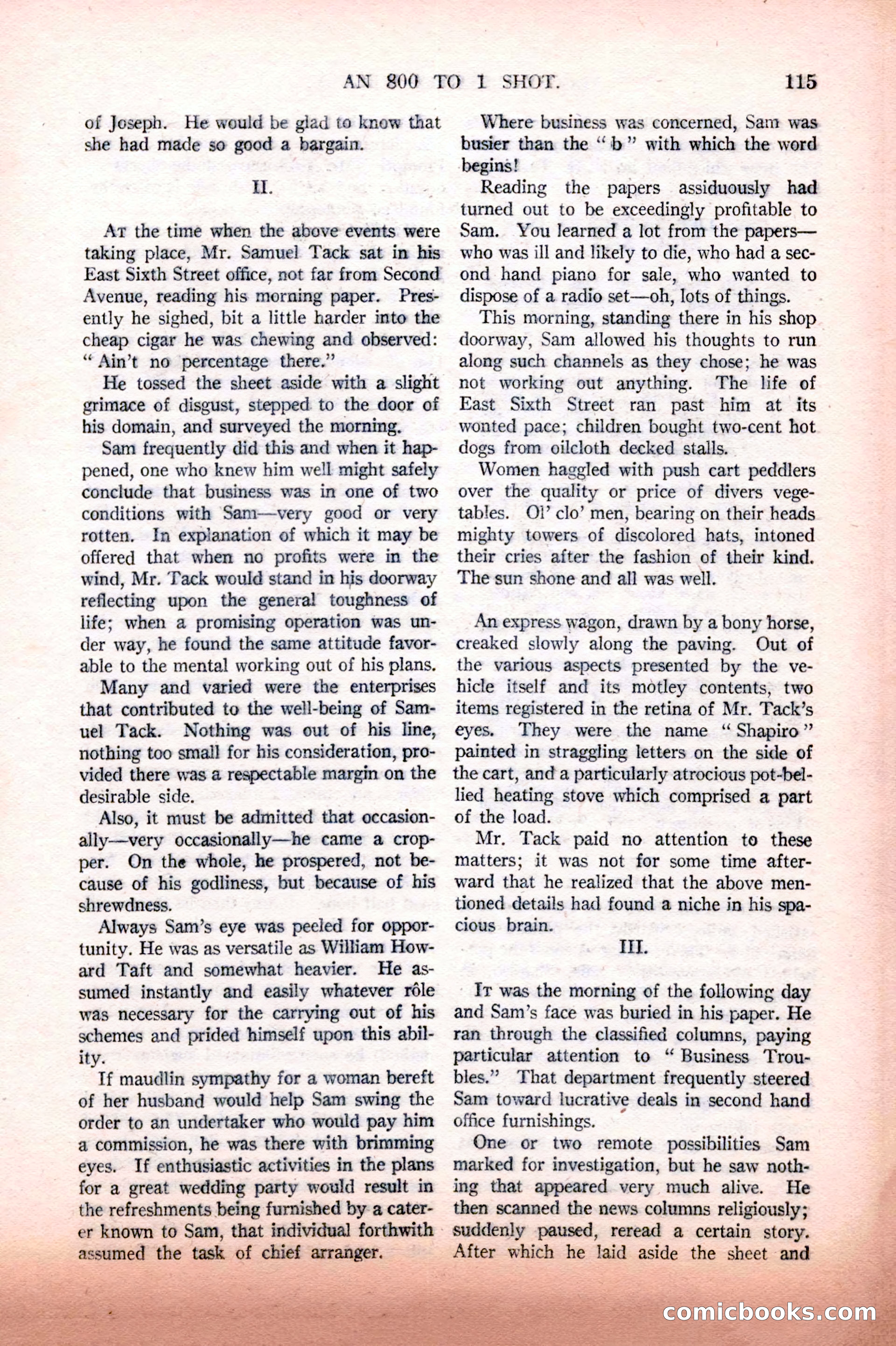
A restored page from Pulp Fiction, 1927. Page through the whole issue in the reader above.
📄 Transcribed text from this page (OCR, searchable)
Machine-transcribed from the original scan — historical spelling and the odd misread are preserved.
AN 800 TO 1 of Joseph. He would be glad to know that she had made so good a bargain. II. Art the time when the above events were taking place, Mr. Samuel Tack sat in his East Sixth Street office, not far from Second Avenue, reading his morning paper. Pres- ently he sighed, bit a little harder into the cheap cigar he was chewing and observed: “ Ain’t no percentage there.” He tossed the sheet aside with a slight grimace of disgust, stepped to the door of his domain, and surveyed the morning. Sam frequently did this and when it hap- pened, one who knew him well might safely conclude that business was in one of two conditions with Sam—very good or very rotten. In explanation of which it may be offered that when no profits were in the wind, Mr. Tack would stand in his doorway reflecting upon the general toughness of life; when a promising operation was un- der way, he found the same attitude favor- able to the mental working out of his plans. Many and varied were the enterprises that contributed to the well-being of Sam- uel Tack. Nothing was out of his line, nothing too small for his consideration, pro- vided there was a respectable margin on the desirable side. Also, it must be admitted that occasion- ally—very occasionally—he came a crop- per. On the whole, he prospered, not be- cause of his godliness, but because of his shrewdness. Always Sam’s eye was peeled for oppor- tunity. He was as versatile as William How- ard Taft and somewhat heavier. He as- sumed instantly and easily whatever réle was necessary for the carrying out of his schemes and prided himself upon this abil- ity. If maudlin sympathy for a woman bereft of her husband would help Sam swing the order to an undertaker who would pay him a commission, he was there with brimming eyes. If enthusiastic activities in the plans for a great wedding party would result in the refreshments being furnished by a cater- er known to Sse. be ee forGewith Sage Seed es SHOT. 115 Where business was concerned, Sam was busier than the “b” with which the word begins! Reading the papers assiduously had turned out to be exceedingly profitable to Sam. You learned a lot from the papers— who was ill and likely to die, who had a sec- ond hand piano for sale, who wanted to dispose of a radio set—oh, lots of things. This morning, standing there in his shop doorway, Sam allowed his thoughts to run along such channels as they chose; he was not working out anything. The life of East Sixth Street ran past him at its | wonted pace; children bought two-cent hot dogs from oilcloth decked stalls. Women haggled with push cart peddlers over the quality or price of divers vege- tables. Ol’ clo’ men, bearing on their heads mighty towers of discolored hats, intoned their cries after the fashion of their kind. The sun shone and all was well. An express wagon, drawn by a bony horse, creaked slowly along the paving. Out of the various aspects presented by the ve- hicle itself and its motley contents, two items registered in the retina of Mr. Tack’s eyes. They were the name “ Shapiro” painted in straggling letters on the side of the cart, and a particularly atrocious pot-bel- lied heating stove which comprised a part of the load. Mr. Tack paid no attention to these matters; it was not for some time after- ward that he realized that the above men- tioned details had found a niche in his spa- cious brain. Ii. Ir was the morning of the following day and Sam’s face was buried in his paper. He ran through the classified columns, paying particular attention to “ Business Trou- bles.” That department frequently steered Sam toward lucrative deals in second hand office furnishings. One or two remote possibilities Sam marked for investigation, but he saw noth- ing that appeared very much alive. He then scanned the news columns religiously; suddenly paused, reread a certain story. _ After Soe he oe Se the sheet at = ae ee ee SS oe ae = Zs =a eae An “cOMmIeDOoke com