
Pulp Fiction, 1927 · page 114 of 168
Argosy All-Story Weekly, February 12, 1927 — page 114: what you’re looking at
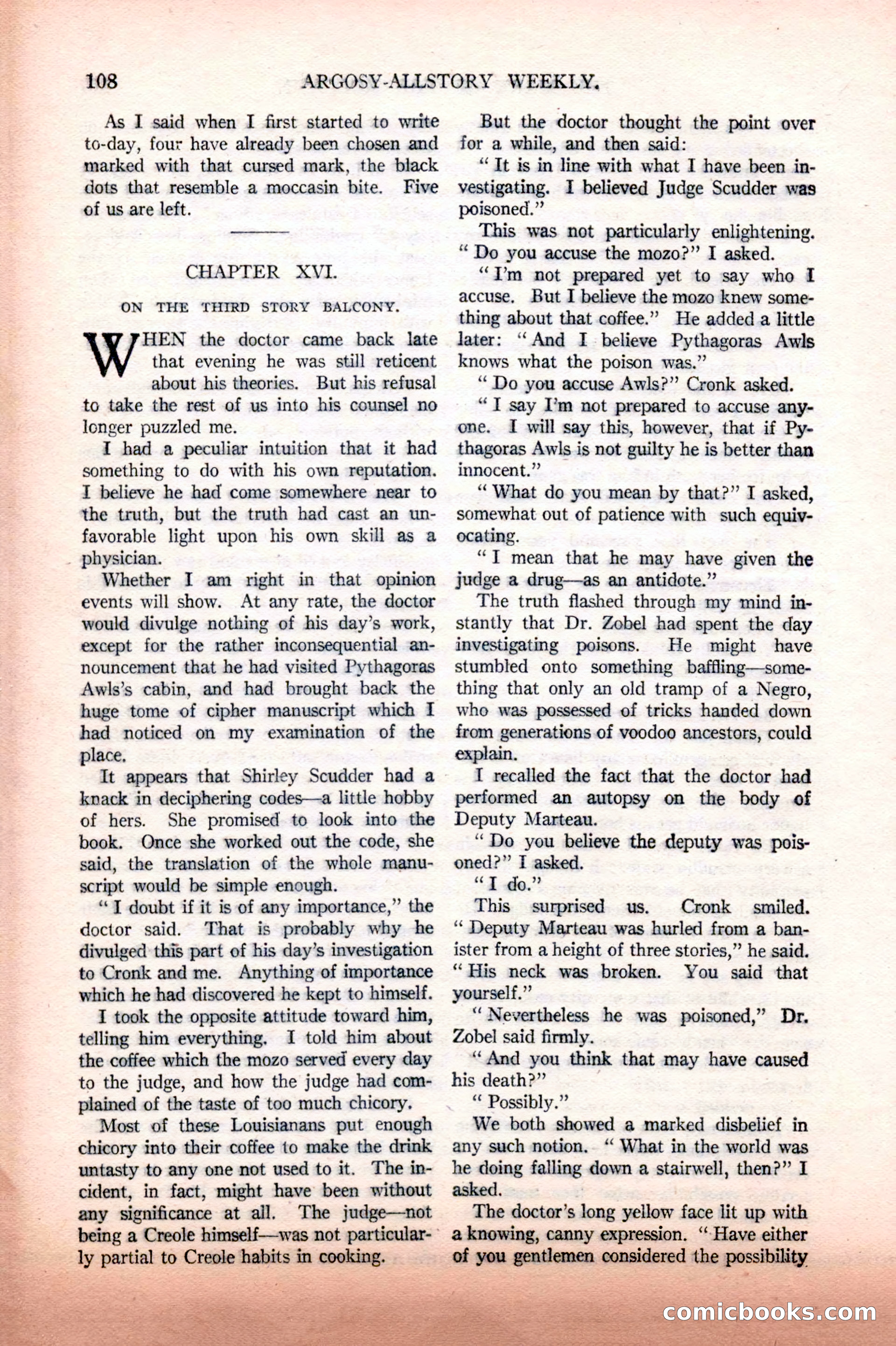
A restored page from Pulp Fiction, 1927. Page through the whole issue in the reader above.
📄 Transcribed text from this page (OCR, searchable)
Machine-transcribed from the original scan — historical spelling and the odd misread are preserved.
ry Te eae 108 As I said when I first started to write to-day, four have already been chosen and marked with that cursed mark, the black dots that resemble a moccasin bite. Five of us are left. oo CHAPTER XVI. ON THE THIRD STORY BALCONY. HEN the doctor came back late that evening he was still reticent about his theories. But his refusal to take the rest of us into his counsel no longer puzzled me. I had a peculiar intuition that it had something to do with his own reputation. T believe he had come somewhere near to the truth, but the truth had cast an un- favorable light upon his own skill as a _ physician. Whether I am right in that opinion events will show. At any rate, the doctor would divulge nothing of his day’s work, except for the rather inconsequential an- nouncement that he had visited Pythagoras Awls’s cabin, and had brought back the huge tome of cipher manuscript which I had noticed on my examination of the place. It appears that Shirley Scudder had a knack in deciphering codes—a little hobby of hers. She promised to look into the book. Once she worked out the code, she said, the translation of the whole manu- script would be simple enough. “‘]T doubt if it is of any importance,” the doctor said. That is probably why he divulged this part of his day’s investigation to Cronk and me. Anything of importance which he had discovered he kept to himself. I took the opposite attitude toward him, telling him everything, I told him about the coffee which the mozo served every day to the judge, and how the judge had com- plained of the taste of too much chicory. Most of these Louisianans put enough chicory into their coffee to make the drink untasty to any one not used to it. The in- cident, in fact, might have been without any significance at all. The judge—not being a Cote himself—was not ene: : ARGOSY-ALLSTORY WEEKLY. But the doctor thought the point over for a while, and then said: “Tt is in line with what I have been in- vestigating. I believed Judge Scudder was poisoned.” This was not particularly enlightening. “Do you accuse the mozo?” I asked. “Tm not prepared yet to say who I accuse, But I believe the mozo knew some- thing about that coffee.” He added a little later: ‘‘And I believe Pythagoras Awls knows what the poison was.” “Do you accuse Awls?” Cronk asked. “T say I’m not prepared to accuse any- one. I will say this, however, that if Py- thagoras Awls is not guilty he is better than innocent.” “What do you mean by that?” I asked, somewhat out of patience with such equiv- ocating. “T mean that he may have given the judge a drug—as an antidote.” The truth flashed through my mind in- stantly that Dr. Zobel had spent the day investigating poisons. He might have stumbled onto something baffling—some- thing that only an old tramp of a Negro, who was possessed of tricks handed down from generations of voodoo ancestors, could explain. I recalled the fact that the doctor had performed an autopsy on the body of Deputy Marteau. ‘Do you believe the deputy was pois- oned?” IT asked. if 4 I do.”’ This surprised us. Cronk smiled. ‘* Deputy Marteau was hurled from a ban- ister from a height of three stories,” he said. “His neck was broken. You said that yourself.” “‘ Nevertheless he was poisoned,” Dr. Zobel said firmly. “And you think that may have caused his death?” “* Possibly.” We both showed a marked disbelief in any such notion. “‘ What in the world was he doing falling down a stairwell, then?” I The doctor’s long yellow face lit up with a eee any: expression. ~ Have either SOMIcBooe COMC