
Pulp Fiction, 1926 · page 99 of 184
Argosy All-Story Weekly, December 4, 1926 — page 99: what you’re looking at
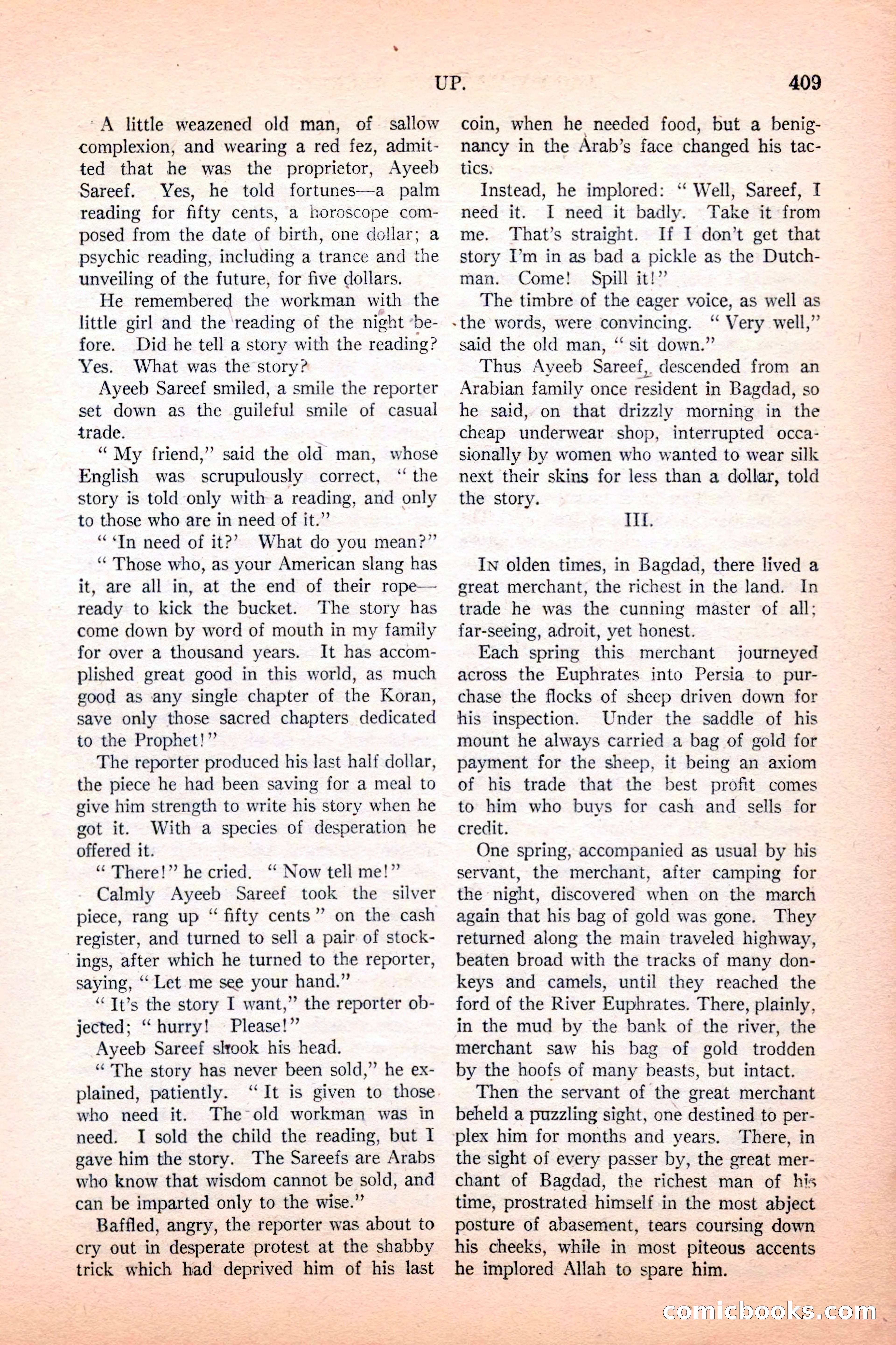
A restored page from Pulp Fiction, 1926. Page through the whole issue in the reader above.
📄 Transcribed text from this page (OCR, searchable)
Machine-transcribed from the original scan — historical spelling and the odd misread are preserved.
UP. ~A little weazened old man, of sallow complexion, and wearing a red fez, admit- ted that he was the proprietor, Ayeeb Sareef. Yes, he told fortunes—a palm reading for fifty cents, a horoscope com- posed from the date of birth, one dollar; a psychic reading, including a trance and the unveiling of the future, for five dollars. He remembered the workman with the little girl and the reading of the night “be- fore. Did he tell a story with the reading? Yes. What was the story? Ayeeb Sareef smiled, a smile the reporter set down as the guileful smile of casual trade. “My friend,” said the old man, whose English was scrupulously correct, “ the story is told only with a reading, and only to those who are in need of it.” “ «Tn need of it?’ What do you mean?” ‘‘ Those who, as your American slang has it, are all in, at the end of their rope— ready to kick the bucket. The story has come down by word of mouth in my family for over a thousand years. It has accom- plished great good in this world, as much good as any single chapter of the Koran, save only those sacred chapters dedicated to the Prophet!” The reporter produced his last half dollar, the piece he had been saving for a meal to give him strength to write his story when he got it. With a species of desperation he offered it. “ There!” he cried. “ Now tell me!” Calmly Ayeeb Sareef took the silver piece, rang up “ fifty cents” on the cash register, and turned to sell a pair of stock- ings, after which he turned to the reporter, saying, ‘‘ Let me see your hand.” “It’s the story I want,” the reporter ob- jected; “hurry! Please!” Ayeeb Sareef slrook his head. “The story has never been sold,” he ex- plained, patiently. “It is given to those who need it. The old workman was in need. I sold the child the reading, but 1 gave him the story. The Sareefs are Arabs who know that wisdom cannot be sold, and can be imparted only to the wise.” Baffled, angry, the reporter was about to cry out in desperate protest at the shabby trick which had deprived him of his last -the words, were convincing. 409 coin, when he needed food, but a benig- nancy in the Arab’s face changed his tac- tics. Instead, he implored: “‘ Well, Sareef, I need it. I need it badly. Take it from me. That’s straight. If I don’t get that story I’m in as bad a pickle as the Dutch- man. Come! Spill it!” The timbre of the eager voice, as well as Very well,” said the old man, ‘ sit down.” Thus Ayeeb Sareef, descended from an Arabian family once resident in Bagdad, so he said, on that drizzly morning in the cheap underwear shop, interrupted occa- sionally by women who wanted to wear silk next their skins for less than a dollar, told the story. Ilf. In olden times, in Bagdad, there lived a great merchant, the richest in the land. In trade he was the cunning master of all; far-seeing, adroit, yet honest. Each spring this merchant journeyed across the Euphrates into Persia to pur- chase the flocks of sheep driven down for his inspection. Under the saddle of his mount he always carried a bag of gold for payment for the sheep, it being an axiom of his trade that the best profit comes to him who buys for cash and sells for credit. One spring, accompanied as usual by his servant, the merchant, after camping for the night, discovered when on the march again that his bag of gold was gone. They returned along the main traveled highway, beaten broad with the tracks of many don- keys and camels, until they reached the ford of the River Euphrates. There, plainly, in the mud by the bank of the river, the merchant saw his bag of gold trodden by the hoofs of many beasts, but intact. Then the servant of the great merchant beheld a puzzling sight, one destined to per- plex him for months and years. There, in the sight of every passer by, the great mer- chant of Bagdad, the richest man of his time, prostrated himself in the most abject posture of abasement, tears coursing down his cheeks, while in most piteous accents he implored Allah to spare him. (€(0) DOOKS iMuce