
Pulp Fiction, 1926 · page 89 of 184
Argosy All-Story Weekly, December 4, 1926 — page 89: what you’re looking at
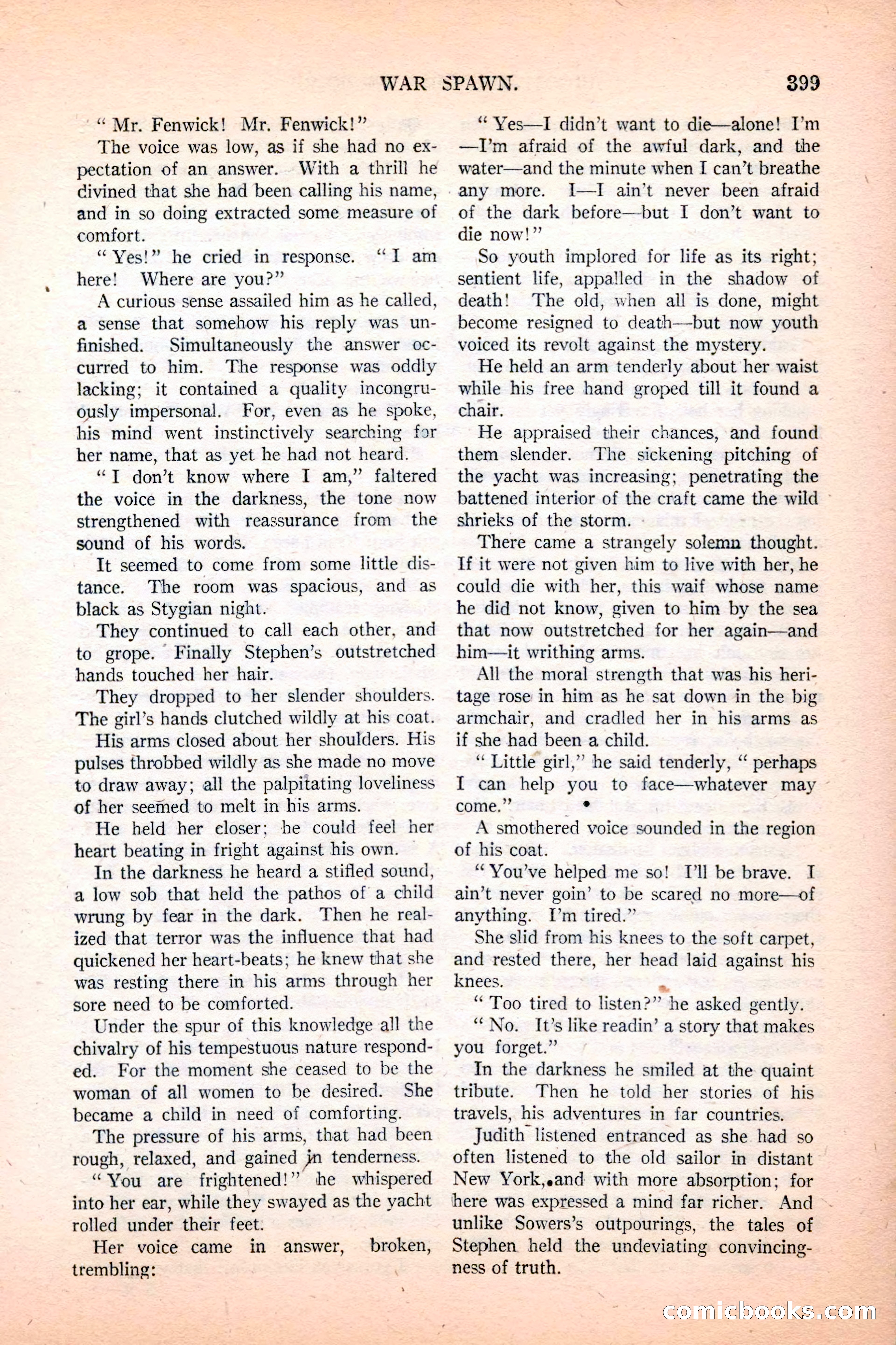
A restored page from Pulp Fiction, 1926. Page through the whole issue in the reader above.
📄 Transcribed text from this page (OCR, searchable)
Machine-transcribed from the original scan — historical spelling and the odd misread are preserved.
WAR SPAWN. “ Mr. Fenwick! Mr. Fenwick!” The voice was low, as if she had no ex- pectation of an answer. With a thrill he Civined that she had been calling his name, and in so doing extracted some measure of comfort. “Yes!” he cried in response. here! Where are you?” A curious sense assailed him as he called, a sense that somehow his reply was un- finished. Simultaneously the answer oc- curred to him. The response was oddly lacking; it contained a quality incongru- ously impersonal. For, even as he spoke, his mind went instinctively searching for her name, that as yet he had not heard. “T don’t know where I am,” faltered the voice in the darkness, the tone now strengthened with reassurance from the sound of his words. It seemed to come from some little dis- tance. The room was spacious, and as black as Stygian night. They continued to call each other, and to grope. Finally Stephen’s outstretched hands touched her hair. They dropped to her slender shoulders. The girl’s hands clutched wildly at his coat. His arms closed about her shoulders. His pulses throbbed wildly as she made no move to draw away; all the palpitating loveliness of her seemed to melt in his arms. He held her closer; he could feel her heart beating in fright against his own. | In the darkness he heard a stifled sound, a low sob that held the pathos of a child wrung by fear in the dark. Then he real- ized that terror was the influence that had quickened her heart-beats; he knew that she was resting there in his arms through her sore need to be comforted. Under the spur of this knowledge all the chivalry of his tempestuous nature respond- ed. For the moment she ceased to be the woman of all women to be desired. She became a child in need of comforting. The pressure of his arms, that had been rough, relaxed, and gained yn tenderness. “Vou are frightened!’”’ he whispered into her ear, while they swayed as the yacht rolled under their feet. Her voice came in answer, trembling: “TT am broken, 399 ‘**'Yes—I didn’t want to die—alone! I’m —I’m afraid of the awful dark, and the water—and the minute when I can’t breathe any more. I—I ain’t never been afraid of the dark before—but I don’t want to die now!” So youth implored for life as its right; sentient life, appalled in the shadow of death! The old, when all is done, might become resigned to death—but now youth voiced its revolt against the mystery. He held an arm tenderly about her waist while his free hand groped till it found a chair. He appraised their chances, and found them slender. The sickening pitching of the yacht was increasing; penetrating the battened interior of the craft came the wild ~ shrieks of the storm. There came a strangely solemn thought. If it were not given him to live with her, he could die with her, this waif whose name he did not know, given to him by the sea that now outstretched for her again—and him—it writhing arms. All the moral strength that was his heri- tage rose in him as he sat down in the big armchair, and cradled her in his arms as if she had been a child. “ Little girl,” he said tenderly, “ perhaps I can help you to face—whatever may — come.” cm A smothered voice sounded in the region of his coat. ‘““'You’ve helped me so! I'll be brave. I ain’t never goin’ to be scared no more—of anything. I’m tired.” She slid from his knees to the soft carpet, and rested there, her head laid against his knees. - “Too tired to listen?” he asked gently. “No. It’s like readin’ a story that makes you forget.” In the darkness he smiled at the quaint tribute. Then he told her stories of his travels, his adventures in far countries. Judith listened entranced as she had so often listened to the old sailor in distant New York,eand with more absorption; for here was expressed a mind far richer. And ~. unlike Sowers’s outpourings, the tales of Stephen held the undeviating convincing- ness of truth. CONMIE NOOLKS Or