
Pulp Fiction, 1926 · page 21 of 184
Argosy All-Story Weekly, December 4, 1926 — page 21: what you’re looking at
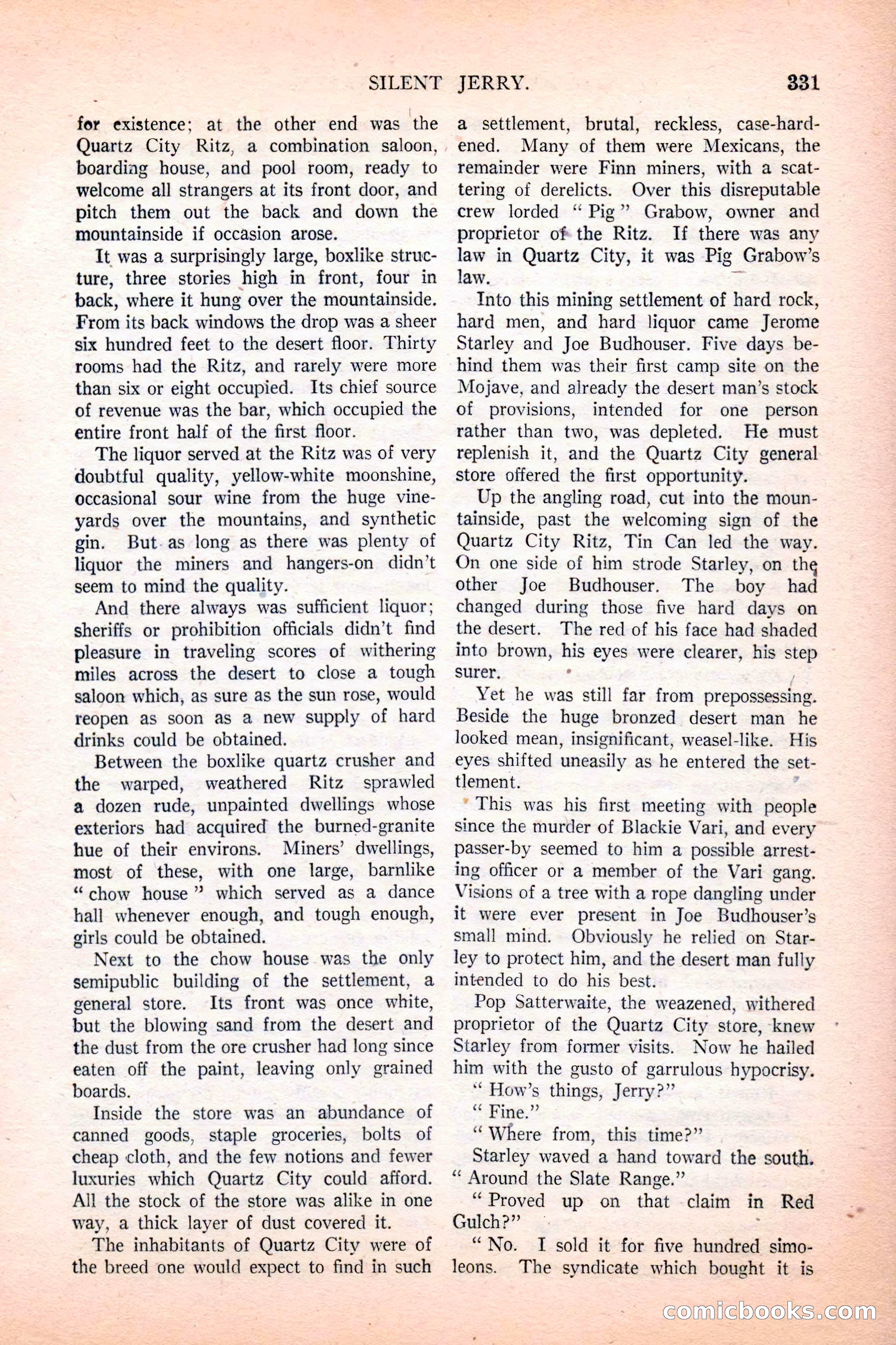
A restored page from Pulp Fiction, 1926. Page through the whole issue in the reader above.
📄 Transcribed text from this page (OCR, searchable)
Machine-transcribed from the original scan — historical spelling and the odd misread are preserved.
SILENT for existence; at the other end was the Quartz City Ritz, a combination saloon, boarding house, and pool room, ready to welcome all strangers at its front door, and pitch them out the back and down the mountainside if occasion arose. It was a surprisingly large, boxlike struc- ture, three stories high in front, four in back, where it hung over the mountainside. From its back windows the drop was a sheer six hundred feet to the desert floor. Thirty rooms had the Ritz, and rarely were more than six or eight occupied. Its chief source of revenue was the bar, which occupied the entire front half of the first floor. The liquor served at the Ritz was of very doubtful quality, yellow-white moonshine, occasional sour wine from the huge vine- yards over the mountains, and synthetic gin. But-as long as there was plenty of liquor the miners and hangers-on didn’t seem to mind the quality. And there always was sufficient liquor; sheriffs or prohibition officials didn’t find pleasure in traveling scores of withering miles across the desert to close a tough saloon which, as sure as the sun rose, would reopen as soon as a new supply of hard drinks could be obtained. Between the boxlike quartz crusher and the warped, weathered Ritz sprawled a dozen rude, unpainted dwellings whose exteriors had acquired the burned-granite hue of their environs. Miners’ dwellings, most of these, with one large, barnlike “ chow house ” which served as a dance hall whenever enough, and tough enough, girls could be obtained. Next to the chow house was the only semipublic building of the settlement, a general store. Its front was once white, but the blowing sand from the desert and the dust from the ore crusher had long since eaten off the paint, leaving only grained boards. Inside the store was an abundance of canned goods, staple groceries, bolts of cheap cloth, and the few notions and fewer luxuries which Quartz City could afford. All the stock of the store was alike in one way, a thick layer of dust covered it. The inhabitants of Quartz City were of the breed one would expect to find in such JERRY. 351 a settlement, brutal, reckless, case-hard- ened. Many of them were Mexicans, the remainder were Finn miners, with a scat- tering of derelicts. Over this disreputable crew lorded “ Pig” Grabow, owner and proprietor of the Ritz. If there was any law in Quartz City, it was Pig Grabow’s law. = Into this mining settlement of hard rock, hard men, and hard liquor came Jerome Starley and Joe Budhouser. Five days be- hind them was their first camp site on the Mojave, and already the desert man’s stock of provisions, intended for one person rather than two, was depleted. He must replenish it, and the Quartz City general store offered the first opportunity. Up the angling road, cut into the moun- tainside, past the welcoming sign of the Quartz City Ritz, Tin Can led the way. On one side of him strode Starley, on the Other Joe Budhouser. The boy had changed during those five hard days on the desert. The red of his face had shaded into brown, his eyes were clearer, his step surer, : , Yet he was still far from prepossessing. Beside the huge bronzed desert man he looked mean, insignificant, weasel-like. His eyes shifted uneasily as he entered the set- tlement. d * This was his first meeting with people since the murder of Blackie Vari, and every passer-by seemed to him a possible arrest- ing officer or a member of the Vari gang. Visions of a tree with a rope dangling under it were ever present in Joe Budhouser’s small mind. Obviously he relied on Star- ley to protect him, and the desert man fully intended to do his best. Pop Satterwaite, the weazened, withered proprietor of the Quartz City store, knew Starley from former visits. Now he hailed him with the gusto of garrulous hypocrisy. ‘“ How’s things, Jerry?” “ Fine.” “Where from, this time?” Starley waved a hand toward the south. “Around the Slate Range.” “Proved up on that claim in Red Gulch?” “No. I sold it for five hundred simo- leons. The syndicate which bought it is CONMIG OOO) <S (E@)