
Pulp Fiction, 1926 · page 158 of 184
Argosy All-Story Weekly, December 4, 1926 — page 158: what you’re looking at
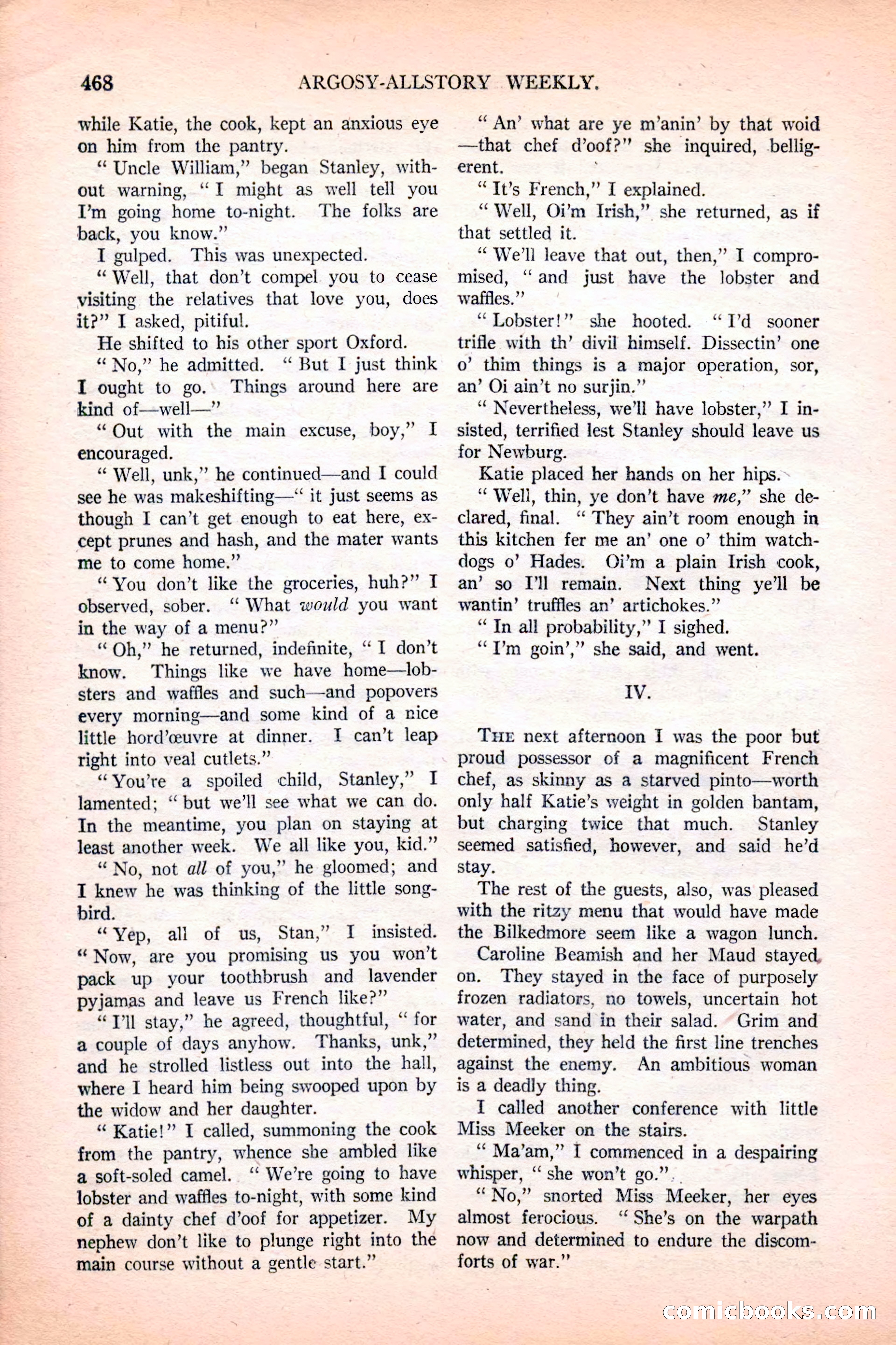
A restored page from Pulp Fiction, 1926. Page through the whole issue in the reader above.
📄 Transcribed text from this page (OCR, searchable)
Machine-transcribed from the original scan — historical spelling and the odd misread are preserved.
468 while Katie, the cook, kept an anxious eye on him from the pantry. “Uncle William,” began Stanley, with- out warning, “I might as well tell you I’m going home to-night. The folks are back, you know.” I gulped. This was unexpected. “Well, that don’t compel you to cease visiting the relatives that love you, does it?” I asked, pitiful. He shifted to his other sport Oxford. “No,” he admitted. ‘“ But I just think I ought to go. Things around here are kind of—well—’” “Out with the main excuse, boy,” I encouraged. “ Well, unk,” he continued—and I could see he was makeshifting— it just seems as though I can’t get enough to eat here, ex- cept prunes and hash, and the mater wants me to come home.” “Vou don’t like the groceries, huh?” I observed, sober. ‘‘ What would you want in the way of a menu?” “Oh,” he returned, indefinite, “I don’t know. Things like we have home—lob- sters and waffles and such—and popovers every morning—and some kind of a nice little hord’ceuvre at dinner. JI can’t leap right into veal cutlets.” “You're a spoiled child, Stanley,” I lamented; “ but we’ll see what we can do. In the meantime, you plan on staying at least another week. We all like you, kid.” “No, not all of you,”’ he gloomed; and I knew he was thinking of the little song- bird. “Yep, all of us, Stan,” I insisted. “ Now, are you promising us you won't pack up your toothbrush and lavender pyjamas and leave us French like?” “T’ll stay,” he agreed, thoughtful, “ for a couple of days anyhow. Thanks, unk,” and he strolled listless out into the hall, where I heard him being swooped upon by the widow and her daughter. “ Katie!” I called, summoning the cook from the pantry, whence she ambled like a soft-soled camel. ‘‘ We’re going to have lobster and waffles to-night, with some kind of a dainty chef d’oof for appetizer. My nephew don’t like to plunge right into the main course without a gentle start.” ARGOSY-ALLSTORY WEEKLY. ‘An’ what are ye m’anin’ by that woid —that chef d’oof?” she inquired, bellig- erent. “ Tt’s French,” I explained. “Well, Oi’m Irish,” she returned, as if that settled it. “We'll leave that out, then,” I compro- mised, “and just have the lobster and waffles.”’ “Lobster!” she hooted. ‘I’d sooner trifle with th’ divil himself. Dissectin’ one o’ thim things is a major operation, sor, an’ Oj ain’t no surjin.” 3 ‘“ Nevertheless, we’ll have lobster,” I in- sisted, terrified lest Stanley should leave us for Newburg. Katie placed her hands on her hips. “Well, thin, ye don’t have me,” she de- clared, final. ‘“ They ain’t room enough in this kitchen fer me an’ one o’ thim watch- dogs o’ Hades. Oi’m a plain Irish cook, an’ so I'll remain. Next thing ye’ll be wantin’ truffles an’ artichokes.” “Tn all probability,” I sighed. “I’m goin’,” she said, and went. IV. THE next afternoon I was the poor but proud possessor of a magnificent French chef, as skinny as a starved pinto—worth only half Katie’s weight in golden bantam, but charging twice that much. Stanley seemed satisfied, however, and said he’d Stay. The rest of the guests, also, was pleased with the ritzy menu that would have made the Bilkedmore seem like a wagon lunch. Caroline Beamish and her Maud stayed, on. They stayed in the face of purposely frozen radiators, no towels, uncertain hot water, and sand in their salad. Grim and determined, they held the first line trenches against the enemy. An ambitious woman is a deadly thing. I called another conference with little Miss Meeker on the stairs. ‘““Ma’am,” I commenced in a despairing whisper, “‘ she won’t go.” | “No,” snorted Miss Meeker, her eyes almost ferocious. ‘“‘ She’s on the warpath now and determined to endure the discom- forts of war.” (EO) OOO K< (C@)