
Pulp Fiction, 1926 · page 156 of 184
Argosy All-Story Weekly, December 4, 1926 — page 156: what you’re looking at
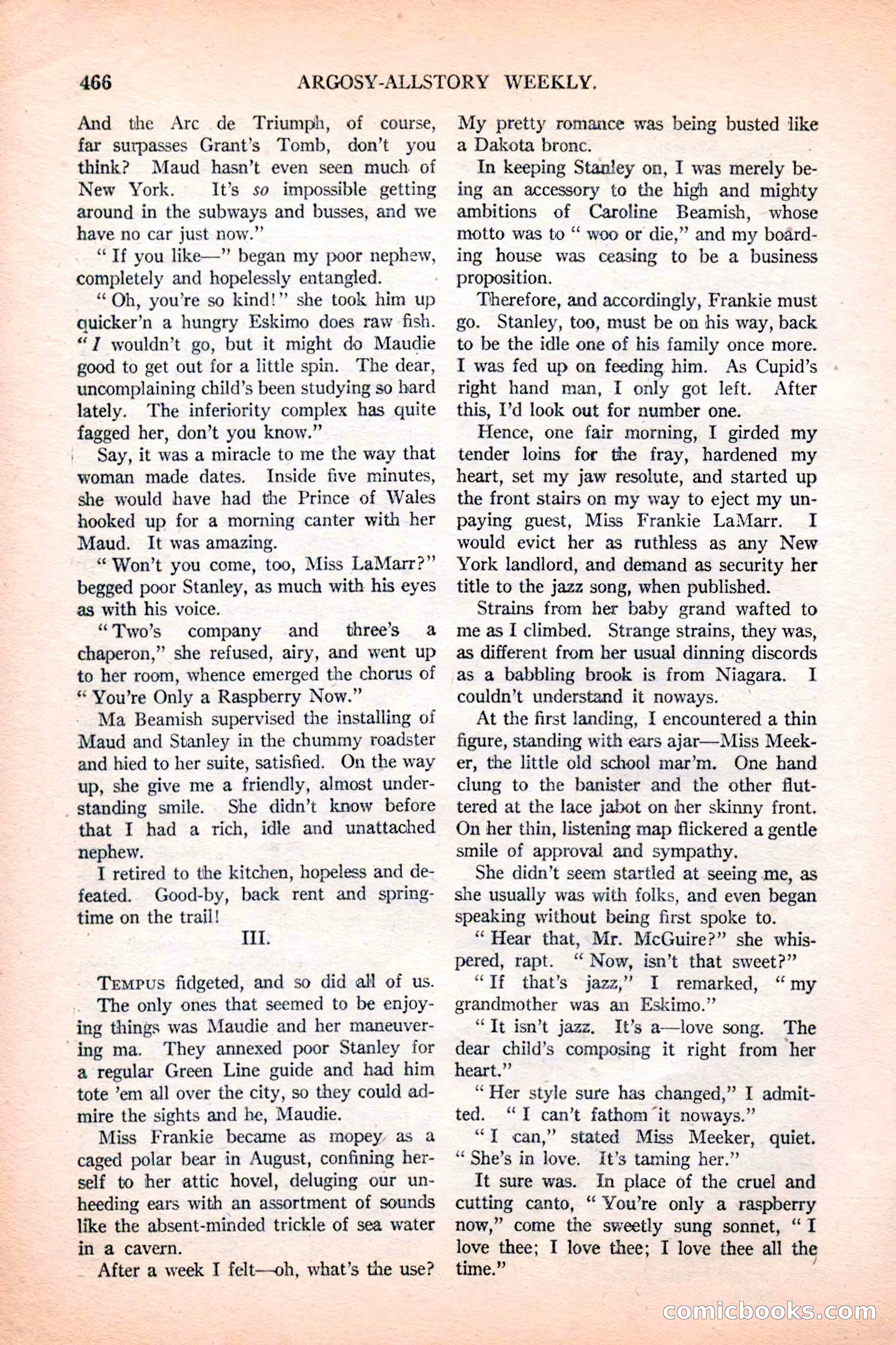
A restored page from Pulp Fiction, 1926. Page through the whole issue in the reader above.
📄 Transcribed text from this page (OCR, searchable)
Machine-transcribed from the original scan — historical spelling and the odd misread are preserved.
466 And the Arc de Triumph, of course, far surpasses Grant’s Tomb, don’t you think? Maud hasn’t even seen much. of New York. It’s so impossible getting around in the subways and busses, and we have no car just now.” “Tf you like—” began my poor nephew, completely and hopelessly entangled. “Oh, you’re so kind!” she took him up quicker’n a hungry Eskimo does raw fish. “7 wouldn’t go, but it might do Maudie good to get out for a little spin. The dear, uncomplaining child’s been studying so hard lately. The inferiority complex has quite fagged her, don’t you know.” Say, it was a miracle to me the way that woman made dates. Inside five minutes, she would have had the Prince of Wales hooked up for a morning canter with her Maud. It was amazing. “ Won’t you come, too, Miss LaMarr?” begged poor Stanley, as much with his eyes as with his voice. “Two’s company and three’s a chaperon,” she refused, airy, and went up to her room, whence emerged the chorus of * You’re Only a Raspberry Now.” Ma Beamish supervised the installing of Maud and Stanley in the chummy roadster and hied to her suite, satisfied. On the way up, she give me a friendly, almost under- standing smile. She didn’t know before that I had a rich, idle and unattached nephew. I retired to the kitchen, hopeless and de- feated. Good-by, back rent and spring- time on the trail! 7 Til. Tempus fidgeted, and so did all of us. The only ones that seemed to be enjoy- ing things was Maudie and her maneuver- ing ma. They annexed poor Stanley for a regular Green Line guide and had him tote ’em all over the city, so they could ad- mire the sights and he, Maudie. Miss Frankie became as mopey as a caged polar bear in August, confining her- self to her attic hovel, deluging our un- heeding ears with an assortment of sounds like the absent-minded trickle of sea water in a cavern. After a week I felt—oh, what’s the use? ARGOSY-ALLSTORY WEEKLY. My pretty romance was being busted like a Dakota bronc. , In keeping Stanley on, I was merely be- ing an accessory to the high and mighty ambitions of Caroline Beamish, whose motto was to “ woo or die,” and my board- ing house was ceasing to be a business proposition. Therefore, and accordingly, Frankie must go. Stanley, too, must be on his way, back to be the idle one of his family once more. I was fed up on feeding him. As Cupid’s right hand man, I only got left. After this, I’d look out for number one. Hence, one fair morning, I girded my tender loins for the fray, hardened my heart, set my jaw resolute, and started up the front stairs on my way to eject my un- paying guest, Miss Frankie LaMarr. I would evict her as ruthless as any New York landlord, and demand as security her title to the jazz song, when published. Strains from her baby grand wafted to me as I climbed. Strange strains, they was, as different from her usual dinning discords as a babbling brook is from Niagara. I couldn’t understand it noways. At the first landing, I encountered a thin figure, standing with ears ajar—Miss Meek- er, the little old school mar’m. One hand clung to the banister and the other flut- tered at the lace jabot on her skinny front. On her thin, listening map flickered a gentle smile of approval and sympathy. She didn’t seem startled at seeing me, as she usually was with folks, and even began speaking without being first spoke to. “ Hear that, Mr. McGuire?” she whis- pered, rapt. “ Now, isn’t that sweet?” “If that’s jazz,” I remarked, “my grandmother was an Eskimo.” “It isn’t jazz. It’s a—love song. The dear child’s composing it right from her heart.”’ “Her style sure has changed,” I admit- ted. “I can’t fathom ‘it noways.” “I can,” stated Miss Meeker, quiet. ‘“ She’s in love. It’s taming her.” It sure was. In place of the cruel and cutting canto, “ You’re only a raspberry now,” come the sweetly sung sonnet, “I love thee; I love thee; I love thee all the time.” COMMICLOOOKS (E@)