
Pulp Fiction, 1926 · page 14 of 184
Argosy All-Story Weekly, December 4, 1926 — page 14: what you’re looking at
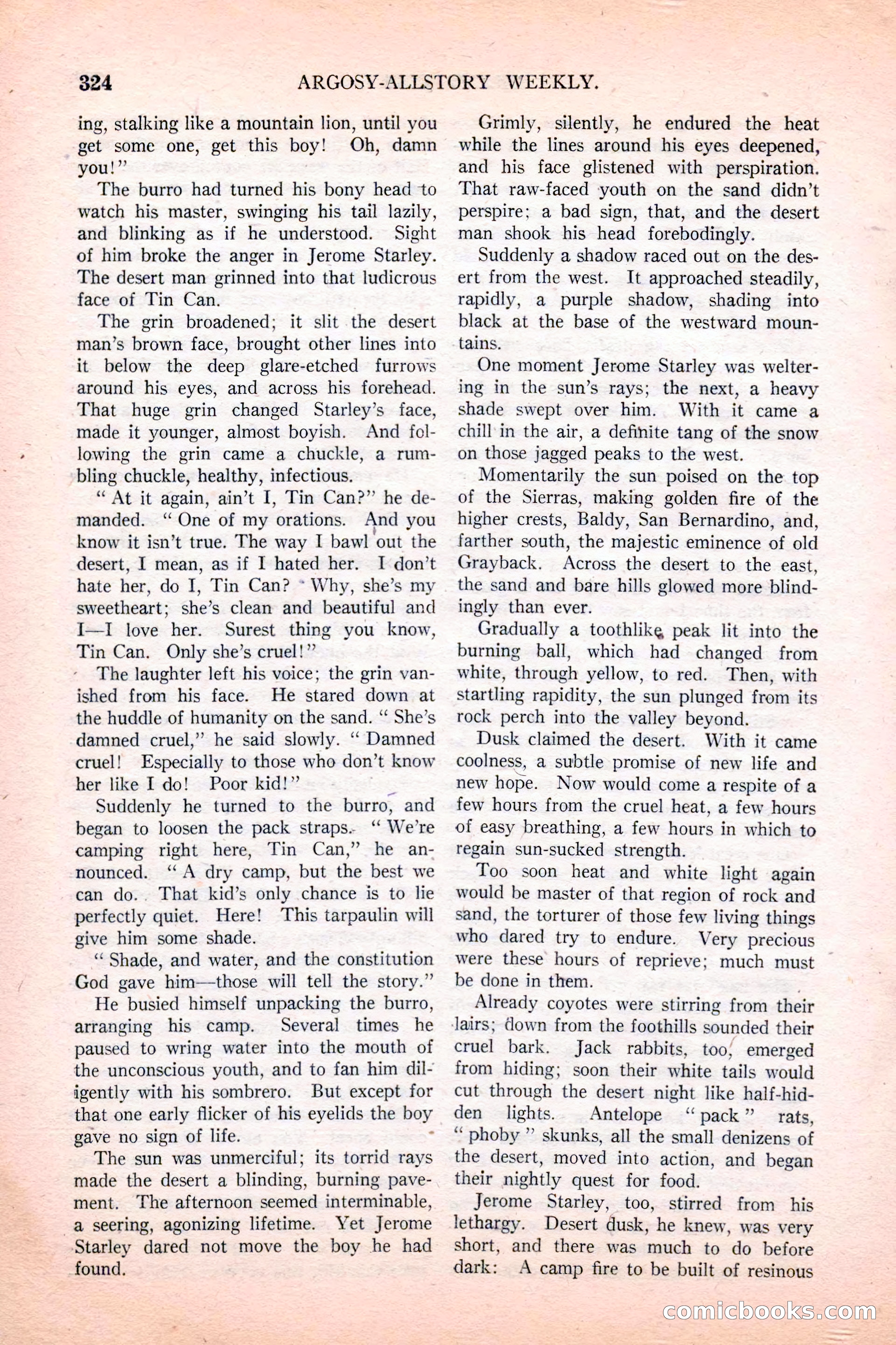
A restored page from Pulp Fiction, 1926. Page through the whole issue in the reader above.
📄 Transcribed text from this page (OCR, searchable)
Machine-transcribed from the original scan — historical spelling and the odd misread are preserved.
O24 ing, stalking like a mountain lion, until you get some one, get this boy! Oh, damn you!” The burro had turned his bony head to watch his master, swinging his tail lazily, and blinking as if he understood. Sight of him broke the anger in Jerome Starley. The desert man grinned into that ludicrous face of Tin Can. The grin broadened; it slit the desert man’s brown face, brought other lines into it below the deep glare-etched furrows around his eyes, and across his forehead. That huge grin changed Starley’s face, made it younger, almost boyish. And fol- lowing the grin came a chuckle, a rum- bling chuckle, healthy, infectious. “At it again, ain’t I, Tin Can?” he de- manded. “One of my orations. And you know it isn’t true. The way I bawl ‘out the desert, I mean, as if I hated her. I don’t hate her, do < Tin Can? * Why, she’s my sweetheart; she’s clean and beautiful and I—I love her. Surest thing you know, Tin Can. Only she’s cruel!” The laughter left his voice; the grin van- ished from his face. He stared down at the huddle of humanity on the sand. “ She’s damned cruel,” he said slowly. ‘““ Damned cruel! Especially to those who don’t know her like I do! Poor kid!” ; Suddenly he turned to the burro, and began to loosen the pack straps. “ We’re camping right here, Tin Can,” he an- nounced. “A dry camp, but the best we can do.. That kid’s only chance is to lie perfectly quiet. Here! This tarpaulin will give him some shade. “Shade, and water, and the constitution God gave him—those will tell the story.” He busied himself unpacking the burro, arranging his camp. Several times he paused to wring water into the mouth of the unconscious youth, and to fan him dil- igently with his sombrero. But except for that one early flicker of his eyelids the boy gave no sign of life. The sun was unmerciful; its torrid rays made the desert a blinding, burning pave- ment. The afternoon seemed interminable, a seering, agonizing lifetime. Yet Jerome Starley dared not move the boy he had found. ARGOSY-ALLSTORY WEEKLY. Grimly, silently, he endured the heat while the lines around his eyes deepened, and his face glistened with perspiration. That raw-faced youth on the sand didn’t perspire; a bad sign, that, and the desert man shook his head forebodingly. Suddenly a shadow raced out on the des- ert from the west. It approached steadily, rapidly, a purple shadow, shading into black at the base of the westward moun- tains. One moment Jerome Starley was welter- ing in the sun’s rays; the next, a heavy shade swept over him. With it came a chill in the air, a definite tang of the snow on those jagged peaks to the west. Momentarily the sun poised on the top of the Sierras, making golden fire of the higher crests, Baldy, San Bernardino, and, farther south, the majestic eminence of old Grayback. Across the desert to the east, the sand and bare hills glowed more blind- ingly than ever. Gradually a toothlike peak lit into the burning ball, which had changed from white, through yellow, to red. Then, with startling rapidity, the sun plunged from its rock perch into the valley beyond. Dusk claimed the desert. With it came coolness, a subtle promise of new life and new hope. Now would come a respite of a few hours from the cruel heat, a few hours of easy breathing, a few hours in which to regain sun-sucked strength. Too soon heat and white light again would be master of that region of rock and sand, the torturer of those few living things who dared try to endure. Very precious were these hours of reprieve; much must be done in them. Already coyotes were stirring from their Jairs; down from the foothills sounded their cruel bark. Jack rabbits, too; emerged from hiding; soon their white tails would cut through the desert night like half-hid- den lights.. Antelope “pack” rats, ‘“ phoby ” skunks, all the small denizens of the desert, moved into action, and began their nightly quest for food. Jerome Starley, too, stirred from his lethargy. Desert dusk, he knew, was very short, and there was much to ‘do before dark: A camp fire to be built of resinous CORNICLOOOKS (F@)