
Pulp Fiction, 1926 · page 139 of 184
Argosy All-Story Weekly, December 4, 1926 — page 139: what you’re looking at
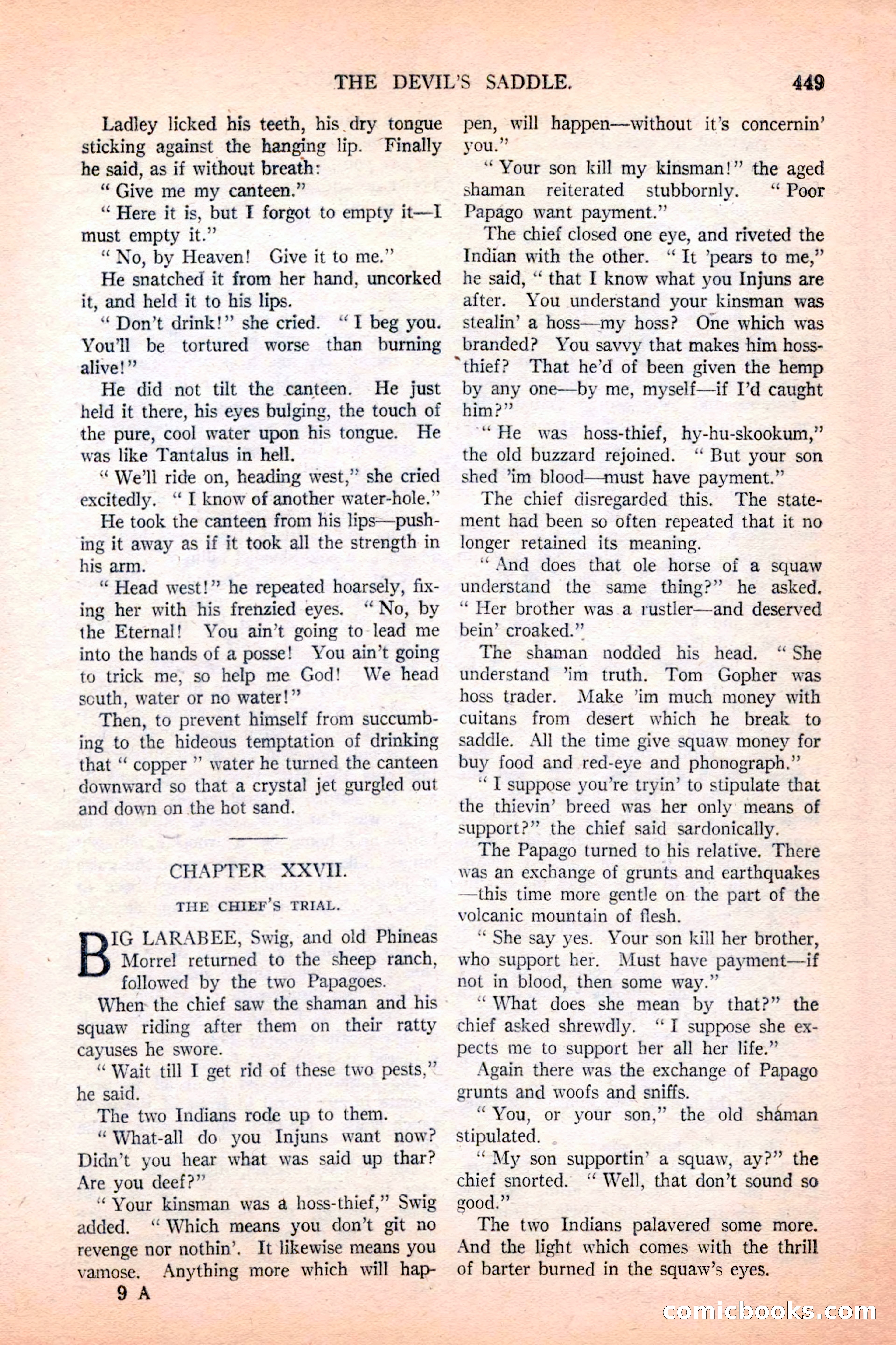
A restored page from Pulp Fiction, 1926. Page through the whole issue in the reader above.
📄 Transcribed text from this page (OCR, searchable)
Machine-transcribed from the original scan — historical spelling and the odd misread are preserved.
THE DEVIL’S SADDLE. Ladley licked his teeth, his dry tongue sticking against the hanging lip. Finally he said, as if without breath: “ Give me my canteen.” “ Here it is, but I forgot to empty it—l must empty it.” “No, by Heaven! Give it to me.” He snatched it from her hand, uncorked it, and held it to his lips. “Don’t drink!” she cried. “I beg you. You'll be tortured worse than burning alive!” He did not tilt the canteen. He just held it there, his eyes bulging, the touch of the pure, cool water upon his tongue. He was like Tantalus in hell. “ We'll ride on, heading west,” she cried excitedly. ‘‘ I know of another water-hole.” He took the canteen from his lips—push- ing it away as if it took all the strength in his arm. “ Head west!” he repeated hoarsely, fix- ing her with his frenzied eyes. “No, by the Eternal! You ain’t going to lead me into the hands of a posse! You ain’t going to trick me, so help me God! We head south, water or no water!” Then, to prevent himself from succumb- ing to the hideous temptation of drinking that “‘ copper ”’ water he turned the canteen downward so that a crystal jet gurgled out and down on the hot sand. CHAPTER XXVII. THE CHIEF’S TRIAL. IG LARABEE, Swig, and old Phineas Morre! returned to the sheep ranch, followed by the two Papagoes. When: the chief saw the shaman and his squaw riding after them on their ratty cayuses he swore. “Wait till I get rid of these two pests,” he said. The two Indians rode up to them. “ What-all do you Injuns want now? Didn’t you hear what was said up thar? Are you deef?”’ ‘“Vour kinsman was a hoss-thief,” Swig added. ‘“ Which means you don’t git no revenge nor nothin’. It likewise means you vamose, Anything more which will hap- 9A “thief? 449 pen, will happen—without it’s concernin’ you.” “Your son kill my kinsman!” the aged shaman reiterated stubbornly. “ Poor Papago want payment.” The chief closed one eye, and riveted the Indian with the other. “It ‘pears to me,” he said, “‘ that I know what you Injuns are after. You understand your kinsman was stealin’ a hoss—my hoss? One which was branded? You savvy that makes him hoss- That he’d of been given the hemp by any one—by me, myself—if I’d caught him?” “He was hoss-thief, hy-hu-skookum,” the old buzzard rejoined. “‘ But your son shed ’im blood—must have payment.” The chief disregarded this. The state- ment had been so often repeated that it no longer retained its meaning. ‘And does that ole horse of a squaw understand the same thing?” he asked. ‘Her brother was a rustler—and deserved bein’ croaked.” The shaman nodded his head. ‘“ She understand ’im truth. Tom Gopher was hoss trader. Make ’im much money with cuitans from desert which he break to saddle. All the time give squaw money for buy food and red-eye and phonograph.” ‘“T suppose you’re tryin’ to stipulate that the thievin’ breed was her only means of support?” the chief said sardonically. The Papago turned to his relative. There was an exchange of grunts and earthquakes —this time more gentle on the part of the volcanic mountain of flesh. ‘She say yes. Your son kill her brother, who support her. Must have payment—if not in blood, then some way.” ‘What does she mean by that?” the chief asked shrewdly. ‘I suppose she ex- pects me to support her all her life.” Again there was the exchange of Papago grunts and woofs and sniffs. “You, or your son,” the old shaman stipulated. ‘“My son supportin’ a squaw, ay?” the chief snorted. ‘“‘ Well, that don’t sound so good.” The two Indians palavered some more. And the light which comes with the thrill of barter burned in the squaw’s eyes. (COLMMLE DOOKS com