
Pulp Fiction, 1926 · page 101 of 184
Argosy All-Story Weekly, December 4, 1926 — page 101: what you’re looking at
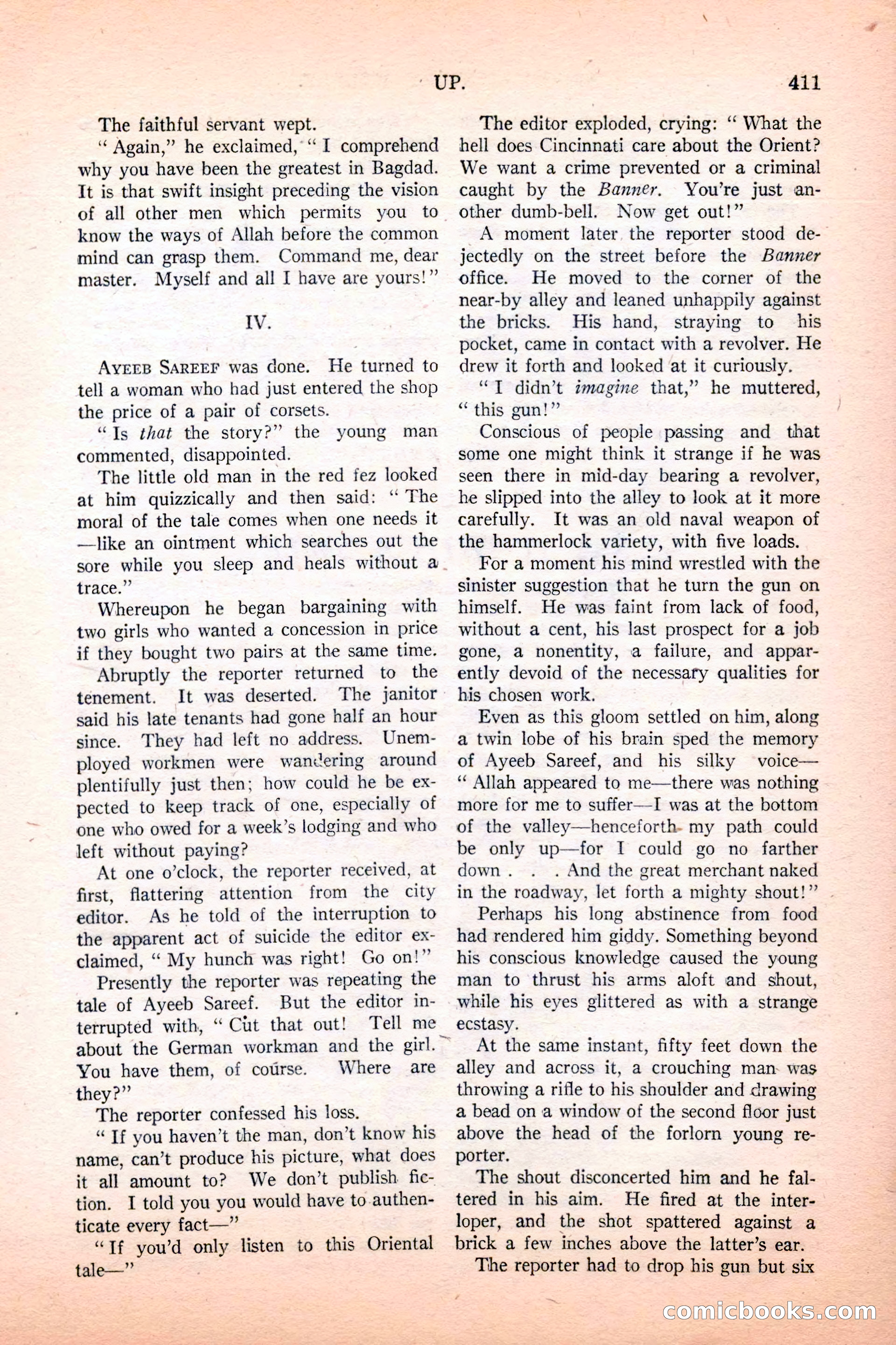
A restored page from Pulp Fiction, 1926. Page through the whole issue in the reader above.
📄 Transcribed text from this page (OCR, searchable)
Machine-transcribed from the original scan — historical spelling and the odd misread are preserved.
“OP, The faithful servant wept. “ Again,” he exclaimed, “ I comprehend why you have been the greatest in Bagdad. It is that swift insight preceding the vision of all other men which permits you to know the ways of Allah before the common mind can grasp them. Command me, dear master. Myself and all I have are yours!” IV. AYEEB SAREEF was done. He turned to tell a woman who had just entered the shop the price of a pair of corsets. “Ts that the story?” the young man commented, disappointed. The little old man in the red fez looked at him quizzically and then said: “ The moral of the tale comes when one needs it —like an ointment which searches out the sore while you sleep and heals without a trace.” Whereupon he began bargaining with two girls who wanted a concession in price if they bought two pairs at the same time. Abruptly the reporter returned to the tenement. It was deserted. The janitor said his late tenants had gone half an hour since. They had left no address. Unem- ployed workmen were wandering around plentifully just then; how could he be ex- pected to keep track of one, especially of one who owed for a week’s lodging and who left without paying? At one o’clock, the reporter received, at first, flattering attention from the city editor. As he told of the interruption to the apparent act of suicide the editor ex- claimed, “ My hunch was right! Go on!” Presently the reporter was repeating the tale of Ayeeb Sareef. But the editor in- terrupted with, “ Cut that out! Tell me about the German workman and the girl. © You have them, of course. Where are they?” The reporter confessed his loss. “ Tf you haven’t the man, don’t know his name, can’t produce his picture, what does it all amount to? We don’t publish fic- tion. I told you you would have to authen- ticate every fact—”’ “Tf you’d only listen to this Oriental > tale— 4il The editor exploded, crying: ‘‘ What the hell does Cincinnati care about the Orient? We want a crime prevented or a criminal caught by the Banner. You're just an- other dumb-bell. Now get out!” A moment later the reporter stood de- jectedly on the street before the Banner office. He moved to the corner of the near-by alley and leaned unhappily against the bricks. His hand, straying to his pocket, came in contact with a revolver. He drew it forth and looked at it curiously. “TI didn’t imagine that,” he muttered, “this gun!” Conscious of people passing and that some one might think it strange if he was seen there in mid-day bearing a revolver, he slipped into the alley to look at it more carefully. It was an old naval weapon of the hammerlock variety, with five loads. For a moment his mind wrestled with the sinister suggestion that he turn the gun on himself. He was faint from lack of food, without a cent, his last prospect for a job gone, a nonentity, a failure, and appar- ently devoid of the necessary qualities for his chosen work. Even as this gloom settled on him, along a twin lobe of his brain sped the memory of Ayeeb Sareef, and his silky voice— ‘‘ Allah appeared to me—there was nothing more for me to suffer—I was at the bottom of the valley—henceforth- my path could be only up—for I could go no farther down . . And the great merchant naked in the roadway, let forth a mighty shout!” ~ Perhaps his long abstinence from food had rendered him giddy. Something beyond his conscious knowledge caused the young man to thrust his arms aloft and shout, while his eyes glittered as with a strange ecstasy. At the same instant, fifty feet down the alley and across it, a crouching man. was throwing a rifle to his shoulder and drawing a bead on a window of the second floor just above the head of the forlorn young re- porter. The shout disconcerted him and he fal- tered in his aim. He fired at the inter- loper, and the shot spattered against a brick a few inches above the latter’s ear. The reporter had to drop his gun but six ~, (C@) mG I00 iS (E(0)