
Pulp Fiction, 1925 · page 92 of 168
Argosy All-Story Weekly, July 11, 1925 — page 92: what you’re looking at
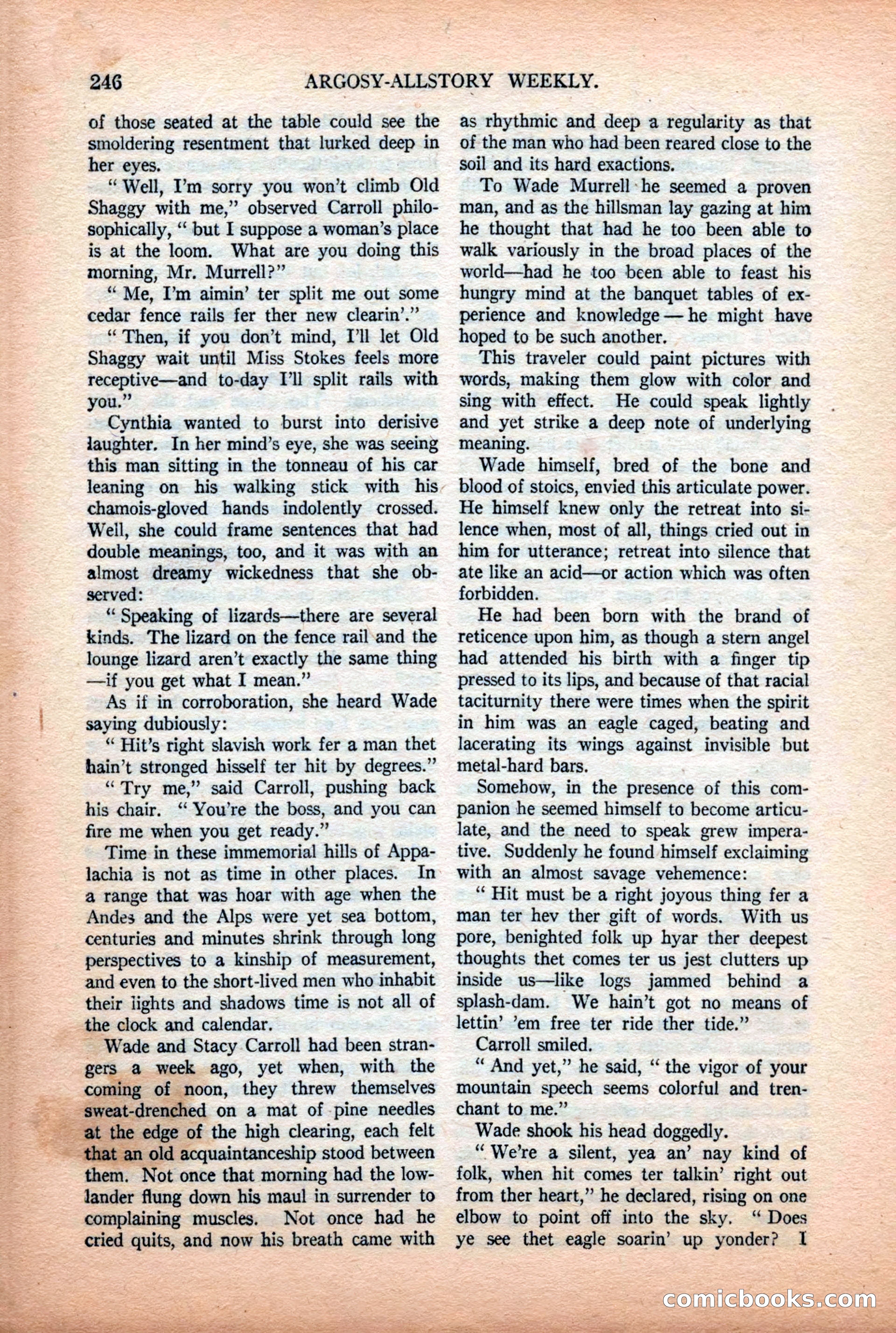
A restored page from Pulp Fiction, 1925. Page through the whole issue in the reader above.
📄 Transcribed text from this page (OCR, searchable)
Machine-transcribed from the original scan — historical spelling and the odd misread are preserved.
| VA URE TREE ome S AVE Kean rene PAN } ‘ Mad ’ ! se Fr 4 Ove sac tod | 246 of those seated at the table could see the smoldering resentment that lurked deep in her eyes. “Well, I’m sorry you won’t climb Old Shaggy with me,” observed Carroll philo- sophically, “‘ but I suppose a woman’s place is at the loom. What are you doing this morning, Mr. Murrell?” “Me, I’m aimin’ ter split me out some cedar fence rails fer ther new clearin’.” “Then, if you don’t mind, I'll let Old Shaggy wait until Miss Stokes feels more receptive—and to-day I'll split rails with you.” Cynthia wanted to burst into derisive jaughter. In her mind’s eye, she was seeing this man sitting in the tonneau of his car leaning on his walking stick with his chamois-gloved hands indolently crossed. Well, she could frame sentences that had double meanings, too, and it was with an almost dreamy wickedness that she ob- served: “ Speaking of lizards—there are several kinds. The lizard on the fence rail-and the lounge lizard aren’t exactly the same thing —if you get what I mean.” As if in corroboration, she heard Wade saying dubiously: “ Hit’s right slavish work fer a man thet hain’t stronged hisself ter hit by degrees.” “Try me,” said Carroll, pushing back his chair. ‘“ You’re the boss, and you can fire me when you get ready.” Time in these immemorial hills of Appa- lachia is not as time in other places. In a range that was hoar with age when the Andes and the Alps were yet sea bottom, centuries and minutes shrink through long perspectives to a kinship of measurement, and even to the short-lived men who inhabit their lights and shadows time is not all of the clock and calendar. Wade and Stacy Carroll had been stran- a week ago, yet when, with the of f noon, they threw themselves ched on a mat of - pine needles _— . once that morning had the low- lander flung down his maul in surrender to complaining muscles. Not once had he cried quits, and now his breath came with ARGOSY-ALLSTORY WEEKLY. as rhythmic and deep a regularity as that of the man who had been reared close to the soil and its hard exactions. To Wade Murrell: he seemed a proven man, and as the hillsman lay gazing at him he thought that had he too been able to walk variously in the broad places of the world—had he too been able to feast his hungry mind at the banquet tables of ex- perience and knowledge — he might have hoped to be such another. This traveler could paint pictures with words, making them glow with color and sing with effect. He could speak lightly and yet strike a deep note of underlying meaning. Wade himself, bred of the bone and blood of stoics, envied this articulate power. He himself knew only the retreat into si- lence when, most of all, things cried out in him for utterance; retreat into silence that ate like an acid—or action which was often forbidden. He had been born with the brand of reticence upon him, as though a stern angel had attended his birth with a finger tip pressed to its lips, and because of that racial taciturnity there were times when the spirit in him was an eagle caged, beating and lacerating its wings against invisible but metal-hard bars. Somehow, in the presence of this com- panion he seemed himself to become articu- late, and the need to speak grew impera- tive. Suddenly he found himself exclaiming with an almost savage vehemence: ‘“‘ Hit must be a right joyous thing fer a man ter hev ther gift of words. With us pore, benighted folk up hyar ther deepest thoughts thet comes ter us jest clutters up inside us—like logs jammed behind a splash-dam. We hain’t got no means of lettin’ ’em free ter ride ther tide.” Carroll smiled. “And yet,” he said, ‘‘ the vigor of your mountain speech seems colorful and tren- chant to me.” Wade shook his head doggedly. “We're a silent, yea an’ nay kind of folk, when hit comes ter talkin’ right out from ther heart,” he declared, rising on one elbow to point off into the sky. ‘“ Does ye see thet eagle soarin’ up yonder? I book =