
Pulp Fiction, 1925 · page 33 of 168
Argosy All-Story Weekly, July 11, 1925 — page 33: what you’re looking at
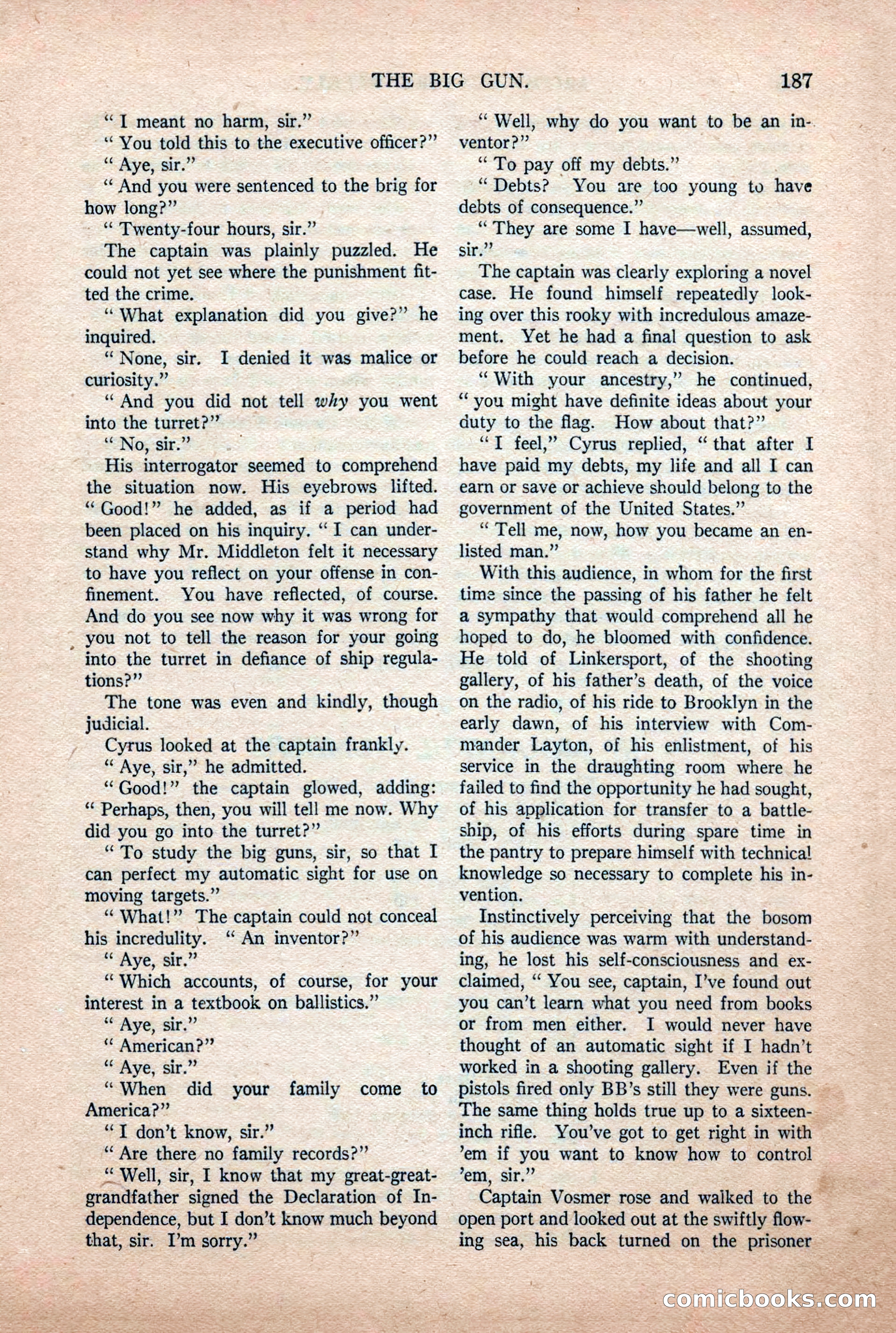
A restored page from Pulp Fiction, 1925. Page through the whole issue in the reader above.
📄 Transcribed text from this page (OCR, searchable)
Machine-transcribed from the original scan — historical spelling and the odd misread are preserved.
THE BIG GUN. “ T meant no harm, sir.” ‘‘' You told this to the executive officer?” “* Aye, sir.” ‘“‘ And you were sentenced to the brig for how long?” - “ Twenty-four hours, sir.” The captain was plainly puzzled. He could not yet see where the punishment fit- ted the crime. “What explanation did you give?” he inquired. “None, sir. curiosity.” “And you did not tell why you went into the turret?” ‘“No, sir.” His interrogator seemed to comprehend the situation now. His eyebrows lifted. “Good!” he added, as if a period had been placed on his inquiry. “I can under- stand why Mr. Middleton felt it necessary to have you reflect on your offense in con- finement. You have reflected, of course. And do you see now why it was wrong for _ you not to tell the reason for your going into the turret in defiance of ship regula- tions?”’ The tone was even and kindly, though judicial. Cyrus looked at the captain frankly. “* Aye, sir,” he admitted. “Good!” the captain glowed, adding: *“‘ Perhaps, then, you will tell me now. Why did you go into the turret?” “To study the big guns, sir, so that I can perfect my automatic sight for use on moving targets.” “What!” The captain could not conceal his incredulity. ‘ An inventor?” “* Aye, sir.” : “Which accounts, of course, for your interest in a textbook on ballistics.” “* Aye, sir.” “* American?” “* Aye, sir.” : “When did your family come to America?” “‘T don’t know, sir.” “Are there no family records?” “ Well, sir, I know that my great-great- grandfather signed the Declaration of In- dependence, but I don’t know much beyond that, sir. I’m sorry.” I denied it was malice or 187 “Well, why do you want to be an in-. ventor?”’ “To pay off my debts.” “Debts? You are too young to have debts of consequence.” “They are some I have—well, assumed, sir.” The captain was clearly exploring a novel case. He found himself repeatedly look- ing over this rooky with incredulous amaze- ment. Yet he had a final question to ask before he could reach a decision. “With your ancestry,” he continued, “you might have definite ideas about your duty to the flag. How about that?” ““T feel,” Cyrus replied, “that after I have paid my debts, my life and all I can earn or save or achieve should belong to the government of the United States.” “Tell me, now, how you became an en- listed man.” With this audience, in whom for the first time since the passing of his father he felt a sympathy that would comprehend all he hoped to do, he bloomed with confidence. He told of Linkersport, of the shooting gallery, of his father’s death, of the voice on the radio, of his ride to Brooklyn in the early dawn, of his interview with Com- mander Layton, of his enlistment, of his service in the draughting room where he failed to find the opportunity he had sought, of his application for transfer to a battle- ship, of his efforts during spare time in the pantry to prepare himself with technica! knowledge so necessary to complete his in- vention. Instinctively perceiving that the bosom of his audience was warm with understand- ing, he lost his self-consciousness and ex- claimed, “ You see, captain, I’ve found out you can’t learn what you need from books or from men either. I would never have thought of an automatic sight if I hadn’t worked in a shooting gallery. Even if the pistols fired only BB’s still they were guns. — The same thing holds true up to a sixteen- inch rifle. You’ve got to get right in with ’em if you want to know how to control ‘em, sir.” Captain Vosmer rose and walked to the open port and looked out at the swiftly flow- ing sea, his back turned on the prisoner = comicbooks. Tiles ~s = May ae SS