
Pulp Fiction, 1925 · page 27 of 168
Argosy All-Story Weekly, July 11, 1925 — page 27: what you’re looking at
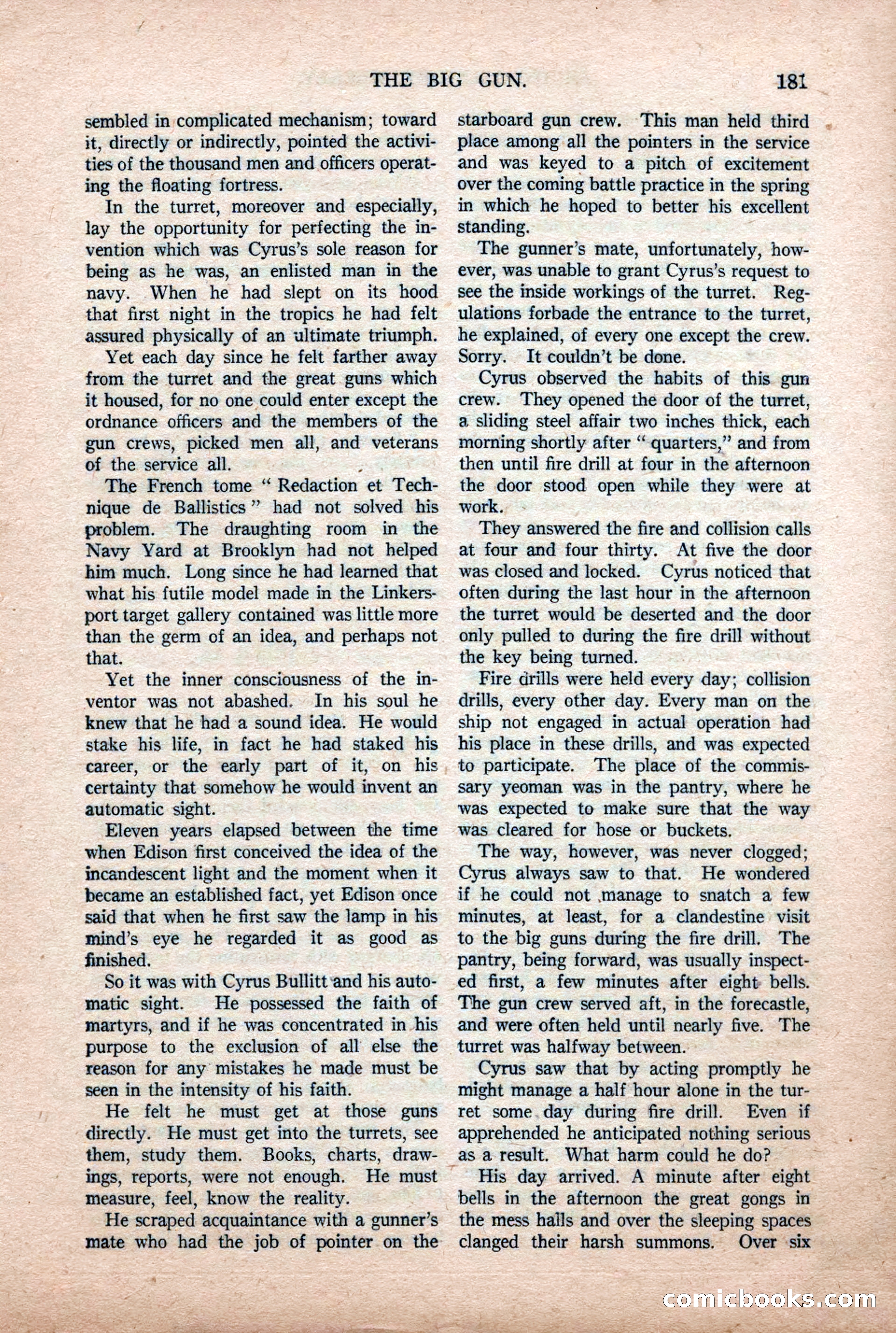
A restored page from Pulp Fiction, 1925. Page through the whole issue in the reader above.
📄 Transcribed text from this page (OCR, searchable)
Machine-transcribed from the original scan — historical spelling and the odd misread are preserved.
ah pe aie 2-5 Ne The i 44 PPP eer A toy of GE PO a NN a ae: eh a THE BIG GUN. sembled in complicated mechanism; toward it, directly or indirectly, pointed the activi- ties of the thousand men and officers operat- ing the floating fortress. In the turret, moreover and especially, lay the opportunity for perfecting the in- vention which was Cyrus’s sole reason for being as he was, an enlisted man in the navy. When he had slept on its hood that first night in the tropics he had felt assured physically of an ultimate triumph. Yet each day since he felt farther away from the turret and the great guns which it housed, for no one could enter except the ordnance officers and the members of the gun crews, picked men all, and veterans of the service all. ; The French tome “ Redaction et Tech- nique de Ballistics” had not solved his problem. The draughting room in the Navy Yard at Brooklyn had not helped him much. Long since he had learned that what his futile model made in the Linkers- port target gallery contained was little more than the germ of an idea, and perhaps not that. Yet the inner consciousness of the in- ventor was not abashed. In his soul he knew that he had a sound idea. He would stake his life, in fact he had staked his career, or the early part of it, on his certainty that somehow he would invent an automatic sight. Eleven years elapsed between the time when Edison first conceived the idea of the incandescent light and the moment when it became an established fact, yet Edison once said that when he first saw the lamp in his mind’s eye he regarded it as good as finished. So it was with Cyrus Bullitt ‘and his auto- matic sight. He possessed the faith of martyrs, and if he was concentrated in his purpose to the exclusion of all else the reason for any mistakes he made must be seen in the intensity of his faith. He felt he must get at those guns directly. He must get into the turrets, see them, study them. Books, charts, draw- ings, reports, were not enough. He must measure, feel, know the reality. He scraped acquaintance with a gunner’s mate who had the job of pointer on the ” “ , i * “ s pd T~ —_ 4 - arene. Sa, —— 7 ° ~ = * s i TE -_- - ay rate? ato » ee 1 pln cae _ —oe Pe wt <> es en Se es ping OSs at TRE ek pe ee Oe > Ss ee eee eee eT ener, Pee ee 181 starboard gun crew. This man held third place among all the pointers in the service and was keyed to a pitch of excitement over the coming battle practice in the spring in which he hoped to better his excellent standing. The gunner’s mate, unfortunately, how- ever, was unable to grant Cyrus’s request to see the inside workings of the turret. Reg- ulations forbade the entrance to the turret, he explained, of every one except the crew. Sorry. It couldn’t be done. Cyrus observed the habits of this gun crew. They opened the door of the turret, a sliding steel affair two inches thick, each morning shortly after “quarters,” and from then until fire drill at four in the afternoon the door stood open while they were at work. They answered the fire and collision calls at four and four thirty. At five the door was closed and locked. Cyrus noticed that often during the last hour in the afternoon the turret would be deserted and the door only pulled to during the fire drill without the key being turned. ) Fire drills were held every day; collision drills, every other day. Every man on the ship not engaged in actual operation had his place in these drills, and was expected to participate. The place of the commis- sary yeoman was in the pantry, where he was expected to make sure that the way was cleared for hose or buckets. The way, however, was never clogged; Cyrus always saw to that. He wondered if he could not manage to snatch a few minutes, at least, for a clandestine visit to the big guns during the fire drill. The pantry, being forward, was usually inspect- ed first, a few minutes after eight bells. The gun crew served aft, in the forecastle, and were often held until nearly five. The— turret was halfway between. Cyrus saw that by acting promptly he might manage a half hour alone in the tur- ret some. day during fire drill. Even if apprehended he anticipated nothing serious as a result. What harm could he do? — His day arrived. A minute after eight bells in the afternoon the great gongs in | the mess hails and over the sleeping spaces clanged their harsh summons. Over six = COMmicbooks