
Pulp Fiction, 1925 · page 142 of 168
Argosy All-Story Weekly, July 11, 1925 — page 142: what you’re looking at
A restored page from Pulp Fiction, 1925. Page through the whole issue in the reader above.
📄 Transcribed text from this page (OCR, searchable)
Machine-transcribed from the original scan — historical spelling and the odd misread are preserved.
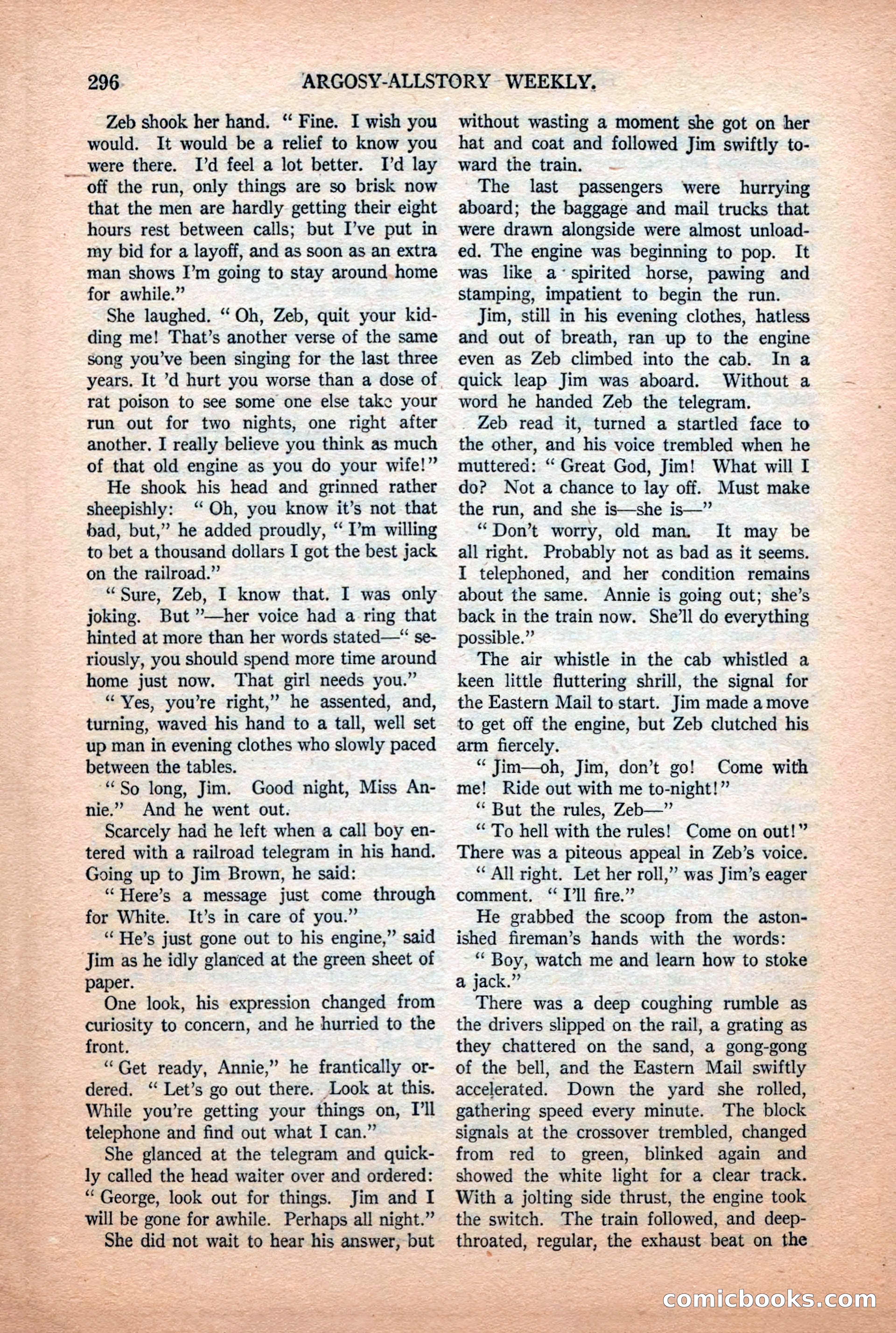
296 ARGOSY-ALLSTORY WEEKLY. Zeb shook her hand. “ Fine. I wish you would. It would be a relief to know you were there. I’d feel a lot better. I’d lay off the run, only things are so brisk now that the men are hardly getting their eight hours rest between calls; but I’ve put in my bid for a layoff, and as soon as an extra man shows I’m going to stay around. home for awhile.” She laughed. ‘Oh, Zeb, quit your kid- ding me! That’s another verse of the same song you’ve been singing for the last three years. It ’d hurt you worse than a dose of rat poison to see some one else take your run out for two nights, one right after another. I really believe you think as much of that old engine as you do your wife!” He shook his head and grinned rather sheepishly: ‘“ Oh, you know it’s not that bad, but,” he added proudly, “ I’m willing to bet a thousand dollars I got the best jack on the railroad.” “Sure, Zeb, I know that. I was only joking. But ’—her voice had a ring that hinted at more than her words stated—* se- riously, you should spend more time around home just now. That girl needs you.” “Yes, you’re right,” he assented, and, turning, waved his hand to a tall, well set up man in evening clothes who slowly paced between the tables. “So long, Jim. Good night, Miss An- nie.” And he went out. Scarcely had he left when a call boy en- tered with a railroad telegram in his hand. Going up to Jim Brown, he said: _ “Here’s a message just come through for White. It’s in care of you.” “He’s just gone out to his engine,” said Jim as he idly glanced at the green sheet of paper. One look, his expression changed from curiosity to concern, and he hurried to the front. “Get ready, Annie,” he frantically or- dered. ‘“ Let’s go out there. Look at this. While you’re getting your things on, I'll _ telephone and find out what I can.” She glanced at the telegram and quick- ly called the head waiter over and ordered: “George, look out for things. Jim and I will be gone for awhile. Perhaps all night.” She did not wait to hear his answer, but without wasting a moment she got on her hat and coat and followed Jim swiftly to- ward the train. The last passengers were hurrying aboard; the baggage and mail trucks that were drawn alongside were almost unload- ed. The engine was beginning to pop. It was like a-spirited horse, pawing and stamping, impatient to begin the run. Jim, still in his evening clothes, hatless and out of breath, ran up to the engine even as Zeb climbed into the cab. In a quick leap Jim was aboard. Without a word he handed Zeb the telegram. Zeb read it, turned a startled face to the other, and his voice trembled when he muttered: “ Great God, Jim! What will I do? Not a chance to lay off. Must make the run, and she is—she is—” “Don’t worry, old man, It may be all right. Probably not as bad as it seems. I telephoned, and her condition remains about the same. Annie is going out; she’s back in the train now. She’ll do everything possible.”’ The air whistle in the cab whistled a keen little fluttering shrill, the signal for the Eastern Mail to start. Jim made a move to get off the engine, but Zeb clutched his arm fiercely. “* Jim—oh, Jim, don’t go! Come with me! Ride out with me to-night!” “‘ But the rules, Zeb—”’ “To hell with the rules! Come on out!” There was a piteous appeal in Zeb’s voice. ** All right. Let her roll,” was Jim’s eager comment. “ [ll fire.” He grabbed the scoop from the aston- ished fireman’s hands with the words: “‘ Boy, watch me and learn how to stoke a jack.” There was a deep coughing rumble as the drivers slipped on the rail, a grating as they chattered on the sand, a gong-gong of the bell, and the Eastern Mail swiftly accelerated. Down the yard she rolled, gathering speed every minute. The block | signals at the crossover trembled, changed from red to green, blinked again and showed the white light for a clear track. With a jolting side thrust, the engine took the switch. The train followed, and deep- throated, regular, the exhaust beat on the. — Fs 2 es ¥ ~m sh, a Peet F ae Bene a RO _ eS st} > . “< . SMe