
Pulp Fiction, 1925 · page 13 of 168
Argosy All-Story Weekly, July 11, 1925 — page 13: what you’re looking at
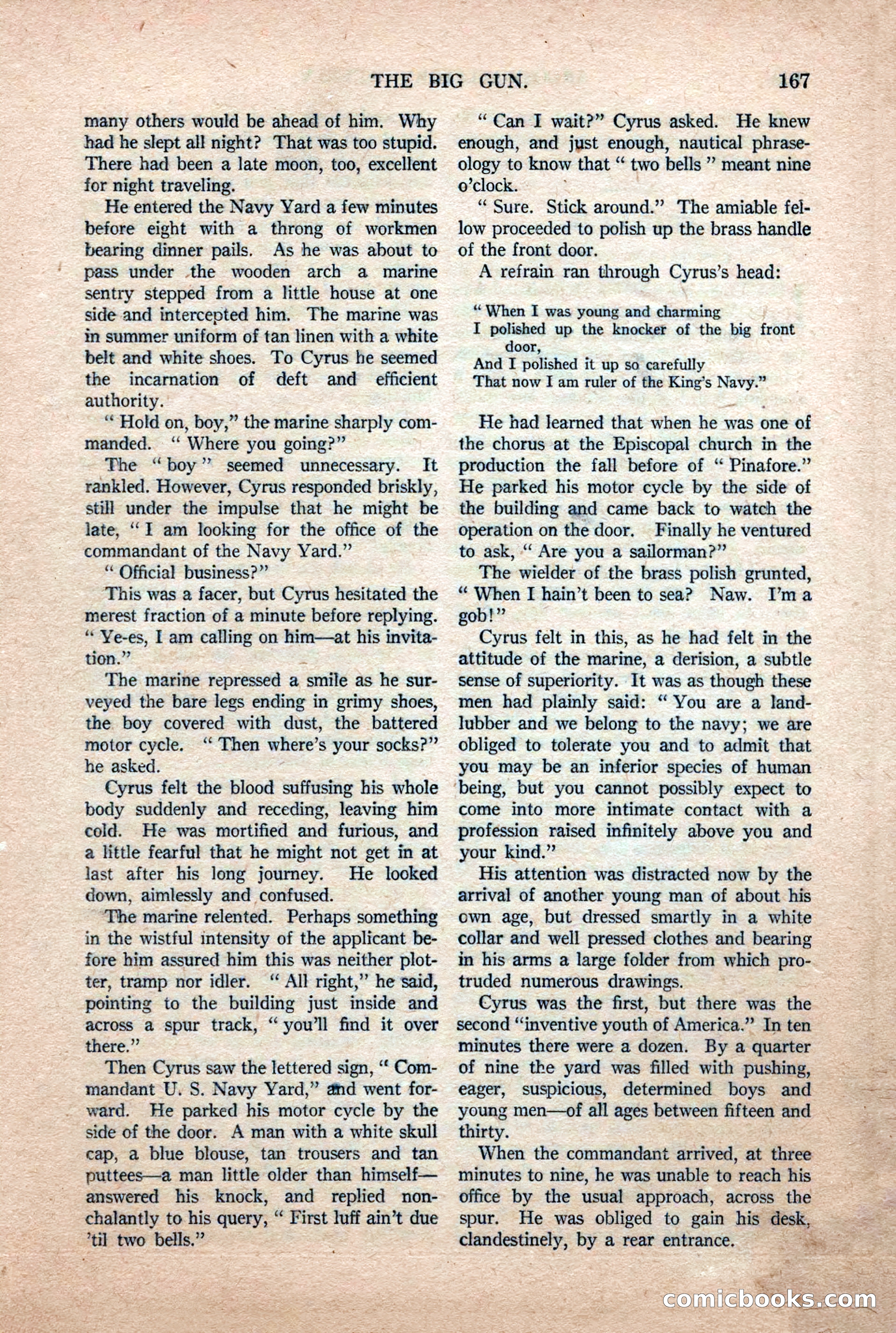
A restored page from Pulp Fiction, 1925. Page through the whole issue in the reader above.
📄 Transcribed text from this page (OCR, searchable)
Machine-transcribed from the original scan — historical spelling and the odd misread are preserved.
THE BIG GUN. many others would be ahead of him. Why had he slept all night? That was too stupid. There had been a late moon, too, excellent for night traveling. He entered the Navy Yard a few minutes before eight with a throng of workmen bearing dinner pails. As he was about to pass under the wooden arch a marine sentry stepped from a little house at one side and intercepted him. The marine was in summer uniform of tan linen with a white belt and white shoes. To Cyrus he seemed the incarnation of deft and _ efficient authority. “Hold on, boy,” the marine sharply com- manded. ‘“‘ Where you going?” The “boy” seemed unnecessary. It rankled. However, Cyrus responded briskly, still under the impulse that he might be late, ‘‘I am looking for the office of the commandant of the Navy Yard.” “ Official business?” This was 2 facer, but Cyrus hesitated the merest fraction of a minute before replying. “ Ye-es, I am calling on him—at his invita- tion.” 2 The marine repressed a smile as he sur- veyed the bare legs ending in grimy shoes, the boy covered with dust, the battered motor cycle. ‘‘ Then where’s your socks?” he asked. Cyrus felt the blood suffusing his whole body suddenly and receding, leaving him cold. He was mortified and furious, and a little fearful that he might not get in at last after his long journey. He looked down, aimlessly and confused. ‘The marine relented. Perhaps something in the wistful intensity of the applicant be- fore him assured him this was neither plot- ter, tramp nor idler. “ All right,” he said, pointing to the building just inside and across a spur track, “ you'll find it over there.” Then Cyrus saw the lettered sign, ‘“‘ Com- mandant U. S. Navy Yard,” and went for- ward. He parked his motor cycle by the side of the door. A man with a white skull cap, a blue blouse, tan trousers and tan puttees—a man little older than himself— answered his knock, and replied non- chalantly to his query, “ First luff ain’t due "til two bells.” 167 “Can I wait?” Cyrus asked. He knew enough, and just enough, nautical phrase- ology to know that “ two bells ” meant nine o’clock. “Sure. Stick around.” The amiable fel- low proceeded to polish up the brass handle of the front door. A refrain ran through Cyrus’s head: “When I was young and charming I polished up the knocker of the big front door, And I polished it up so carefully That now I am ruler of the King’s Navy.” He had learned that when he was one of the chorus at the Episcopal church in the production the fall before of “ Pinafore.” He parked his motor cycle by the side of the building and came back to watch the operation on the door. Finally he ventured to ask, “‘ Are you a sailorman?” The wielder of the brass polish grunted, ““ When I hain’t been to sea? Naw. ma gob!” Cyrus felt in this, as he had felt in the attitude of the marine, a derision, a subtle sense of superiority. It was as though these men had plainly said: “ You are a land- lubber and we belong to the navy; we are obliged to tolerate you and to admit that you may be an inferior species of human ‘being, but you cannot possibly expect to come into more intimate contact with a profession raised infinitely above you and your kind.” His attention was distracted now by the arrival of another young man of about his own age, but dressed smartly in a white collar and well pressed clothes and bearing in his arms a large folder from which pro- truded numerous drawings. Cyrus was the first, but there was the second “inventive youth of America.” In ten minutes there were a dozen. By a quarter of nine the yard was filled with pushing, eager, suspicious, determined boys and young men—of all ages between fifteen and thirty. When the commandant arrived, at ‘es minutes to nine, he was unable to ‘seneh his office by the usual approach, across the spur. He was obliged to gain his desk, — — cea by a rear entrance. eee os COmic books.com