
Pulp Fiction, 1925 · page 129 of 168
Argosy All-Story Weekly, July 11, 1925 — page 129: what you’re looking at
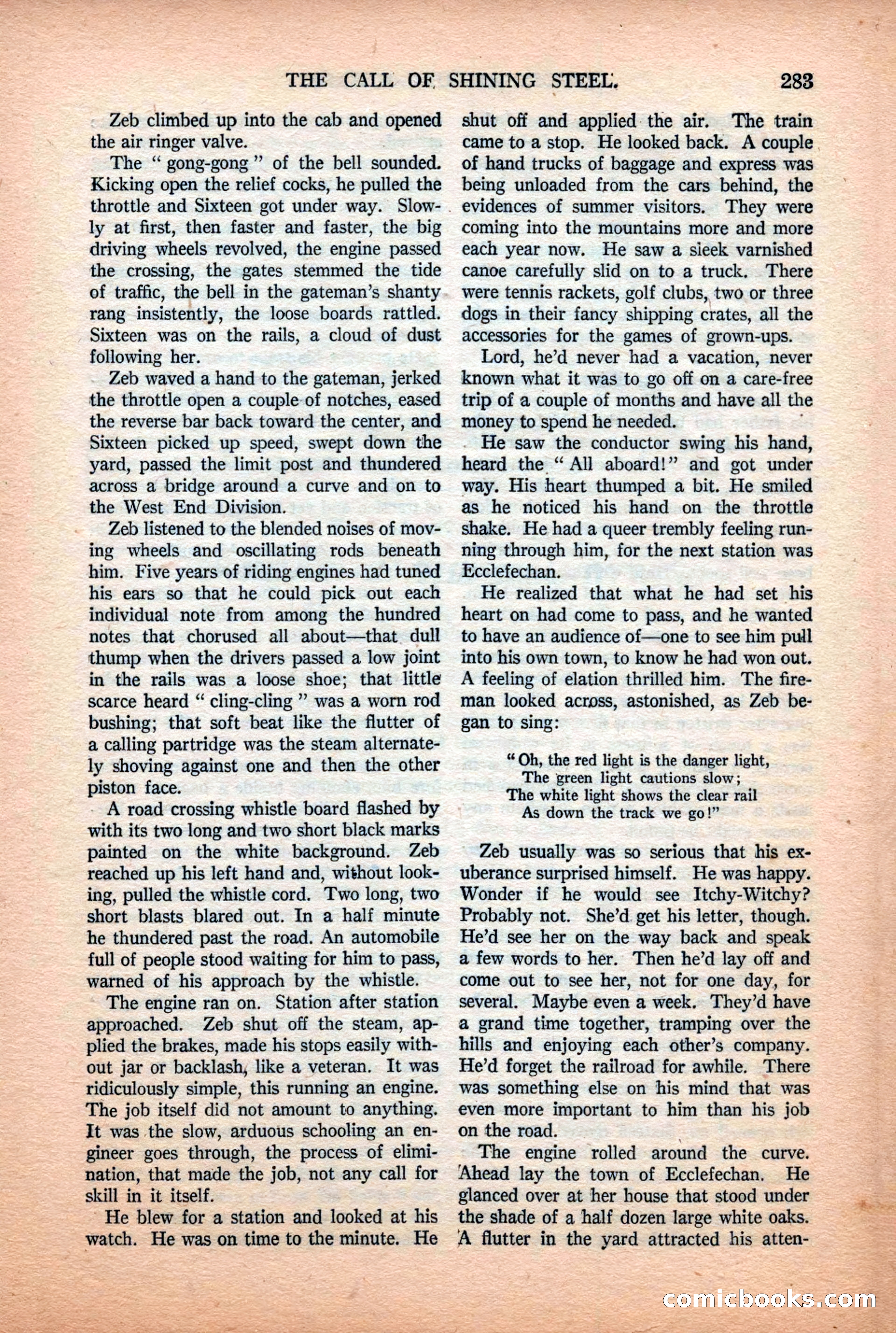
A restored page from Pulp Fiction, 1925. Page through the whole issue in the reader above.
📄 Transcribed text from this page (OCR, searchable)
Machine-transcribed from the original scan — historical spelling and the odd misread are preserved.
THE CALL OF SHINING STEEL. Zeb climbed up into the cab and opened the air ringer valve. The “ gong-gong ” of the bell sounded. Kicking open the relief cocks, he pulled the throttle and Sixteen got under way. Slow- . ly at first, then faster and faster, the big driving wheels revolved, the engine passed the crossing, the gates stemmed the tide of traffic, the bell in the gateman’s shanty rang insistently, the loose boards rattled. Sixteen was on the rails, a cloud of dust following her. Zeb waved a hand to the gateman, jerked the throttle open a couple of notches, eased the reverse bar back toward the center, and Sixteen picked up speed, swept down the yard, passed the limit post and thundered across a bridge around a curve and on to the West End Division. Zeb listened to the blended noises of mov- ing wheels and oscillating rods beneath him. Five years of riding engines had tuned his ears so that he could pick out each individual note from among the hundred notes that chorused all about—that dull thump when the drivers passed a low joint in the rails was a loose shoe; that little scarce heard “ cling-cling ” was a worn rod bushing; that soft beat like the flutter of a calling partridge was the steam alternate- ly shoving against one and then the other piston face. - A road crossing whistle board flashed by with its two long and two short black marks painted on the white background. Zeb reached up his left hand and, without look- ing, pulled the whistle cord. Two long, two short blasts blared out. In a half minute he thundered past the road. An automobile full of people stood waiting for him to pass, warned of his approach by the whistle. The engine ran on. Station after station approached. Zeb shut off the steam, ap- plied the brakes, made his stops easily with- out jar or backlash, like a veteran. It was ridiculously simple, this running an engine. The job itself did not amount to anything. It was the slow, arduous schooling an en- gineer goes through, the process of elimi- nation, that made the job, not any call for skill in it itself. He blew for a station and looked at his watch. He was on time to the minute. He 283 shut off and applied. the air. The train came to a stop. He looked back. A couple. of hand trucks of baggage and express was being unloaded from the cars behind, the evidences of summer visitors. They were coming into the mountains more and more each year now. He saw a sieek varnished canoe carefully slid on to a truck. There were tennis rackets, golf clubs, two or three dogs in their fancy shipping crates, all the accessories for the games of grown-ups. Lord, he’d never had a vacation, never known what it was to go off on a care-free trip of a couple of months and have all the money to spend he needed. . He saw the conductor swing his hand, heard the “ All aboard!” and got under way. His heart thumped a bit. He smiled as he noticed his hand on the throttle shake. He had a queer trembly feeling run- ning through him, for the next station was Ecclefechan. He realized that what he had set his heart on had come to pass, and he wanted to have an audience of—one to see him pull into his own town, to know he had won out. A feeling of elation thrilled him. The fire- man looked across, astonished, as Zeb be- gan to sing: “ Oh, the red light is the danger light, The green light cautions slow; The white light shows the clear rail As down the track we go!” Zeb usually was so serious that his ex- uberance surprised himself. He was happy. Wonder if he would see Itchy-Witchy? Probably not. She’d get his letter, though. He’d see her on the way back and speak a few words to her. Then he’d lay off and come out to see her, not for one day, for several. Maybe even a week. They’d have a grand time together, tramping over the hills and enjoying each other’s company. He’d forget the railroad for awhile. There was something else on his mind that was even more important to him than his job on the road. The engine rolled around the curve. Ahead lay the town of Ecclefechan. He glanced over at her house that stood under the shade of a half dozen large white oaks. A flutter in the yard attracted his atten- = ~~ aed ~ x z 4 ) ~ a, ae a Fs -" ~ — ee, . = : eS = nag sg oe ue Sn —— a a... ae ~~ po — ad _ 2 ee a