
Pulp Fiction, 1925 · page 120 of 168
Argosy All-Story Weekly, July 11, 1925 — page 120: what you’re looking at
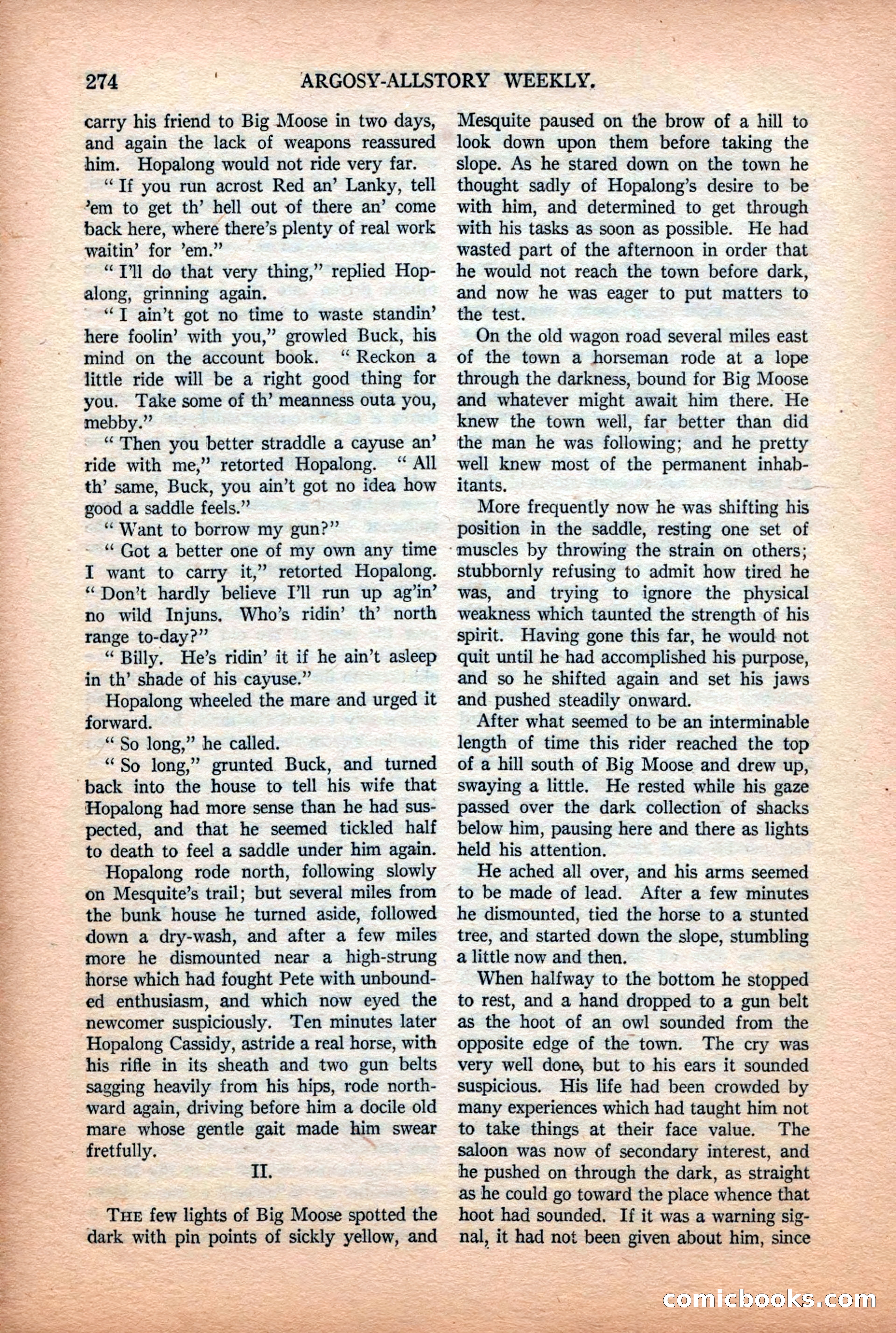
A restored page from Pulp Fiction, 1925. Page through the whole issue in the reader above.
📄 Transcribed text from this page (OCR, searchable)
Machine-transcribed from the original scan — historical spelling and the odd misread are preserved.
Ow SU Pyia te fa fi tti t) ws he ay FAR AO ATES FOG ? a Real | , 274 carry his friend to Big Moose in two days, and again the lack of weapons reassured him. Hopalong would not ride very far. “Tf you run acrost Red an’ Lanky, tell ?em to get th’ hell out of there an’ come back here, where there’s plenty of real work waitin’ for ’em.” “T’ll do that very thing,” replied Hop- along, grinning again. “T ain’t got no time to waste standin’ here foolin’ with you,” growled Buck, his mind on the account book. ‘“ Reckon a little ride will be a right good thing for you. Take some of th’ meanness outa you, mebby.” “Then you better straddle a cayuse an’ ride with me,” retorted Hopalong. “ All th’ same, Buck, you ain’t got no idea how good a saddle feels.” “Want to borrow my gun?” “ Got a better one of my own any time I want to carry it,” retorted Hopalong. “Don’t hardly believe I'll run up ag’in’ no wild Injuns. Who’s ridin’ th’ north range to-day?” “Billy, He’s ridin’ it if he ain’t asleep in th’ shade of his cayuse.” Hopalong wheeled the mare and urged it forward. “So long,” he called. “So long,” grunted Buck, and turned ‘back into the house to tell his wife that Hopalong had more sense than he had sus- pected, and that he seemed tickled half to death to feel a saddle under him again. Hopalong rode north, following slowly on Mesquite’s trail; but several miles from the bunk house he turned aside, followed down a dry-wash, and after a few miles more he dismounted near a_high-strung horse which had fought Pete with unbound- ed enthusiasm, and which now eyed the newcomer suspiciously. ‘Ten minutes later Hopalong Cassidy, astride a real horse, with his rifle in its sheath and two gun belts sagging heavily from his hips, rode north- ward again, driving before him a docile old mare whose gentle gait made him swear - fretfully. Il. THE few lights of Big Moose spotted the dark with pin points of sickly yellow, and ARGOSY-ALLSTORY WEEKLY. Mesquite paused on the brow of a hill to look down upon them before taking the slope. As he stared down on the town he thought sadly of Hopalong’s desire to be with him, and determined to get through with his tasks as soon as possible. He had wasted part of the afternoon in order that he would not reach the town before dark, and now he was eager to put matters to the test. On the old wagon road several miles east of the town a horseman rode at a lope through the darkness, bound for Big Moose and whatever might await him there. He knew the town well, far better than did the man he was following; and he pretty well knew most of the permanent inhab- itants. More frequently now he was shifting his position in the saddle, resting one set of ‘muscles by throwing the strain on others; stubbornly refusing to admit how tired he was, and trying to ignore the physical weakness which taunted the strength of his spirit. Having gone this far, he would not quit until he had accomplished his purpose, and so he shifted again and set his jaws and pushed steadily onward. After what seemed to be an interminable length of time this rider reached the top of a hill south of Big Moose and drew up, swaying a little. He rested while his gaze passed over the dark collection of shacks below him, pausing here and there as lights held his attention. He ached all over, and his arms seemed © to be made of lead. After a few minutes he dismounted, tied the horse to a stunted tree, and started down the slope, stumbling a little now and then. When halfway to the bottom he stopped to rest, and a hand dropped to a gun belt as the hoot of an owl sounded from the opposite edge of the town. The cry was very well done, but to his ears it sounded suspicious. His life had been crowded by many experiences which had taught him not to take things at their face value. The saloon was now of secondary interest, and he pushed on through the dark, as straight as he could go toward the place whence that hoot had sounded. If it was a warning sig- nal, it had not been given about him, since I