
Pulp Fiction, 1925 · page 111 of 168
Argosy All-Story Weekly, July 11, 1925 — page 111: what you’re looking at
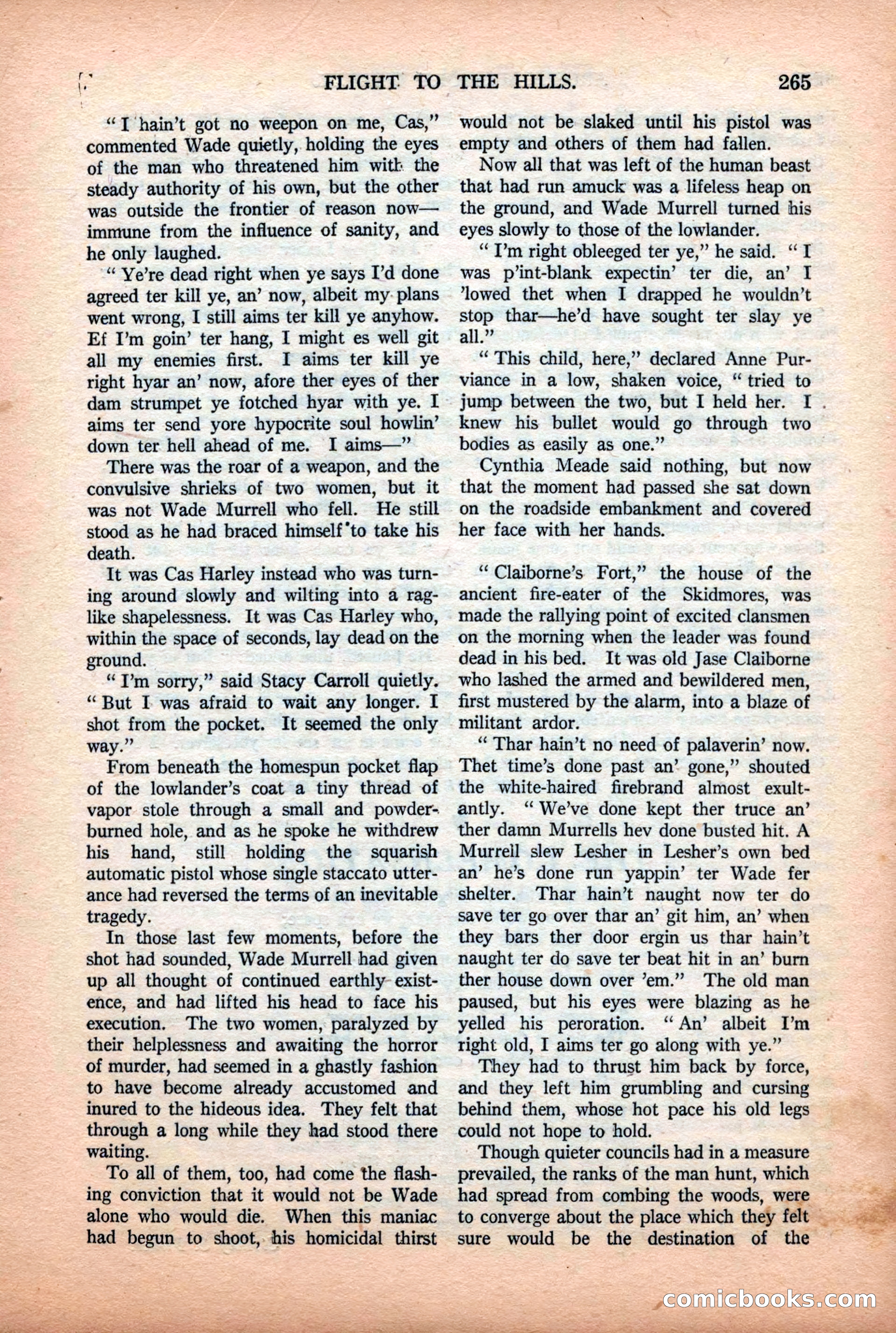
A restored page from Pulp Fiction, 1925. Page through the whole issue in the reader above.
📄 Transcribed text from this page (OCR, searchable)
Machine-transcribed from the original scan — historical spelling and the odd misread are preserved.
FLIGHT TO “T hain’t got no weepon on me, Cas,” commented Wade quietly, holding the eyes of the man who threatened him with the steady authority of his own, but the other was outside the frontier of reason now— immune from the influence of sanity, and he only laughed. : “Ve’re dead right when ye says I’d done agreed ter kill ye, an’ now, albeit my- plans went wrong, I still aims ter kill ye anyhow. Ef I’m goin’ ter hang, I might es well git all my enemies first. I aims ter kill ye right hyar an’ now, afore ther eyes of ther dam strumpet ye fotched hyar with ye. I aims ter send yore hypocrite soul howlin’ down ter hell ahead of me. I aims—” There was the roar of a weapon, and the convulsive shrieks of two women, but it was not Wade Murrell who fell. He still stood as he had braced himself*to take his death. It was Cas Harley instead who was turn- ing around slowly and wilting into a rag- like shapelessness. It was Cas Harley who, within the space of seconds, lay dead on the ground. “Tm sorry,” said Stacy Carroll quietly. “ But I was afraid to wait any longer. I shot from the pocket. It seemed the only way.” From beneath the homespun pocket flap of the lowlander’s coat a tiny thread of vapor stole through a small and powder- burned hole, and as he spoke he withdrew his hand, still holding the squarish automatic pistol whose single staccato utter- ance had reversed the terms of an inevitable tragedy. In those last few moments, before the shot had sounded, Wade Murrell had given up all thought of continued earthly- exist- ence, and had lifted his head to face his execution. The two women, paralyzed by their helplessness and awaiting the horror of murder, had seemed in a ghastly fashion to have become already accustomed and inured to the hideous idea. They felt that through a long while they had stood there waiting. 7 To all of them, too, had come the flash- ing conviction that it would not be Wade alone who would die. When this maniac had begun to shoot, his homicidal thirst THE HILLS. 265 would not be slaked until his pistol was empty and others of them had fallen. Now all that was left of the human beast that had run amuck was a lifeless heap on the ground, and Wade Murrell turned his eyes slowly to those of the lowlander. “Tm right obleeged ter ye,” he said. ‘I was p’int-blank expectin’ ter die, an’ I ‘lowed thet when I drapped he wouldn’t stop thar—he’d have sought ter slay ye all.” “This child, here,’ declared Anne Pur- viance in a low, shaken voice, “ tried to jump between the two, but I held her. [ . knew his bullet would go through two bodies as easily as one.” Cynthia Meade said nothing, but now that the moment had passed she sat down on the roadside embankment and covered her face with her hands. “‘ Claiborne’s. Fort,” the house of the ancient fire-eater of the Skidmores, was made the rallying point of excited clansmen on the morning when the leader was found dead in his bed. It was old Jase Claiborne who lashed the armed and bewildered men, first mustered by the alarm, into a blaze of militant ardor. “Thar hain’t no need of palaverin’ now. Thet time’s done past an’ gone,” shouted the white-haired firebrand almost exult- antly. ‘“ We’ve done kept ther truce an’ ther damn Murrells hev done busted hit. A Murrell slew Lesher in Lesher’s own bed an’ he’s done run yappin’ ter Wade fer shelter. Thar hain’t naught now ter do save ter go over thar an’ git him, an’ when they bars ther door ergin us thar hain’t naught ter do save ter beat hit in an’ burn ther house down over ’em.” The old man paused, but his eyes were blazing as he yelled his peroration. “ An’ albeit I’m right old, I aims ter go along with ye.” They had to thrust him back by force, and they left him grumbling and cursing behind them, whose hot pace his old legs could not hope to hold. Though quieter councils had in a measure prevailed, the ranks of the man hunt, which had spread from combing the woods, were = to converge about the place which they felt: sure would be the destination of the