
Pulp Fiction, 1925 · page 106 of 168
Argosy All-Story Weekly, July 11, 1925 — page 106: what you’re looking at
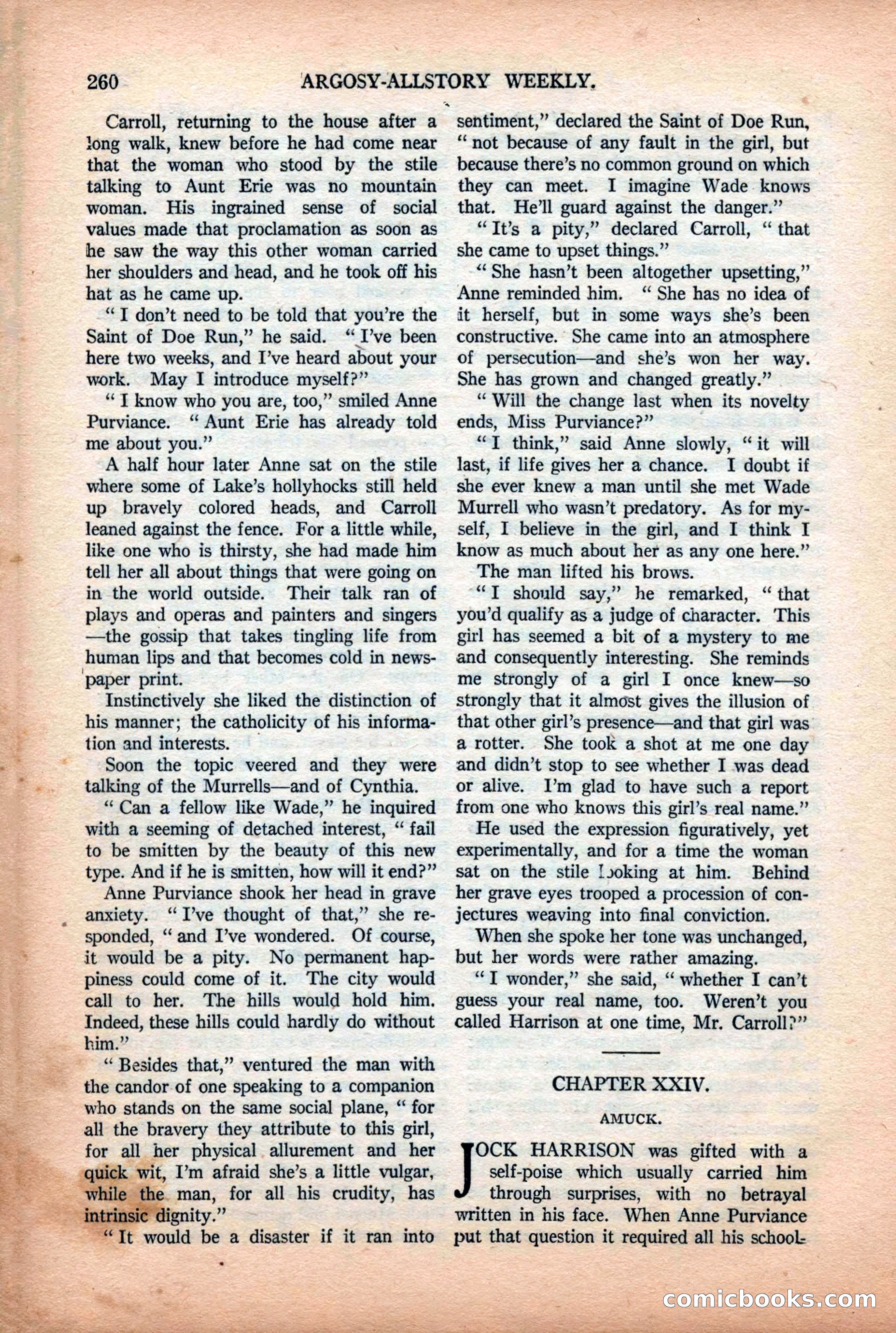
A restored page from Pulp Fiction, 1925. Page through the whole issue in the reader above.
📄 Transcribed text from this page (OCR, searchable)
Machine-transcribed from the original scan — historical spelling and the odd misread are preserved.
Wh etree te bet Uys Ma Py with s$ » Pip: aN 260 Carroll, returning to the house after a long walk, knew before he had come near that the woman who stood by the stile talking to Aunt Erie was no mountain woman. His ingrained sense of social values made that proclamation as soon as he saw the way this other woman carried her shoulders and head, and he took off his hat as he came up. “I don’t need to be told that you’re the ras Saint of Doe Run,” he said. “I’ve been here two weeks, and I’ve heard about your work. May I introduce myself?” ‘“*T know who you are, too,’”’ smiled Anne Purviance. “ Aunt Erie has already told me about you.” A half hour later Anne sat on the stile where some of Lake’s hollyhocks still held up bravely colored heads, and Carroll leaned against the fence. For a little while, like one who is thirsty, she had made him tell her all about things that were going on in the world outside. Their talk ran of plays and operas and painters and singers —the gossip that takes tingling life from human lips and that becomes cold in news- paper print. 3 Instinctively she liked the distinction of his manner; the catholicity of his informa- Sg tion and interests. . ~*~ §oo0n the topic veered and they were _*.. talking of the Murrells—and of Cynthia. “Can a fellow like Wade,” he inquired a , 33 with a seeming of detached interest, “ fail a to be smitten by the beauty of this new = type. And if he is smitten, how will it end?” 23 Anne Purviance shook her head in grave anxiety. “I’ve thought of that,” she re- sponded, ‘‘ and I’ve wondered. Of course, it would be a pity. No permanent hap- piness could come of it. The city would call to her. The hills would hold him. Indeed, these hills could hardly do without = him.” _————s« :~Besides that,” ventured the man with | _ the candor of one speaking to a companion who stands on the same social plane, “ for all the bravery they attribute to this girl, et all... her physical allurement and her k wit, I’m afraid she’s a little vulgar, the man, for all his crudity, has > =e Mt would-be disaster-if ik ran into ARGOSY-ALLSTORY WEEKLY. t sentiment,” declared the Saint of Doe Run, “not because of any fault in the girl, but because there’s no common ground on which they can meet. I imagine Wade. knows that. He’ll guard against the danger.” “It’s a pity,” declared Carroll, ‘ that she came to upset things.” “‘She hasn’t been altogether upsetting,” Anne reminded him. “ She has no idea of it herself, but in some ways she’s been constructive. She came into an atmosphere of persecution—and she’s won her way. She has grown and changed greatly.” “Will the change last when its novelty ends, Miss Purviance?” “T think,” said Anne slowly, “ it will last, if life gives her a chance. I doubt if she ever knew a man until she met Wade Murrell who wasn’t predatory. As for my- self, I believe in the girl, and I think I know as much about her as any one here.” The man lifted his brows. “IT should say,” he remarked, “ that you’d qualify as a judge of character. This gitl has seemed a bit of a mystery to me and consequently interesting. She reminds me strongly of a girl I once knew—so strongly that it almost gives the illusion of that other girl’s presence—and that girl was. a rotter. She took a shot at me one day and didn’t stop to see whether I was dead or alive. I’m glad to have such a report from one who knows this girl’s real name.” He used the expression figuratively, yet experimentally, and for a time the woman sat on the stile looking at him. Behind her grave eyes trooped a procession of con- jectures weaving into final conviction. When she spoke her tone was unchanged, but her words were rather amazing. “I wonder,” she said, ‘‘ whether I can’t guess your real name, too. Weren’t you called Harrison at one time, Mr. Carroll?” CHAPTER XXIV, AMUCK. OCK HARRISON was gifted with a J self-poise which usually carried him through surprises, with no_ betrayal written in his face. When Anne Purviance put that question it required all his school- ae - | 4 my ~, + - Soe al cbooks.com or ac) a SS a a To Te a Oo