
Pulp Fiction, 1925 · page 54 of 172
Argosy All-Story Weekly — page 54: what you’re looking at
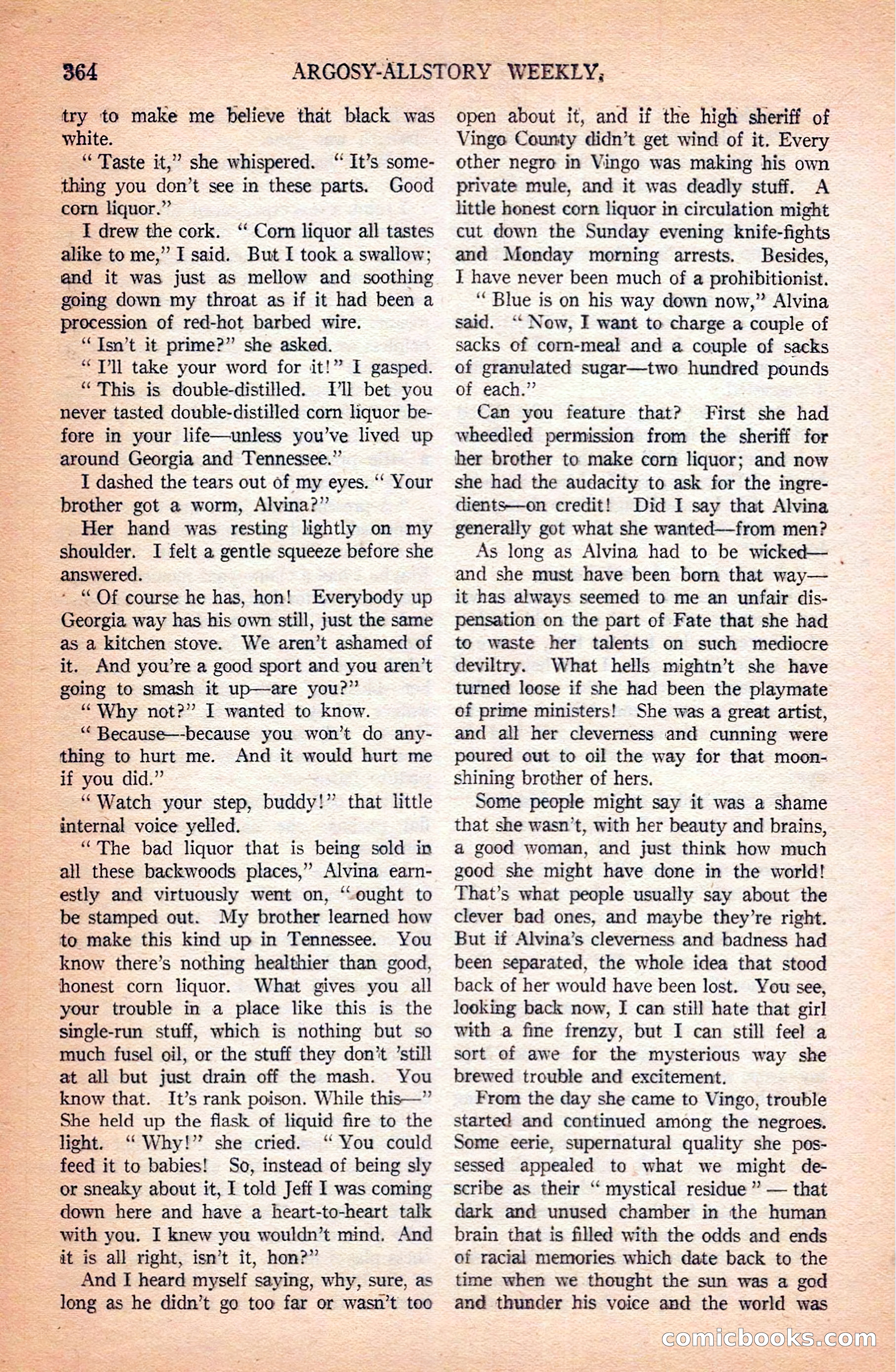
A restored page from Pulp Fiction, 1925. Page through the whole issue in the reader above.
📄 Transcribed text from this page (OCR, searchable)
Machine-transcribed from the original scan — historical spelling and the odd misread are preserved.
ee try to make me believe that black was ‘white. “Taste it,” she whispered. “ It’s some- thing you don’t see in these parts. Good corn liquor.” _ I drew the cork. “ Corn liquor all tastes alike to me,” I said. But I took a swallow; and it was just as mellow and soothing going down my throat as if it had been a oS procession of red-hot barbed wire. _“Tsn’t it prime?” she asked. “ll take your word for it!” I gasped. “This is double-distilled. WUll bet you never tasted double-distilled corn liquor be- fore in your life—unless you’ve lived up around Georgia and Tennessee.” I dashed the tears out of my eyes. “‘ Your brother got a worm, Alvina?”’ Her hand was resting lightly on my shoulder. I felt a gentle squeeze before she answered. Tight. a P ‘ “Of course he has, hon! Everybody up Georgia way has his own still, just the same as a kitchen stove. We aren’t ashamed of - it. And you’re a good sport and you aren’t going to smash it up—are you?” _“ Why not?” I wanted to know. ““ Because—-because you won’t do any- thing to hurt me. And it would hurt me if you did.” “Watch your step, buddy!” that little - internal voice yelled. “The bad liquor that is being sold in all these backwoods places,” Alvina earn- estly and virtuously went on, “cought to be stamped out. My brother learned how to make this kind up in Tennessee. You know there’s nothing healthier than good, honest corn liquor. What gives you all your trouble in a place like this is the single-run stuff, which is nothing but so much fusel oil, or the stuff they don’t ’still at all but just drain off the mash. You know that. It’s rank poison. While this—” She held up the flask of liquid fire to the “Why!” she cried. “ You could feed it to babies! So, instead of being sly or sneaky about it, I told Jeff I was coming down here and have a heart-to-heart talk _ with you. I knew you wouldn’t mind. And it is all right, isn’t it, hon?” And I heard myself saying, why, sure, as long as he didn’t go too far or wasn’t too ARGOSY-ALLSTORY WEEKLY, open about it, and if the high sheriff of Vinge County didn’t get wind of it. Every other negro in Vingo was making his own private mule, and it was deadly stuff. A little honest corn liquor in circulation might cut down the Sunday evening knife-fights and Monday morning arrests. Besides, I have never been much of a prohibitionist. ‘Blue is on his way down now,” Alvina said. “‘ Now, I want to charge a couple of sacks of corn-meal and a couple of sacks of granulated sugar—two hundred pounds of each.” Can you feature that? First she had wheedled permission from the sheriff for her brother to make corn liquor; and now she had the audacity to ask for the ingre- dients—on credit! Did I say that Alvina generally got what she wanted—from men? As long as Alvina had to be wicked— | and she must have been born that way— it has always seemed to me an unfair dis- pensation on the part of Fate that she had to waste her talents on such mediocre deviltry. What hells mightn’t she have turned loose if she had been the playmate of prime ministers! She was a great artist, and all her cleverness and cunning were poured out to oil the way for that moon- shining brother of hers. Some people might say it was a shame that she wasn’t, with her beauty and brains, a good woman, and just think how much good she might have done in the world! That’s what people usually say about the clever bad ones, and maybe they’re right. But if Alvina’s cleverness and badness had been separated, the whole idea that stood back of her would have been lost. You see, looking back now, I can still hate that girl with a fime frenzy, but I can still feel a sort of awe for the mysterious way she brewed trouble and excitement. From the day she came to Vingo, trouble started and continued among the negroes. Some eerie, supernatural quality she pos- sessed appealed to what we might de- scribe as their “ mystical residue ” — that dark and unused chamber in the human brain that is filled with the odds and ends of racial memories which date back to the time when we thought the sun was a god and thunder his voice and the world was oO (EOPMIC YOO KS q(EC)