
Pulp Fiction, 1925 · page 43 of 172
Argosy All-Story Weekly — page 43: what you’re looking at
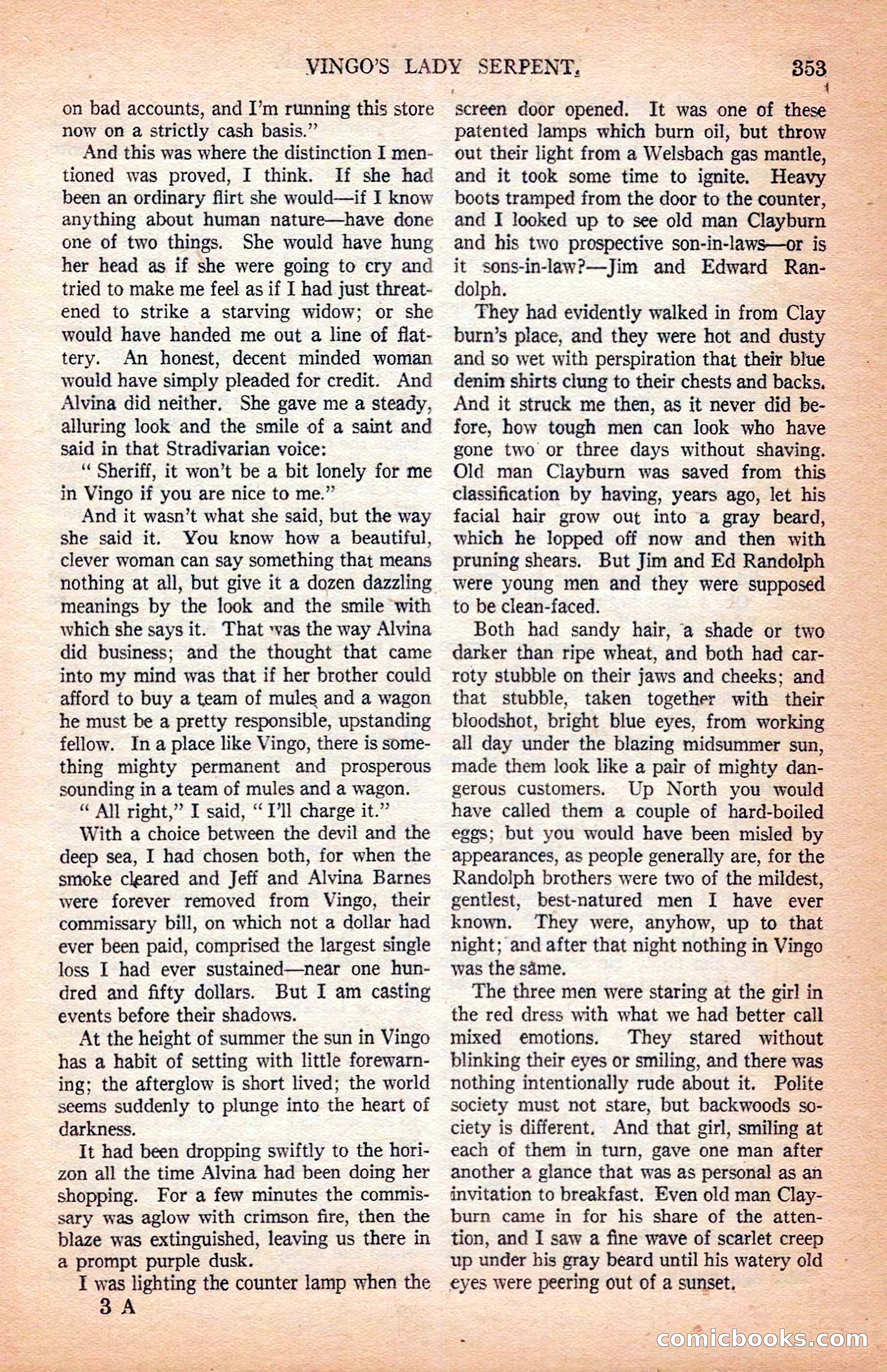
A restored page from Pulp Fiction, 1925. Page through the whole issue in the reader above.
📄 Transcribed text from this page (OCR, searchable)
Machine-transcribed from the original scan — historical spelling and the odd misread are preserved.
VINGO’S LADY SERPENT. on bad accounts, and I’m running this store now on a strictly cash basis.” And this was where the distinction I men- tioned was proved, I think. If she had been an ordinary flirt she would—if I know anything about human nature—have done one of two things. She would have hung her head as if she were going to ery and tried to make me feel as if I had just threat- ened to strike a starving widow; or she would have handed me out a line of flat- tery. An honest, decent minded woman would have simply pleaded for credit. And Alvina did neither. She gave me a steady, alluring look and the smile of a saint and said in that Stradivarian voice: “ Sheriff, it won’t be a bit lonely for me in Vingo if you are nice to me.” And it wasn’t what she said, but the way She said it. You know how a beautiful, clever woman can say something that means nothing at all, but give it a dozen dazzling meanings by the look and the smile with which she says it. That was the way Alvina did business; and the thought that came into my mind was that if her brother could afford to buy a team of mules and a wagon he must be a pretty responsible, upstanding fellow. Ina place like Vingo, there is some- thing mighty permanent and prosperous sounding in a team of mules and a wagon. “ All right,” I said, “I'll charge it.” With a choice between the devil and the deep sea, I had chosen both, for when the smoke cleared and Jeff and Alvina Barnes were forever removed from Vingo, their commissary bill, on which not a dollar had ever been paid, comprised the largest single loss I had ever sustained—near one hun- dred and fifty dollars. But I am casting events before their shadows. At the height of summer the sun in Vingo has a habit of setting with little forewarn- ing; the afterglow is short lived; the world seems suddenly to plunge into the heart of darkness. It had been dropping swiftly to the hori- zon all the time Alvina had been doing her shopping. For a few minutes the commis- sary was aglow with crimson fire, then the blaze was extinguished, leaving us there in a prompt purple dusk. I was lighting the counter lamp when the 3 A < screen door opened. It was one of these patented Jamps which burn oil, but throw out their light from a Welsbach gas mantle, and it took some time to ignite. Heavy boots tramped from the door to the counter, and I looked up to see old man Clayburn and his two prospective son-in-laws—or is it sons-in-law?—Jim and Edward Ran- dolph. They had evidently walked in from Clay burn’s place, and they were hot and dusty and so wet with perspiration that their blue denim shirts clung to their chests and backs. And it struck me then, as it never did be- fore, how tough men can look who have gone two or three days without shaving. Old man Clayburn was saved from this classification by having, years ago, let his facial hair grow out into a gray beard, which he lopped off now and then with pruning shears. But Jim and Ed Randolph were young men and they were supposed to be clean-faced. Both had sandy hair, a shade or two darker than ripe wheat, and both had car- roty stubble on their jaws and cheeks; and that stubble, taken together with their bloodshot, bright blue eyes, from working all day under the blazing midsummer sun, made them look like a pair of mighty dan- gerous customers. Up North you would have called them a couple of hard-boiled eggs; but you would have been misled by appearances, as people generally are, for the Randolph brothers were two of the mildest, gentlest, best-natured men I have ever known. They were, anyhow, up to that night; and after that night nothing in Vingo was the same. 7 The three men were staring at the girl in the red dress with what we had better call mixed emotions. They stared without blinking their eyes or smiling, and there was nothing intentionally rude about it. Polite society must not stare, but backwoods so- ciety is different. And that girl, smiling at each of them in turn, gave one man after another a glance that was as personal as an invitation to breakfast. Even old man Clay- burn came in for his share of the atten-. tion, and I saw a fine wave of scarlet creep up under his gray beard until his watery old eyes were peering out of a sunset. _ =comicbooks,. we as ——.. >» tn a re Pate