
Pulp Fiction, 1925 · page 32 of 172
Argosy All-Story Weekly — page 32: what you’re looking at
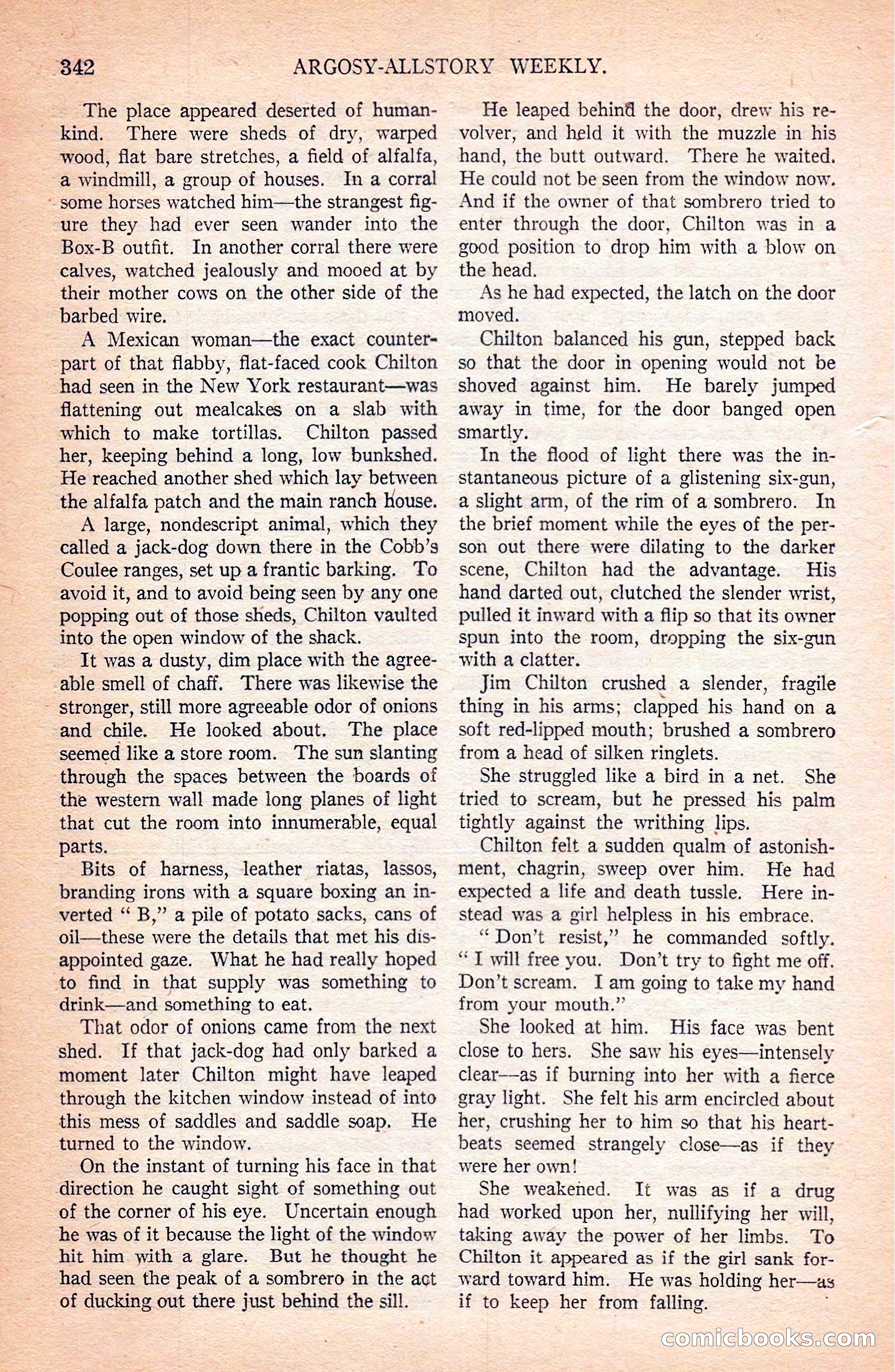
A restored page from Pulp Fiction, 1925. Page through the whole issue in the reader above.
📄 Transcribed text from this page (OCR, searchable)
Machine-transcribed from the original scan — historical spelling and the odd misread are preserved.
842 able smell of chaff. - stronger, still more agreeable odor of onions The place appeared deserted of human- kind. There were sheds of dry, warped wood, flat bare stretches, a field of alfalfa, a windmill, a group of houses. In a corral ~ some horses watched him—the strangest fig- ure they had ever seen wander into the Box-B outfit. In another corral there were calves, watched jealously and mooed at by their mother cows on the other side of the barbed wire. A Mexican woman—the exact counter- part of that flabby, flat-faced cook Chilton had seen in the New York restaurant—was flattening out mealcakes on a slab with which to make tortillas. Chilton passed her, keeping behind a long, low bunkshed. He reached another shed which lay between the alfalfa patch and the main ranch House. A large, nondescript animal, which they called a jack-dog down there in the Cobb’s Coulee ranges, set up a frantic barking. To avoid it, and to avoid being seen by any one popping out of those sheds, Chilton vaulted into the open window of the shack. It was a dusty, dim place with the agree- There was likewise the and chile. He looked about. ‘The place seemed like a store room. The sun slanting through the spaces between the boards of the western wall made long planes of light that cut the room into innumerable, equal parts. Bits of harness, leather riatas, lassos, branding irons with a square boxing an in- verted ‘“‘ B,” a pile of potato sacks, cans of oil—these were the details that met his dis- appointed gaze. What he had really hoped to find in that supply was something to drink—and something to eat. That odor of onions came from the next shed. If that jack-dog had only barked a moment later Chilton might have leaped through the kitchen window instead of into this mess of saddles and saddle soap. He turned to the window. On the instant of turning his face in that direction he caught sight of something out of the corner of his eye. Uncertain enough he was of it because the light of the window hit him with a glare. But he thought he had seen the peak of a sombrero in the act of ducking out there just behind the sill. ARGOSY-ALLSTORY WEEKLY. He leaped behind the door, drew his re- volver, and held it with the muzzle in his hand, the butt outward. There he waited. He could not be seen from the window now. And if the owner of that sombrero tried to enter through the door, Chilton was in a good position to drop him with a blow on the head. As he had expected, the latch on the door moved. Chilton balanced his gun, stepped back so that the door in opening would not be shoved against him. He barely jumped away in time, for the door banged open smartly. In the flood of light there was the in- stantaneous picture of a glistening six-gun, a slight arm, of the rim of a sombrero. In the brief moment while the eyes of the per- son out there were dilating to the darker scene, Chilton had the advantage. His hand darted out, clutched the slender wrist, pulled it inward with a flip so that its owner spun into the room, dropping the six-gun with a clatter. Jim Chilton crushed a slender, fragile thing in his arms; clapped his hand on a soft reds -lipped mouth; brushed a sombrero from a head of silken iihelets. She struggled like a bird in a net. She tried to scream, but he pressed his palm tightly against the writhing lips. Chilton felt a sudden qualm of astonish- ment, chagrin, sweep over him. He had expected a life and death tussle. Here in- stead was a girl helpless in his embrace. “Don’t resist,” he commanded softly. “I will free you. Don’t try to fight me off. Don’t scream. I am going to take my hand from your mouth.” She looked at him. His face was bent close to hers. She saw his eyes—intensely clear—as if burning into her with a fierce gray light. She felt his arm encircled about her, crushing her to him so that his heart- beats seemed strangely close—as if they were her own! She weakened. Jt was as if a drug had worked upon her, nullifying her will, taking away the power of her limbs. To Chilton it appeared as if the girl sank for- ward toward him. He was holding her—as if to keep her from falling. oO EOmMmichbooks:.co 5}