
Pulp Fiction, 1925 · page 152 of 172
Argosy All-Story Weekly — page 152: what you’re looking at
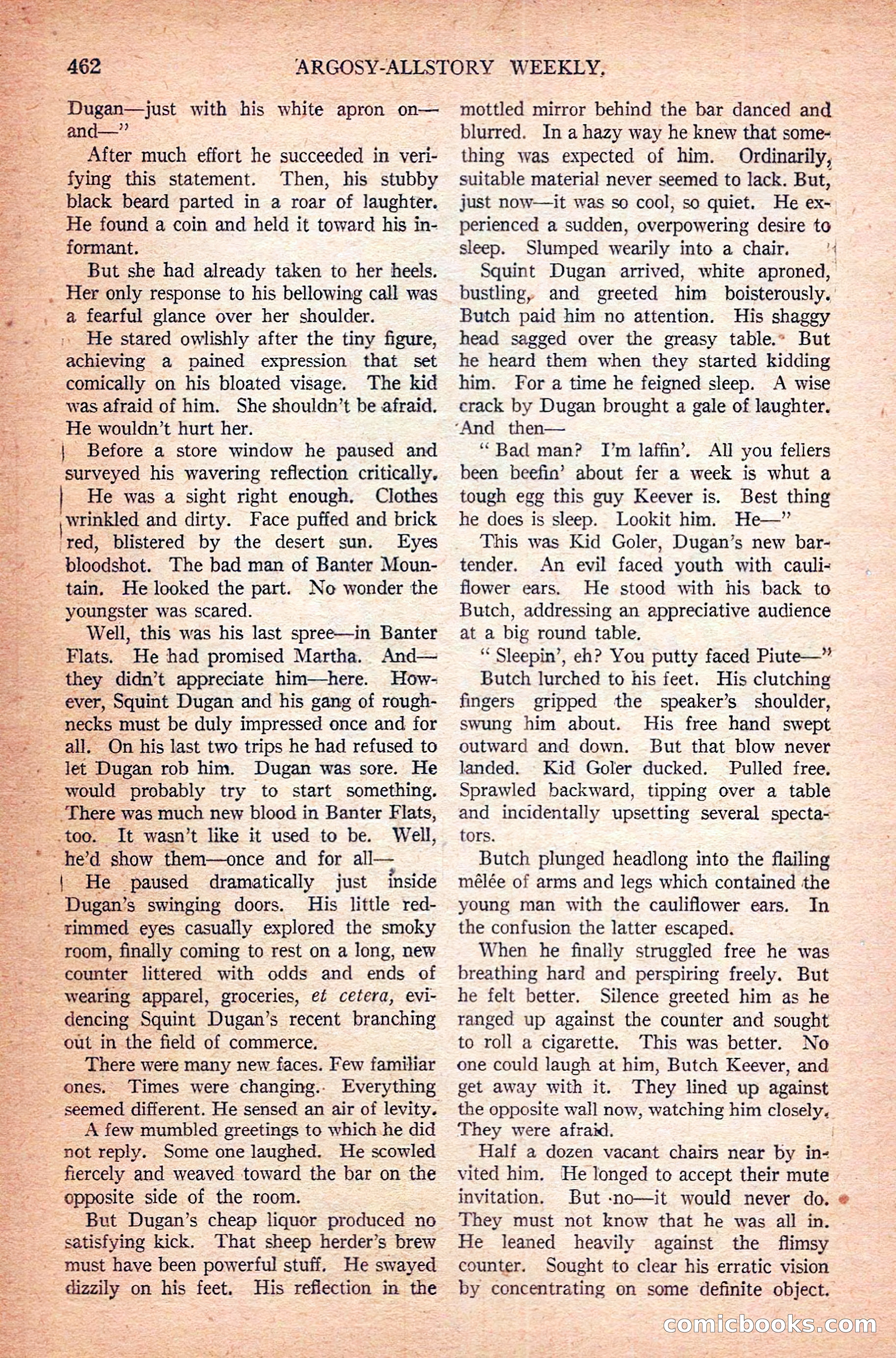
A restored page from Pulp Fiction, 1925. Page through the whole issue in the reader above.
📄 Transcribed text from this page (OCR, searchable)
Machine-transcribed from the original scan — historical spelling and the odd misread are preserved.
3 yo ah Res i ah ass Me alee ER 67? 2) (OW MM ©) ee ae Oyo $1: "Ss AOVES APCS A astteee al Bt tes at Y ae t ‘ pei + eS) q Ag! . Hs s 4 Ti £5 Hee ygs a 2 ry i ye ’ ‘ ~ 462 Dugan—just with his white apron on— After much effort he succeeded in veri- fying this statement. Then, his stubby black beard parted in a roar of laughter. He found a coin and held it toward his in- _ formant. But she had already taken to her heels. . Her only response to his bellowing call was . @ fearful glance over her shoulder. A . + He stared owlishly after the tiny figure, achieving a pained expression that set comically on his bloated visage. The kid ‘was afraid of him. She shouldn’t be afraid. He wouldn’t hurt her. | Before a store window he paused and surveyed his wavering reflection critically. He was a sight right enough. Clothes wrinkled and dirty. Face puffed and brick red, blistered by the desert sun. Eyes _ bloodshot. The bad man of Banter Moun- tain. He looked the part. No wonder the youngster was scared. Well, this was his last spree—in Banter Flats. He had promised Martha. And— they didn’t appreciate him—here. How- ever, Squint Dugan and his gang of rough- necks must be duly impressed once and for all. On his last two trips he had refused to let Dugan rob him. Dugan was sore. He would probably try to start something. = f There was much new blood in Banter Flats, . too. It wasn’t like it used to be. Well, ~ he’d show them—once and for all— : =e He -paused dramatically just inside Dugan’s swinging doors. His little red- * rimmed eyes casually explored the smoky room, finally coming to rest on a long, new counter littered with odds and ends of wearing apparel, groceries, e¢ cetera, evi- 7 dencing Squint Dugan’s recent branching out in the field of commerce. _ There were many new faces. Few familiar ones. ‘Times were changing.. Everything - seemed different. He sensed an air of levity. A few mumbled greetings to which he did not reply. Some one laughed. He scowled fiercely and weaved toward the bar on the ‘opposite side of the room. But Dugan’s cheap liquor produced no _ satisfying kick. That sheep herder’s brew must have been powerful stuff. He swayed dizzily on his feet. His reflection in the ‘ARGOSY-ALLSTORY WEEKLY. mottled mirror behind the bar danced and blurred. In a hazy way he knew that some- thing was expected of him. Ordinarily, suitable material never seemed to lack. But, just now—it was so cool, so quiet. He ex- perienced a sudden, overpowering desire to sleep. Slumped wearily into a chair. 4 Squint Dugan arrived, white aproned, bustling, and greeted him _boisterously.' Butch paid him no attention. His shaggy head sagged over the greasy table.* But he heard them when they started kidding him. For a time he feigned sleep. A wise crack by Dugan brought a gale of laughter. ‘And then— ‘Bad man? I’m laffin’. All you feliers been beefin’ about fer a week is whut a tough egg this guy Keever is. Best thing he does is sleep. Lookit him. He—”’ This was Kid Goler, Dugan’s new bar- tender. An evil faced youth with cauli- flower ears. He stood with his back to Butch, addressing an appreciative audience at a big round table. ‘“ Sleepin’, eh? You putty faced Piute—” Butch lurched to his feet. His clutching fingers gripped the speaker’s shoulder, swung him about. His free hand swept outward and down. But that blow never landed. Kid Goler ducked. Pulled free. Sprawled backward, tipping over a table and incidentally upsetting several specta- tors. | Butch plunged headlong into the flailing mélée of arms and legs which contained the young man with the cauliflower ears. In the confusion the latter escaped. When he finally struggled free he was breathing hard and perspiring freely. But he felt better. Silence greeted him as he ranged up against the counter and sought to roll a cigarette. This was better. No one could laugh at him, Butch Keever, and get away with it. They lined up against the opposite wall now, watching him closely. They were afraid. | Half a dozen vacant chairs near by in- vited him. He longed to accept their mute invitation. But -no—it would never do. They must not know that he was all in. He leaned heavily against the flimsy counter. Sought to clear his erratic vision by concentrating on some definite object. (CEOPMIE OO KS jC) oo