
Pulp Fiction, 1925 · page 135 of 172
Argosy All-Story Weekly — page 135: what you’re looking at
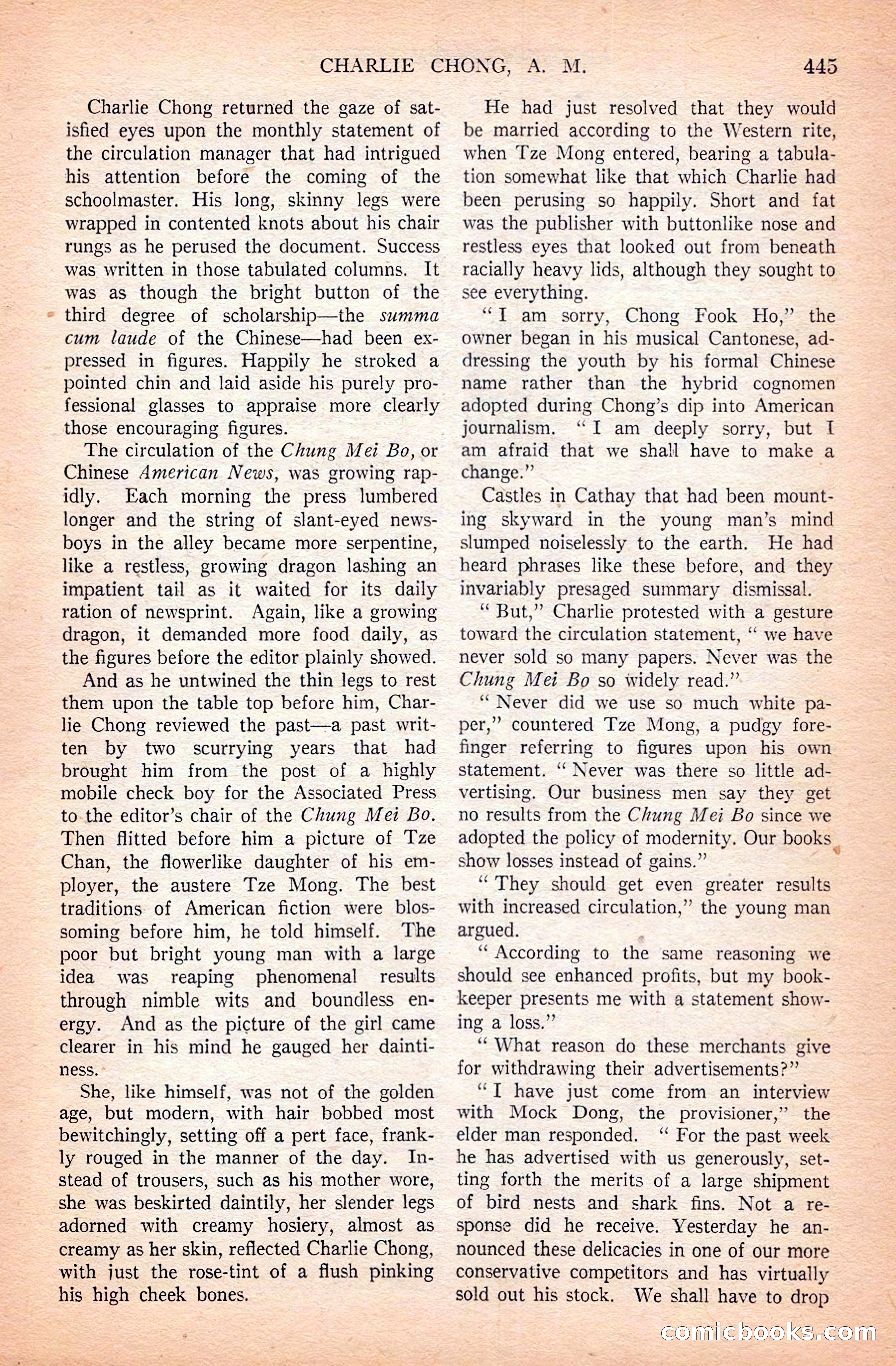
A restored page from Pulp Fiction, 1925. Page through the whole issue in the reader above.
📄 Transcribed text from this page (OCR, searchable)
Machine-transcribed from the original scan — historical spelling and the odd misread are preserved.
S CHARLIE CHONG, A. M. Charlie Chong returned the gaze of sat- ished eyes upon the monthly statement of the circulation manager that had intrigued his attention before the coming of the schoolmaster. His long, skinny legs were wrapped in contented knots about his chair rungs as he perused the document. Success was written in those tabulated columns. It was as though the bright button of the third degree of scholarship—the summa cum laude of the Chinese—had been ex- pressed in figures. Happily he stroked a pointed chin and laid aside his purely pro- fessional glasses to appraise more clearly those encouraging figures. The circulation of the Chung Mei Bo, or Chinese American News, was growing rap- idly. Each morning the press lumbered longer and the string of slant-eyed news- boys in the alley became more serpentine, like a restless, growing dragon lashing an impatient tail as it waited for its daily ration of newsprint. Again, like a growing dragon, it demanded more food daily, as the figures before the editor plainly showed. And as he untwined the thin legs to rest them upon the table top before him, Char- lie Chong reviewed the past—a past writ- ten by two scurrying years that had brought him from the post of a highly mobile check boy for the Associated Press to the editor’s chair of the Chung Mei Bo. Then flitted before him a picture of Tze Chan, the flowerlike daughter of his em- ployer, the austere Tze Mong. The best traditions of American fiction were blos- soming before him, he told himself. The poor but bright young man with a large idea was reaping phenomenal results through nimble wits and boundless en- ergy. And as the picture of the girl came clearer in his mind he gauged her dainti- ness. She, like himself, was not of the golden age, but modern, with hair bobbed most bewitchingly, setting off a pert face, frank- ly rouged in the manner of the day. In- stead of trousers, such as his mother wore, she was beskirted daintily, her slender legs adorned with creamy hosiery, almost as creamy as her skin, reflected Charlie Chong, with just the rose-tint of a flush pinking his high cheek bones. 445 He had just resolved that they would be married according to the Western rite, when Tze Mong entered, bearing a tabula- tion somewhat like that which Charlie had been perusing so happily. Short and fat was the publisher with buttonlike nose and restless eyes that looked out from beneath racially heavy lids, although they sought to see everything. “TY am sorry, Chong Fook Ho,” the owner began in his musical Cantonese, ad- dressing the youth by his formal Chinese name rather than the hybrid cognomen adopted during Chong’s dip into American journalism. ‘I am deeply sorry, but [ am afraid that we shall have to make a change.” Castles in Cathay that had been mount- ing skyward in the young man’s mind slumped noiselessly to the earth. He had heard phrases like these before, and they invariably presaged summary dismissal. ‘ But,” Charlie protested with a gesture toward the circulation statement, “‘ we have never sold so many papers. Never was the Chung Mei Bo so widely read.” ‘“ Never did we use so much white pa- per,’ countered Tze Mong, a pudgy fore- finger referring to figures upon his own statement. ‘‘ Never was there so little ad- vertising. Our business men say they get no results from the Chung Mei Bo since we adopted the policy of modernity. Our books | show losses instead of gains.” “They should get even greater results with increased circulation,” the young man argued. ‘According to the same reasoning we should see enhanced profits, but my book- keeper presents me with a statement show- ing a loss.” ‘What reason do these merchants give for withdrawing their advertisements?” “JT have just come from an interview with Mock Dong, the provisioner,” the elder man responded. ‘“ For the past week he has advertised with us generously, set- ting forth the merits of a large shipment of bird nests and shark fins. Not a re- sponse did he receive. Yesterday he an- nounced these delicacies in one of our more conservative competitors and has virtually sold out his stock. We shall have to drop <S oO GComichoo (S@)