
Pulp Fiction, 1925 · page 127 of 172
Argosy All-Story Weekly — page 127: what you’re looking at
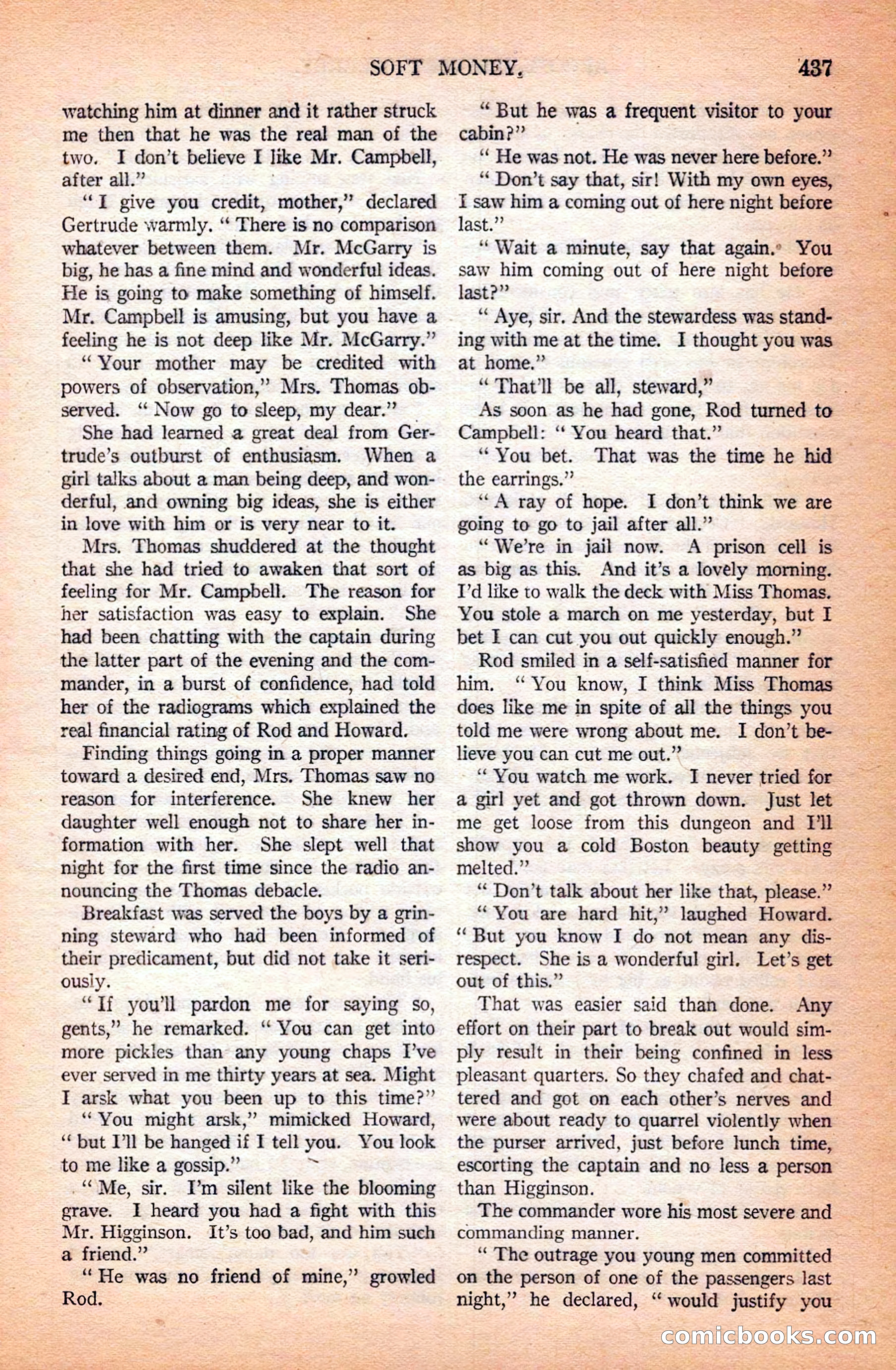
A restored page from Pulp Fiction, 1925. Page through the whole issue in the reader above.
📄 Transcribed text from this page (OCR, searchable)
Machine-transcribed from the original scan — historical spelling and the odd misread are preserved.
SOFT MONEY. watching him at dinner and it rather struck me then that he was the real man of the two. I don’t believe I like Mr. Campbell, after all.” “I give you credit, mother,” declared Gertrude warmly. “‘ There is no comparison whatever between them. Mr. McGarry is big, he has a fine mind and wonderful ideas. He is going to make something of himself. Mr. Campbell is amusing, but you have a feeling he is not deep like Mr. McGarry.” “Your mother may be credited with powers of observation,” Mrs. Thomas ob- served. ‘“‘ Now go to sleep, my dear.” She had learned a great deal from Ger- trude’s outburst of enthusiasm. When a girl talks about a man being deep, and won- derful, and owning big ideas, she is either in love with him or is very near to it. Mrs. Thomas shuddered at the thought that she had tried to awaken that sort of feeling for Mr. Campbell. The reason for her satisfaction was easy to explain. She had been chatting with the captain during the latter part of the evening and the com- mander, in a burst of confidence, had told her of the radiograms which explained the real financial rating of Rod and Howard. Finding things going In a proper manner toward a desired end, Mrs. Thomas saw no reason for interference. She knew her daughter well enough not to share her in- formation with her. She slept well that night for the first time since the radio an- nouncing the Thomas debacle. Breakfast was served the boys by a grin- ning steward who had been informed of their predicament, but did not take it seri- ously. “Tf youll pardon me for saying so, gents,” he remarked. “ You can get into more pickles than any young chaps I’ve ever served in me thirty years at sea. Might I arsk what you been up to this time?” “You might arsk,’ mimicked Howard, ‘but Dl be hanged if I tell you. You look to me like a gossip.” “Me, sir. I’m silent like the blooming grave: I heard you had a fight with this Mr. Higginson. It’s too bad, and him such a friend.” “He was no friend of mine,” growled =e _ Rod, cabin?” “ He was not. He was never here before.” __ ‘Don’t say that, sir! With my own eyes, I saw him a coming out of here night before —_ last.” last?” “ But he was a frequent visitor to your = “Wait a minute, say that again You — saw him coming out of here night before — ‘“ Aye, sir. And the stewardess was stand- — ye fy "AME r) t a IETRG Barty Asse ‘4 : 2yh. % BPS ing with me at the time. I thought you was at home.” “That'll be all, steward,” y hohe if ny Naigt vi y aah or Yaa alee ath ay rey Mie As soon as he had gone, Rod turned to —— Campbell: “‘ You heard that.” eee “You bet. That was the time he hid ae the earrings.” ae ‘““A ray of hope. I don’t think we are Re going to go to jail after all.” eae “We're in jail now. <A prison cell is as big as this. And it’s a lovely morning. I'd like to walk the deck with Miss Thomas, = You stole a march on me yesterday, but I = bet E can cut you out quickly enough.” Jas Rod smiled in a self-satisfied manner for him. “You know, I think Miss Thomas does like me in spite of all the things you told me were wrong about me. Idon’tbe- lieve you can cut me out.” ae “You watch me work. I never tried for ese a girl yet and got thrown down. Just let me get loose from this dungeon and Po show you a cold Boston beauty getting oo aie melted.” pa “‘ Don’t talk about her like that, please.” ee “You are hard hit,” laughed Howard. “But you know I do not mean any dis- ae respect. She is a wonderful girl. Let’s get out of this.” ae That was easier said than done. Any effort on their part to break out would sim- ply result in their being confined in less <e pleasant quarters. So they chafed and chat- — tered and got on each other’s nerves and were about ready to quarrel violently when the purser arrived, just before lunch time, escorting the captain and no less a person ee than Higginson. ees The commander wore his most severe and oa commanding manner. ae “ The outrage you young men coeacniere = on the person of one of the passengers last = night,” he declared, “would justify you comichoo S comi : Z aa ~" 1 ‘ i rs Lee s* <> v ea)